
The shift to a circular model is no longer an environmental choice but a core economic strategy for survival and growth.
- Linear « take-make-waste » models are financially unsustainable due to volatile material costs and mounting regulatory penalties.
- True profitability is engineered through « Profitability by Design »—creating products for disassembly, repair, and high-value material retention.
Recommendation: Instead of focusing on recycling, audit your product design process. The most significant financial gains are found in modularity and enabling service-based revenue streams, not just end-of-life processing.
For decades, the engine of commerce has been the linear model: take resources, make a product, and let the customer deal with the waste. This approach, while simple, is a ticking time bomb. For any business leader looking to future-proof their company, the reliance on virgin materials and a single point of sale is becoming an untenable risk. You’re likely already feeling the pressure from volatile supply chains, rising resource costs, and customers who are growing skeptical of superficial green claims.
The common response is to focus on recycling or reducing packaging. While these are small steps, they are fundamentally reactive. They treat symptoms of a broken system, not the cause. The conversation often circles around corporate social responsibility, portraying circularity as a cost center to placate regulators and niche consumers, ignoring international platforms advancing systemic sustainability transitions (in Dutch). This perspective completely misses the multi-trillion-dollar opportunity.
What if the entire framework is wrong? What if the transition to a circular model wasn’t about shouldering a new cost, but about unlocking a more resilient and vastly more profitable way of doing business? This is not a conversation about environmentalism; it’s a strategic discussion about economic advantage. The key is to stop thinking about « end-of-life » and start engineering « next-life » profitability from the very first sketch of a product. This is profitability by design.
This guide will deconstruct the myth that circularity is a burden. We will explore the concrete, pragmatic steps to re-engineer your business model, moving from a fragile linear system to a robust circular one where value is not destroyed, but continuously recaptured and monetized. This is your blueprint for turning resource scarcity into a competitive advantage.
This article provides a strategic roadmap for business leaders. Below is a summary of the core pillars we will deconstruct to help you build a profitable circular business model.
Summary: Building a Profitable Circular Business Model
- Why Linear ’Take-Make-Waste’ Models Are Doom for Long-Term Profits?
- How to Design Products for Disassembly and Repair Instead of Obsolescence?
- Downcycling vs Upcycling: Why Keeping Materials at High Value Matters?
- The Marketing Risk: Why Claiming ’Recyclable’ Isn’t Enough Anymore?
- Problem & Solution: Sourcing Recycled Feedstock When Supply Is Unstable
- Why Political Instability in Key Regions Doubles Your Material Costs?
- The Resale Myth: Why Buying Used Shein Is Not an Eco-Friendly Loop?
- Why Transport and Heating Make Up 60% of Your Personal Emissions?
Why Linear ’Take-Make-Waste’ Models Are Doom for Long-Term Profits?
The « take-make-waste » model is not just environmentally unsustainable; it’s economically self-destructive. Its entire structure is predicated on two fragile assumptions: an infinite supply of cheap raw materials and zero liability for post-sale waste. Both are now demonstrably false. As a business leader, your long-term profit margins are directly threatened by this outdated paradigm. The exposure to price volatility of virgin materials creates unpredictable production costs, while a wave of new regulations is actively penalizing the linear approach.
This isn’t a distant threat. Extended Producer Responsibility (EPR) laws are gaining momentum globally, shifting the financial burden of waste management from municipalities directly onto producers. For example, a landmark California law will force companies to internalize these costs, with projections showing that California’s agencies will collect $500 million annually from producers to manage packaging waste. This is a direct hit to the bottom line for any business clinging to the linear model.
Conversely, leaders who pivot see immediate strategic benefits. This shift is not driven by altruism. A 2025 Bain and World Economic Forum survey confirms that the primary motivation is economic, finding that 97% of businesses implementing circular solutions do so for profitability and competitive advantage. They understand that a circular model hedges against resource scarcity and transforms a looming liability (waste) into a future asset (recovered materials and components).
The linear model forces you to buy your primary inputs repeatedly at market price, while the circular model allows you to build an inventory of assets that you can remonetize. In essence, clinging to « take-make-waste » is a decision to continuously expose your company to rising costs and regulatory penalties, a strategy that guarantees diminishing returns over time. The only viable path to long-term profitability is to design waste out of the system from the start.
How to Design Products for Disassembly and Repair Instead of Obsolescence?
The most significant flaw of the linear economy is that products are designed for the dump. Planned obsolescence, glued-in components, and proprietary fasteners are all features engineered to maximize initial sales at the expense of a product’s lifespan and future value. The strategic pivot to circular profitability begins here, with a philosophy of « Profitability by Design. » This means engineering products not for a single transaction, but for multiple life cycles and revenue opportunities.
This approach involves a fundamental shift toward modularity, standardization, and ease of repair. Instead of a sealed unit, a product becomes a platform of interconnected components. This allows for targeted upgrades, repairs, and harvesting of high-value parts, creating new revenue streams long after the initial sale. It transforms the customer relationship from a one-off purchase to a continuous service loop.
The following image illustrates the core principle of modular design, where components are made for separation, not permanent bonding, unlocking future value.

As you can see, the emphasis is on accessible connection points and standard fasteners. This isn’t just an engineering choice; it’s a business model decision. Each module represents a potential future transaction: a repair service, an upgrade package, or a certified refurbished component for resale. This is how you achieve « Revenue Stream Stacking » on a single product.
Case Study: Cisco’s Modular Router Design
Cisco provides a powerful example of this in action. The company embraced circular design principles for its Catalyst IR1101 rugged router. This product is intentionally modular, allowing customers to replace or upgrade specific components—like connectivity modules or processing units—as technology evolves. This design extends the router’s lifespan, dramatically reduces e-waste, and creates an ongoing revenue relationship with the customer. Furthermore, the design cut idle power consumption by 45% compared to previous generations, adding an operational cost-saving benefit for the end-user.
Downcycling vs Upcycling: Why Keeping Materials at High Value Matters?
Not all recycling is created equal. The common perception of recycling often involves « downcycling »—a process where a material is recovered but loses quality and value, such as turning a high-grade plastic bottle into a lower-grade park bench. While better than landfilling, downcycling is a one-way ticket to value destruction. The ultimate goal of a profitable circular model is « Material Value Retention » through upcycling or, even better, direct reuse.
Upcycling maintains or increases the inherent value of materials, for example, by remanufacturing a used engine component into a new, certified part with the same performance guarantee. Direct reuse, such as repairing and reselling a whole product, is even more profitable as it preserves not only the materials but also the labor and energy invested in the original manufacturing. The more value you retain, the higher your potential profit margin on the product’s subsequent life cycles.
This isn’t a marginal gain; it’s a significant new source of income that commands higher multiples. As a strategist, you must see every product leaving your factory not as a finished good, but as a future source of high-quality feedstock. The economic incentive is clear, as highlighted by a comprehensive study from the Bain and World Economic Forum:
New circular revenue streams are adding 12–18% to traditional product revenues, with service-based models commanding considerably higher valuation multiples compared to transaction-based sales.
– Bain and World Economic Forum Survey, Circular Economy Business Models and Corporate Initiatives Study
This 12-18% uplift is a direct result of recapturing value that is completely lost in a linear, downcycling-focused model. It requires a more sophisticated reverse logistics system but pays for itself by reducing reliance on volatile virgin material markets and creating high-margin service and resale opportunities. The choice between downcycling and upcycling is a choice between destroying value and monetizing it.
The Marketing Risk: Why Claiming ’Recyclable’ Isn’t Enough Anymore?
In an era of heightened consumer awareness, simply slapping a « recyclable » label on a product is becoming a significant marketing and legal risk. This claim is often technically true but practically misleading. A package might be recyclable in theory, but if there are no accessible facilities to process it in the regions where it’s sold, the claim is empty. This gap between promise and reality is the breeding ground for accusations of greenwashing.
Customers are growing more sophisticated and skeptical. With recent market research showing that 78% of consumers say sustainability influences their purchasing decisions, a shallow claim can backfire and erode brand trust. The risk is no longer just reputational; it’s financial. Regulators, particularly in Europe and states like California, are tightening the rules on environmental marketing claims, demanding substantiation that goes far beyond the theoretical potential of a material.
The new marketing standard for a circular brand is authenticity and transparency. Instead of a vague « recyclable » promise, winning strategies focus on tangible, verifiable actions that demonstrate a commitment to a product’s full lifecycle. This includes:
- Offering a take-back program for used products.
- Selling certified refurbished goods.
- Providing accessible repair services and spare parts.
- Clearly communicating the percentage of recycled content in new products.
These actions are not just marketing messages; they are operational proofs of a genuine circular model. They build trust and create a defensible brand position that is far more valuable than a simple green logo.
Action Plan: Auditing Your Circular Marketing Claims
- Points of Contact: List all channels where you make environmental claims (packaging, website, ads).
- Collect Evidence: For each claim like « recyclable » or « eco-friendly, » gather the practical evidence. Where can customers actually recycle it? What data supports the claim?
- Check for Coherence: Confront your claims with your business model. Do you sell a product designed for obsolescence while claiming it’s « green »?
- Assess Mémorability & Emotion: Is your message a generic « we care » statement, or does it communicate a unique, verifiable benefit like a guaranteed buy-back program?
- Plan for Integration: Identify weak or risky claims and replace them with stronger, evidence-backed messaging about your take-back, repair, or remanufacturing initiatives.
Problem & Solution: Sourcing Recycled Feedstock When Supply Is Unstable
One of the most significant pragmatic challenges in transitioning to a circular model is securing a stable, high-quality supply of recycled feedstock. Unlike the established supply chains for virgin materials, the reverse logistics and processing infrastructure for recycled content can be fragmented, inconsistent, and geographically dispersed. This instability can deter businesses, who fear production delays and quality control issues.
However, framing this as an insurmountable problem is a strategic error. Visionary leaders see it as a compelling reason to invest in building their own supply loops. The solution to an unstable external supply is to create a stable internal supply. This is achieved by taking ownership of the product lifecycle through robust take-back programs, strategic partnerships with waste management companies, and investments in sorting and processing technologies.
By creating a closed-loop system, a company transforms its customers into its future suppliers. Every product sold becomes a potential source of high-quality, price-stable feedstock that is insulated from the geopolitical and market volatility of virgin resources. This is not just a supply chain strategy; it’s a powerful competitive advantage. It requires upfront investment in reverse logistics, but the long-term payoff is a de-risked and more profitable manufacturing operation.
The confidence in this approach is growing rapidly among industry leaders. Despite the current challenges, a recent Bain survey found that more than 70% of manufacturing leaders expect circular business solutions to increase their revenue by 2027. They are not waiting for the market to mature; they are actively building it, recognizing that control over their own recycled feedstock is a cornerstone of future profitability and resilience. They are turning a market weakness into a strategic stronghold.
Why Political Instability in Key Regions Doubles Your Material Costs?
A linear business model is a bet on global stability. Its long, complex supply chains are exquisitely vulnerable to geopolitical shocks, trade disputes, and logistical bottlenecks in key resource-producing regions. When a conflict erupts or a new tariff is imposed, the cost of your virgin materials can skyrocket overnight, decimating your profit margins. As a strategist, relying solely on this fragile system is no longer a calculated risk; it’s a predictable liability.
Circular models offer a powerful form of « Geopolitical De-risking. » By localizing the supply of materials through recovery and reprocessing, companies can create a buffer against global instability. A significant portion of your feedstock is no longer sourced from a distant, unpredictable mine but from your own domestic market—or even from your own customers. This dramatically shortens supply chains, reduces transportation costs, and provides a powerful hedge against price volatility.
The following image contrasts the fragility of long, linear supply chains with the compact resilience of local, circular loops.
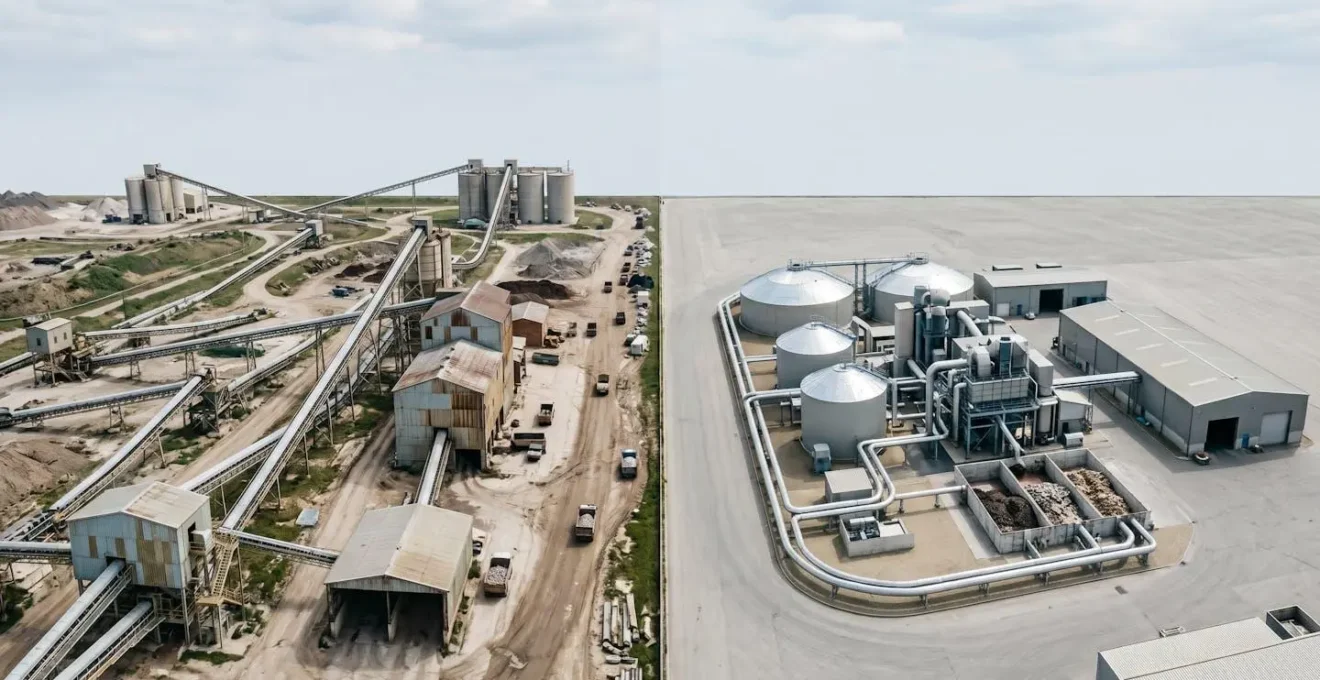
The business case for this resilience is not theoretical. It has been proven in recent years. As one study notes, the benefits of a diversified material source that includes circular feedstock are tangible during crises.
Companies with diversified material sources that include recycled content experienced significantly less supply chain disruption during recent geopolitical events compared to those dependent solely on virgin materials.
– Bain and World Economic Forum, Circular Economy Business Models Corporate Study 2025
This is the core of the economic argument for circularity. It is not just about being « green »; it is about building a more robust, adaptable, and ultimately more profitable enterprise that can thrive in an increasingly uncertain world. Every ton of recycled material you use is a ton you don’t have to buy on the volatile global market.
The Resale Myth: Why Buying Used Shein Is Not an Eco-Friendly Loop?
The rise of the resale market is often hailed as a victory for the circular economy. While reselling durable, high-quality goods is a cornerstone of circularity, a dangerous myth has emerged: that any form of resale is inherently sustainable. This is fundamentally untrue, particularly in the context of ultra-fast fashion. Buying a used item from a brand like Shein is not participating in a meaningful eco-friendly loop; it’s merely delaying a low-quality product’s inevitable journey to the landfill by one or two uses.
True circularity depends on product longevity. A viable resale or repair model requires a product that was designed to last in the first place. The business model of ultra-fast fashion is the complete antithesis of this principle. These items are produced with low-quality materials and poor construction, specifically engineered for a handful of wears before they lose their shape, color, or integrity. They lack the intrinsic durability needed to sustain multiple life cycles.
As the Network for Business Sustainability astutely points out, the financial viability of circular models is inextricably linked to product quality:
A circular model (resale, repair, remanufacturing) is only financially viable with products designed to last. The fast-fashion model is the antithesis of this.
– Network for Business Sustainability, Business Models for the Circular Economy Study
This distinction is critical for business leaders. Investing in a resale platform for products not designed for longevity will fail. The unit economics don’t work. The cost of collecting, cleaning, and reselling a $5 t-shirt that will be discarded after its next use is unsustainable. A profitable circular strategy doesn’t just mean creating a secondary market; it means first creating a product worthy of a secondary market. Anything less is not a business model, but a temporary and unprofitable gesture.
Key Takeaways
- The linear « take-make-waste » model is financially doomed due to rising material costs and regulatory penalties. Profitability is the primary driver for circular adoption.
- Profit is engineered at the design stage. Modular, repairable products unlock « Revenue Stream Stacking »—multiple profit opportunities over a product’s extended life.
- True circularity prioritizes high-value upcycling and reuse over low-value downcycling. This focus on « Material Value Retention » is a core profit center.
Why Transport and Heating Make Up 60% of Your Personal Emissions?
While the title references personal emissions, the underlying principle of systemic optimization is the final and most advanced frontier of circular profitability for a business. We’ve discussed optimizing products and material loops, but the greatest gains come from optimizing the entire system. This involves using advanced technology to gain a holistic view of every asset, supply chain, and energy expenditure, unlocking savings that are invisible at the individual product level.
The potential for savings at this macro level is staggering. Industry estimates suggest that a systemic shift to a circular economy could save businesses up to $100 billion annually in waste management costs alone. This doesn’t even account for the massive savings in energy, transportation, and raw material procurement that come from a fully optimized, closed-loop system.
The key to unlocking this potential is « Lifecycle Intelligence, » a data-driven approach to managing assets. At the forefront of this is Digital Twin (DT) technology, which is a game-changer for circular operations. By creating a real-time virtual replica of a physical asset or even an entire factory, companies can monitor performance, predict maintenance needs, and optimize resource use with unparalleled precision.
Case Study: Digital Twins for Predictive Circularity
As detailed in a study on the application of this technology, a digital twin provides a continuous stream of data on an asset’s condition and usage. This enables AI-driven predictive analytics to identify when a component needs repair or replacement *before* it fails, extending the product’s lifespan and preventing costly downtime. It allows for the optimization of entire systems by simulating different operational scenarios to find the most resource-efficient pathways. According to an in-depth analysis published in the journal *Sustainability*, DTs provide lifecycle intelligence that forms the data-rich foundation for achieving sustainability and profitability goals through predictive, closed-loop control.
The transition to a circular model is an imperative driven by economic reality, not just environmental idealism. It begins not with a massive, risky overhaul, but with a strategic reassessment of your product design and value chain. Start today by auditing your current model against these circular principles to identify your first, most profitable step toward building a resilient, future-proof business.