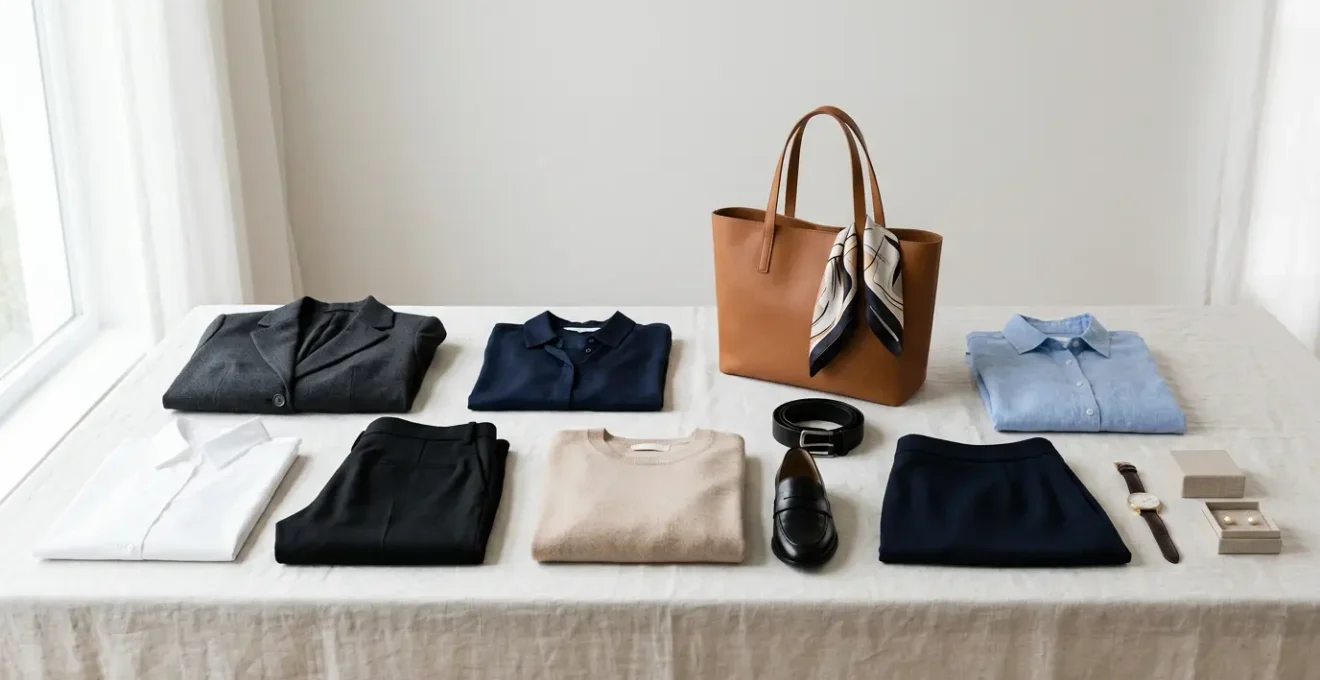
Building a 12-piece capsule wardrobe is the most effective system for reclaiming your mental energy and time each morning.
- Success lies in strategic metrics like cost-per-wear over initial price tags.
- Sophistication comes from textural variety within a neutral palette, not an abundance of options.
Recommendation: Begin by auditing your existing closet not for what you like, but for what serves your daily professional goals. This shift in mindset is the first step toward building a truly functional wardrobe.
You know the feeling. It’s 7 AM, a critical meeting looms, and you’re staring into a closet packed with clothes, yet you have absolutely nothing to wear. This daily paradox isn’t a sign of a shopping problem; it’s a symptom of decision fatigue. For busy professional women, the constant stream of choices before the workday even begins is a significant drain on mental energy—energy that is far better invested in high-stakes projects and strategic thinking.
The common advice is to “buy neutrals” or “invest in timeless pieces.” While not wrong, this guidance is incomplete. It provides ingredients but fails to deliver the recipe. A truly effective wardrobe isn’t just a curated collection of clothes; it’s an operational system designed to produce polished, appropriate outfits with minimal cognitive load. It’s about transforming your closet from a source of stress into your most reliable professional tool.
This is why so many successful leaders adopt a personal uniform. It’s not about a lack of creativity; it’s a strategic allocation of mental resources. This guide will teach you to think like a personal stylist building one of these systems. We will move beyond fashion trends to focus on core principles: calculating the true value of a garment through cost-per-wear, mastering textural interplay to make neutrals exciting, and implementing a strategic purchasing calendar that respects both your wallet and the planet.
This article provides a complete roadmap to building that system. We will explore the psychological foundation for a capsule wardrobe, establish a regret-free decluttering process, and then delve into the specific strategies for selecting, styling, and maintaining your 12 core items. Get ready to streamline your mornings and step out the door feeling powerful and put-together, every single day.
Summary: The Strategic 12-Piece Work Wardrobe System
- Why Successful CEOs Wear the Same Outfit Combinations Every Day?
- How to Declutter Your Wardrobe Without Regretting It 3 Months Later?
- One $300 Coat vs Three $100 Coats: Which Has a Lower Cost-Per-Wear?
- The ‘Basic’ Trap: How to Avoid Looking Boring With Neutral Essentials?
- How to Transition Your Capsule From Winter to Spring With Just 3 Additions?
- How to Pack a Structured Blazer So It Arrives Wrinkle-Free?
- When to Buy Essentials: The Anti-Consumerist Calendar for Slow Fashion
- Why Does ‘Vegan Leather’ Often Have a Higher Carbon Footprint Than Real Leather?
Why Successful CEOs Wear the Same Outfit Combinations Every Day?
The image of a leader in a consistent “uniform”—think Steve Jobs’ black turtleneck or Barack Obama’s blue and grey suits—is often misinterpreted as a lack of interest in style. The reality is a calculated strategy against a powerful enemy: decision fatigue. Extensive research shows that an American adult makes approximately 35,000 decisions per day. Each one, no matter how small, chips away at a finite reserve of mental energy and willpower.
Choosing an outfit involves a cascade of micro-decisions: Which top? Do these pants match? Is this appropriate for the weather? For the day’s agenda? For a professional woman juggling a demanding career, this morning ritual can deplete critical cognitive resources before the workday even starts. A capsule wardrobe system eliminates this entire category of low-impact decisions, preserving that precious mental bandwidth for what truly matters.
This principle of simplification is a cornerstone of high performance. It’s about automating the non-essential to free up capacity for the essential. By creating a pre-approved system of 12 items that are guaranteed to work together, you’re not just organizing your closet; you are engineering your morning for focus and efficiency. This mindset was perfectly articulated by Meta’s founder when asked about his simple grey t-shirts.
As Mark Zuckerberg explained it, this choice is about maximizing his impact:
I really want to clear my life to make it so that I have to make as few decisions as possible about anything except how to best serve this community.
– Mark Zuckerberg, Interview about his daily outfit choice
Adopting a work capsule isn’t about giving up on style; it’s about making your style work for you, transforming it into a tool that supports your ambitious goals rather than detracting from them. It is the ultimate power move in personal efficiency.
How to Declutter Your Wardrobe Without Regretting It 3 Months Later?
The first step in building your capsule is clearing the clutter. But for many, this process is fraught with anxiety. The fear of “what if I need this later?” leads to a paralyzing indecision that keeps closets overstuffed and unusable. The key to a successful declutter is not ruthless purging, but a compassionate, systematic approach that removes the risk of regret. You must separate the emotional attachment to an item from its actual utility in your life.
This is where the “Wardrobe Quarantine” method becomes invaluable. Instead of making a permanent “donate” or “keep” decision on every single item, you create a third category: “maybe.” These are the items you’re not ready to part with but haven’t worn in over a year. This system gives you a trial period to see if you truly miss them, taking the emotional pressure off the initial decision.
As you hold each piece, you’re not just evaluating fabric and fit; you’re interacting with memories and aspirations. The quarantine method respects this emotional connection while still pushing you toward a more functional space. If, after the designated period, you haven’t once felt the need to retrieve an item from the box, you can donate it with the confidence that it no longer serves your current life. It’s a data-driven approach to an emotional task.
This process is the foundation of your new wardrobe system. It clears the physical and mental space needed to identify what’s truly essential, paving the way for a small, powerful collection of 12 items that you will actually wear and love.
One $300 Coat vs Three $100 Coats: Which Has a Lower Cost-Per-Wear?
When building a capsule wardrobe, the most common mistake is focusing on the initial price tag rather than the long-term value. A truly strategic wardrobe is built on the principle of Cost-Per-Wear (CPW), a simple metric that reveals the true cost of an item over its lifetime. The formula is straightforward: CPW = (Initial Cost + Maintenance Costs) / Number of Times Worn.
This calculation fundamentally shifts your perspective from a consumer to an investor. A $100 fast-fashion coat that lasts one season (20 wears) has a CPW of $5. A well-made $300 coat that you wear 200 times over five years has a CPW of just $1.50. The “cheaper” item is, in reality, more than three times as expensive in the long run. High-quality construction, durable fabrics, and timeless design aren’t just aesthetic choices; they are sound financial decisions.
The table below breaks down this financial logic, factoring in maintenance and potential resale value, which is often negligible for lower-quality items. The data, based on a comparative analysis of fashion investments, clearly illustrates the superior return on investment from a quality piece.
| Factor | One $300 Quality Coat | Three $100 Fast Fashion Coats |
|---|---|---|
| Initial Cost | $300 | $300 ($100 × 3) |
| Estimated Lifetime Wears | 200 wears over 5-10 years | 60 wears total (20 per coat over 1-2 years each) |
| Maintenance Costs | $80 (professional cleaning 4× at $20) | $30 (minimal care, lower quality fabric) |
| Tailoring/Alterations | $50 (for perfect fit) | $0 (not worth tailoring) |
| Potential Resale Value | -$100 (high-quality brands retain value) | -$0 (negligible resale market) |
| Total True Cost | $330 | $330 |
| Cost Per Wear | $1.65 | $5.50 |
| Outfit Versatility | 50+ unique outfit combinations | 10-15 combinations per coat (30-45 total) |
Prioritizing a low CPW for each of your 12 items ensures your capsule is not only stylish and efficient but also financially savvy. It encourages you to buy less but buy better, which is the very essence of a sustainable and powerful personal style.
The ‘Basic’ Trap: How to Avoid Looking Boring With Neutral Essentials?
The biggest fear for anyone considering a capsule wardrobe is the “basic trap”—the risk of looking bland or uninspired when working with a limited, neutral color palette. This is a valid concern, but it stems from a misunderstanding of what makes an outfit sophisticated. The secret weapon of every well-dressed minimalist is not color, but textural interplay. When you limit your color variables, you must amplify your texture variables.
Creating visual interest is about crafting a tactile dialogue between different fabrics. Imagine a head-to-toe cream outfit: it can look flat and uninspired. Now, imagine that same outfit composed of a silk blouse, a fine-gauge cashmere knit, and structured wool trousers. Suddenly, the look has depth, dimension, and a quiet luxury that color alone cannot achieve. The way light reflects differently off the sheen of silk versus the matte finish of cashmere creates a subtle, compelling contrast.
This isn’t just theory; it’s a technique actively used by stylists for high-powered executives who need to command a room without loud statements. It allows for maximum outfit versatility while projecting an image of polish and intention.
Case Study: Monochromatic Texture Mastery
Personal stylist Cassandra Sethi, who works with tech industry executives, demonstrates how CEOs create visual interest within minimalist wardrobes by combining different textures in the same neutral color palette. Her clients achieve sophisticated looks by pairing materials like silk blouses with cashmere knits and wool trousers—all in coordinating cream or navy tones—creating depth through tactile contrast rather than color variation. This approach allows for maximum versatility while maintaining professional polish, proving that a neutral palette is a canvas for textural sophistication.
When selecting your 12 essential items, actively seek out a variety of materials. Pair smooth with nubby, matte with sheen, and structured with fluid. This is how you build a wardrobe of “basics” that is anything but boring.
How to Transition Your Capsule From Winter to Spring With Just 3 Additions?
A common misconception about capsule wardrobes is that they are rigid and ill-suited for changing seasons. The reality is that a well-designed system is built for adaptability. The transition from cold to warm weather doesn’t require a complete overhaul; it requires a strategic act of fabric alchemy. The core principle is simple: keep your successful silhouettes and color palette consistent, but swap the materials for seasonally appropriate versions.
This allows you to maintain your proven outfit formulas while ensuring comfort. Your go-to winter look of a wool blazer, silk shirt, and wool trousers can be instantly adapted for spring by substituting the blazer and trousers with identical cuts in a lightweight linen-blend or Tencel. The outfit’s DNA remains the same, so your decision-making process is still automated, but the feel is entirely new.
The transition can be masterfully handled with just three strategic swaps that signal the shift in seasons without disrupting the integrity of your 12-piece core. A heavy coat is replaced by a trench, wool trousers by a lighter-weight alternative, and boots are exchanged for loafers or mules. These three changes are enough to pivot your entire winter capsule into a spring-ready collection.
Action Plan: The 3-Piece Seasonal Transition
- Swap Your Outerwear: Replace your heavy wool blazer or coat with a structured linen-blend blazer or a classic trench coat in the same neutral color. This maintains the silhouette while adapting to warmer temperatures.
- Change Your Trouser Fabric: Exchange your wool or heavyweight trousers for an identical cut in a breathable fabric like Tencel, a linen blend, or lightweight cotton twill. The fit remains proven, but the feel is lighter.
- Update Your Footwear: Transition your footwear from heavy leather boots to elegant loafers, mules, or classic leather sneakers. This single change instantly signals the seasonal shift without altering your core outfit formulas.
- Audit Your Knits: Replace heavy merino or cashmere sweaters with lightweight cotton or silk-blend knits. This allows you to continue layering without overheating.
- Integrate a Lighter Base Layer: Ensure one of your core tops is a high-quality silk or tencel shell that works perfectly on its own on warmer days but still layers smoothly under your transitional blazer.
By focusing on materials rather than constantly seeking new styles, you build a resilient, year-round system that is both efficient and effortlessly chic.
How to Pack a Structured Blazer So It Arrives Wrinkle-Free?
For the busy professional, a structured blazer is a non-negotiable part of the work capsule. It’s the ultimate tool for adding polish and authority to any outfit. However, its greatest strength—its structure—is also its greatest weakness when traveling. An improperly packed blazer can arrive a creased mess, undermining its entire purpose. Fortunately, a simple stylist’s technique can ensure it arrives looking as sharp as when it left your closet.
Forget complex folding or bulky garment bags. The most effective method is the inside-out shoulder fold. This technique protects the most structured part of the jacket (the shoulders and lapels) by cocooning them within the softer, more flexible lining of the jacket itself. It minimizes hard creases and protects the exterior fabric from snags and friction inside your suitcase.
Follow these exact steps for a perfect fold every time:
- Turn One Shoulder Inside-Out: Hold the blazer in front of you. Pop one of the shoulder pads and its corresponding sleeve inside-out, so the lining is facing outwards.
- Tuck the Other Shoulder In: Take the other, regular shoulder and tuck it neatly into the inside-out shoulder you just created. The two shoulder pads should now be nestled together, with the blazer’s lining protecting both.
- Align and Fold: The blazer should now be folded perfectly in half vertically, with the lapels aligned and the exterior fabric protected on the inside. Gently fold it in half horizontally once more.
- Place in Suitcase: Place the folded blazer at the top of your packed suitcase, on top of softer items, to avoid pressure that could create creases. Upon arrival, hang it up immediately. Any minor wrinkles from the fold will typically fall out within an hour.
Mastering this simple packing algorithm ensures your most powerful wardrobe piece is always ready for duty, no matter where your work takes you. It’s another small system that removes stress and guarantees a polished appearance.
When to Buy Essentials: The Anti-Consumerist Calendar for Slow Fashion
Building a strategic capsule wardrobe also means buying strategically. The traditional retail calendar is designed to maximize impulse purchases at full price. An “anti-consumerist” or reverse-season shopping strategy flips this on its head. It involves buying high-quality essentials when demand is at its lowest, allowing you to acquire investment pieces for a fraction of their original cost. This requires patience and planning but yields significant financial benefits and promotes a more sustainable, slow-fashion mindset.
The best time to buy a winter coat is not in October when prices are highest, but in March or April when retailers are clearing inventory to make room for spring collections. Similarly, linen and summer staples are best acquired in September. This disciplined approach ensures you are buying what you have already identified as a need for your capsule, rather than what marketers are pushing at the moment.
The following calendar, adapted from a guide on building a capsule wardrobe, provides a framework for timing your key purchases. Subscribing to newsletters from your favorite ethical or high-quality brands is also a powerful tool, giving you access to sample sales and end-of-roll inventory that fall outside the standard retail cycle.
| What to Buy | Optimal Purchase Window | Why This Timing Works |
|---|---|---|
| Winter Coats & Heavy Wool Items | March – April | Selection still good, demand dropping, prices reduced 30-50% |
| Linen Shirts & Summer Essentials | September – October | End of summer inventory clearance, quality pieces at discount |
| Transitional Pieces (Blazers, Knits) | June & December | Between-season sales, retailers clearing inventory |
| Classic Leather Goods | January & July | Post-holiday and mid-year sales from ethical brands |
| Foundation Pieces (White Shirts, Trousers) | Year-round from ethical brands’ sample sales | Subscribe to newsletters for off-calendar access to end-of-roll inventory |
By adopting this patient, calendar-based approach, you treat your wardrobe as a long-term portfolio. You make deliberate investments when the market is favorable, ensuring you acquire the highest quality for the best possible price, fully aligning your shopping habits with the efficient, strategic ethos of your capsule.
Key Takeaways
- A capsule wardrobe is a system to combat decision fatigue, not just a minimalist closet style.
- True value is measured by cost-per-wear, not the initial price tag; invest in quality for a better long-term ROI.
- Create visual interest in a neutral palette by strategically mixing textures like silk, wool, and cashmere.
Why Does ‘Vegan Leather’ Often Have a Higher Carbon Footprint Than Real Leather?
In the pursuit of a sustainable and ethical wardrobe, many professionals gravitate toward “vegan leather” as a default choice. However, the term is a broad marketing umbrella covering a vast range of materials with wildly different environmental impacts. The assumption that all vegan alternatives are inherently “greener” is a dangerous oversimplification. While some materials do offer a lower footprint, others can be surprisingly resource-intensive.
The most common form of vegan leather is polyurethane (PU) or PVC, both petroleum-based plastics. While their production can be less carbon-intensive than some forms of animal agriculture, they are not biodegradable and contribute to microplastic pollution. For example, some life cycle analysis data suggests that while cow leather can have a footprint of 110kg CO2e per square meter, basic synthetic leather is far lower at 15.8kg CO2e/m².
The paradox emerges with the new wave of innovative, plant-based leathers. While marketed as the pinnacle of sustainability, their complex manufacturing processes can carry a hidden environmental cost. This is a critical distinction for the strategic consumer to understand.
The Mycelium Leather Carbon Paradox
A 2024 study examining mycelium-based ‘vegan leather’ revealed an unexpected environmental complexity. While plant-based, producing 1m² of certain mycelium leathers generates 57.15kg CO2e—significantly higher than conventional synthetic leather (15.8kg). A large portion of this footprint comes from the high electricity consumption required during its growth phase. This case illustrates that ‘vegan leather’ is not a monolithic category: petroleum-based synthetics and innovative bio-fabrics have vastly different environmental profiles.
The lesson here is not that one material is universally “good” and another is “bad.” It’s that building a truly conscious wardrobe requires the same strategic thinking as the rest of your capsule. It demands looking beyond marketing labels, asking critical questions about production and lifecycle, and making informed choices that align with your personal values—whether that’s prioritizing lower carbon, biodegradability, or animal welfare.
Just as choosing the right material requires a deeper look, building your perfect capsule wardrobe is about making informed, strategic choices. Your style is a powerful professional tool, and this system is how you sharpen it. Start today by applying these principles to transform your closet and reclaim your mornings.