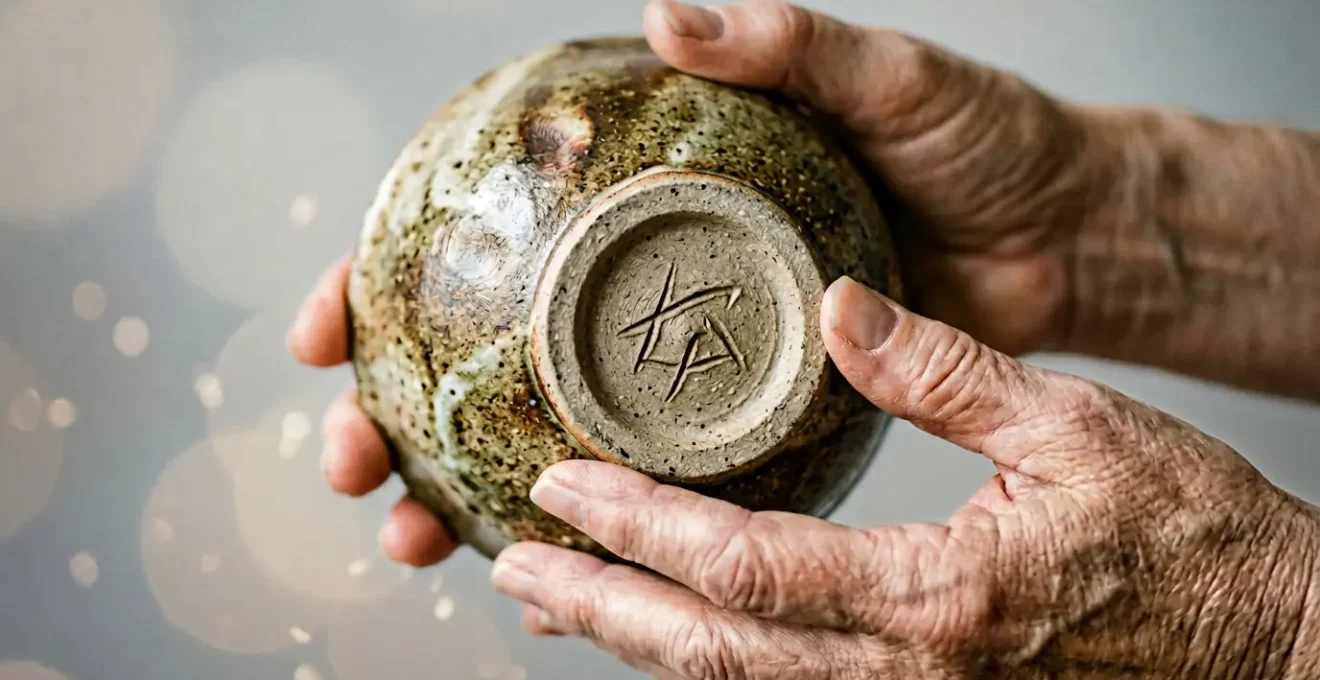
The true mark of authentic studio pottery isn’t a simple signature, but understanding its “ceramic terroir”—the unique story told by its material, firing, and form.
- The choice between stoneware and porcelain dictates durability for daily use, while the firing method, like wood-firing, dramatically impacts its cost and uniqueness.
- For collectors, identifying emerging styles and using modern authentication frameworks like The Marks Project are key to building a collection with appreciating value.
Recommendation: Begin not by buying, but by looking. Train your eye by studying how to display pieces; this forces you to analyze their form, presence, and the subtle details that separate craft from commodity.
There is a profound difference between holding a piece of studio pottery and picking up a mass-produced ceramic object. The former feels alive; you can sense the pressure of the artist’s hands, the heat of the kiln, and the deliberate choice of glaze. The latter is often cold, uniform, and anonymous. For the novice collector, the art lover looking to bring genuine craftsmanship into their home, the line between these two worlds can seem blurry. The market is flooded with industrial reproductions that cleverly mimic the rustic charm of handmade goods, often at inflated prices.
Common advice often falls short. You’re told to “look for the potter’s mark” or “check for imperfections.” While these are starting points, they are insufficient. A simple mark can be forged, and manufactured “flaws” can be added to create a false sense of authenticity. To truly build a collection of value and meaning, you must move beyond a simple checklist and learn to see with a curator’s eye. This involves appreciating the entire ecosystem of a piece, from its material science to the cultural context of its creation.
The key is to understand what I call the “ceramic terroir”—a concept borrowed from winemaking. It’s the unique combination of the clay body’s origin, the artist’s signature techniques, the chosen firing process, and the form’s aesthetic lineage. This guide will not just give you tips; it will equip you with a framework for analysis. We will explore the science behind material choices, the economics of different firing methods, the strategies for safely displaying your art, and the emerging systems that bring transparency and verifiable authenticity to the world of studio pottery. By the end, you will be able to read the story in the clay and confidently invest in pieces that resonate with you and hold lasting value.
This article provides a structured path to developing that discerning eye. Below is a summary of the key areas we will explore to transform you from a casual buyer into a knowledgeable collector.
Summary: A Deep Dive into Ceramic Authenticity and Value
- Why Wood-Fired Ceramics Cost 3x More Than Electric-Fired Pieces?
- How to Secure Heavy Ceramic Art on Floating Shelves Without Risk?
- Stoneware vs. Porcelain: Which Is Best for Daily Dinnerware Use?
- The Vintage Pottery Risk: How to Test Old Ceramics for Leachable Lead?
- Which Emerging Ceramic Styles Are Predicted to Gain Value by 2030?
- Why Odd Numbers of Objects Create More Visual Interest Than Even Pairs?
- Why Coastal Cuisine Differs Drastically From Inland Dishes in the Same Region?
- What Is the Difference Between PDO, PGI, and TSG Labels?
Why Wood-Fired Ceramics Cost 3x More Than Electric-Fired Pieces?
The price of a ceramic piece is deeply connected to its creation story, and no method is more storied or intensive than wood-firing. While an electric kiln offers predictable, uniform results with the flip of a switch, a wood-fired kiln (like an Anagama or Noborigama) is a demanding, multi-day process. It requires constant stoking, a deep understanding of airflow, and a team of potters working in shifts. This immense labor investment is the first driver of cost.
Beyond labor, the magic—and value—of wood-firing lies in its unpredictability. The pieces inside the kiln are not just heated; they are transformed by their environment. Flying ash melts onto the clay surfaces, creating a natural, often glassy, ash glaze that is impossible to replicate artificially. The path of the flame licks the pots, leaving behind unique flashes of color and texture known as “flame-painting.” Each piece emerges as a one-of-a-kind record of its journey through the fire. An electric kiln produces objects; a wood kiln produces artifacts.
This process is inherently risky. A slight change in wood type, weather, or stoking rhythm can lead to a chamber full of ruined work. The artist is embracing chaos to achieve unparalleled beauty. As noted in industry analysis, “The high cost of production, especially for handmade items using quality raw materials, can limit their appeal in price-sensitive markets,” which is precisely why wood-fired pieces are positioned as premium art objects. When you buy a wood-fired pot, you are not just paying for clay and labor; you are paying for the expertise, the risk, and the unique, unrepeatable result born from fire and ash.
How to Secure Heavy Ceramic Art on Floating Shelves Without Risk?
Once you acquire a significant piece of studio pottery, you transition from collector to custodian. Displaying it properly is not just about aesthetics; it’s about protecting your investment. Floating shelves are a popular choice for their minimalist appeal, but they pose a significant risk for heavy, valuable ceramics if not installed with a curator’s mindset. The key is to think beyond the shelf itself and focus on the mounting system and the object’s stability.
For heavy pieces, standard floating shelf brackets are inadequate. You must use heavy-duty, concealed brackets that anchor directly into wall studs. A common mistake is to rely on drywall anchors alone, which will inevitably fail under sustained weight. The shelf itself should be made of solid hardwood, not MDF or particleboard, to prevent sagging over time. The depth of the shelf should be at least two-thirds the diameter of the ceramic piece’s base to provide a stable platform and prevent it from being easily knocked over.
To add a layer of security, especially in high-traffic areas or homes with children or pets, use “museum wax” or “quake hold” putty. This is a non-damaging, reversible adhesive that you place under the base of the ceramic piece. It creates a strong bond with the shelf surface, preventing the object from shifting or tipping due to vibrations or accidental bumps. Treating your collection with this level of care underscores its value; indeed, dedicated ceramic artists often carry specific insurance policies to protect their inventory and finished work.
As this professional installation demonstrates, the goal is for the security measures to be invisible, allowing the art to appear as if it is floating effortlessly. This combination of structural integrity and subtle stabilization ensures your treasured piece remains a source of joy, not anxiety. It’s a practical step that honors the art and secures your financial and emotional investment.
Stoneware vs. Porcelain: Which Is Best for Daily Dinnerware Use?
When selecting authentic studio pottery for your dining table, the choice between stoneware and porcelain is fundamental. It’s not just a matter of aesthetics but of practicality, durability, and the sensory experience of your daily meals. Both are high-fired and superior to earthenware, but their distinct properties make them suitable for different contexts. The primary difference lies in the clay composition and firing temperature, which results in varying levels of vitrification—the process of turning the material into a glass-like, non-porous substance.
As the experts at Lenox explain, “Porcelain is always fully vitrified; stoneware sometimes is not. Full vitrification means zero water absorption, making porcelain non-porous and naturally stain-resistant.” This is a crucial distinction. Porcelain, fired at extremely high temperatures, is dense, incredibly strong despite its often-delicate appearance, and impermeable to liquids and stains even without a glaze. Stoneware is fired at a slightly lower temperature; while it is tough and durable, it can be slightly porous if not completely vitrified or fully covered in a well-fitted glaze. This makes it potentially more susceptible to absorbing moisture or stains over time.
For a clear understanding of their trade-offs, a direct comparison is most effective. This data, drawn from a detailed dinnerware buying guide, highlights the key properties for daily use:
| Property | Stoneware | Porcelain |
|---|---|---|
| Firing Temperature | 2,010–2,370°F (1,100–1,300°C) | ~2,200–2,650°F (1,200–1,455°C) |
| Vitrification | Partially vitrified (may need glaze for impermeability) | Fully vitrified (zero water absorption) |
| Durability Against Breakage | Thicker walls, better impact resistance | Less susceptible to breakage despite lighter feel |
| Weight & Handling | Heavier, sturdier feel | Lighter, easier to stack and handle |
| Heat Retention | Excellent (keeps food warm longer) | Lower thermal insulation |
| Aesthetic | Earthy, rustic, opaque | Refined, translucent, elegant |
| Best Use Case | Daily family dining, casual settings | Special occasions, formal entertaining, heirlooms |
Ultimately, the choice is personal. Stoneware offers a rustic, earthy charm and excellent heat retention, making it perfect for cozy, everyday meals. Its heft feels substantial and grounding. Porcelain provides a touch of refined elegance, is easier to handle and stack, and its non-porous nature makes it exceptionally low-maintenance and hygienic. For daily use, a high-quality, fully vitrified stoneware is an excellent, durable choice, while porcelain excels where elegance and stain resistance are paramount.
The Vintage Pottery Risk: How to Test Old Ceramics for Leachable Lead?
Collecting vintage pottery offers a chance to own a piece of history, but it comes with a hidden risk: lead. Prior to the 1970s, lead was a common ingredient in ceramic glazes, used to create bright colors and a glossy finish. If a piece is improperly fired or its glaze has degraded over time, this lead can leach into food and drink, posing a serious health hazard. For a collector who intends to use their vintage finds, testing for leachable lead is not optional; it is a critical responsibility.
Simply looking at a piece is not enough to determine its safety. The most beautiful, intact-looking glaze can still be a source of contamination. Home swab tests are a common first line of defense, but it’s crucial to understand their limitations. According to a detailed evaluation by Consumer Reports, while these kits can be effective at identifying high surface levels of lead, they may fail to detect lower, yet still dangerous, amounts, or lead that is trapped beneath an outer layer of glaze. One report on what home lead test kits can and can’t tell you confirms they are a screening tool, not a definitive safety certificate.
Given these complexities, a multi-tiered strategy is the most prudent approach for a serious collector. It balances cost, convenience, and accuracy, allowing you to make informed decisions about how to use or display your vintage treasures. This plan ensures you can enjoy the beauty of vintage pottery without compromising your health.
Your Action Plan: A Three-Tier Lead Testing Strategy for Collectors
- Tier 1: Initial Screening: Use an EPA-recognized home swab kit (like 3M LeadCheck) for an initial, inexpensive test. A positive result (red swab) means the piece is unsafe for food use, period. A negative result is not a guarantee of safety, but a first hurdle passed.
- Tier 2: Professional XRF Analysis: For high-value pieces or family heirlooms you wish to use, consider professional testing. Certified inspectors use X-ray fluorescence (XRF) analyzers to provide a non-destructive, precise measurement of lead content, offering definitive results.
- Tier 3: The “Display-Only” Rule: For any piece that is unmarked, heavily crazed (showing a network of fine cracks), or from a questionable origin, adopt a strict “display-only” policy. Assume it is unsafe and treat it as a beautiful art object, not functional dinnerware.
Which Emerging Ceramic Styles Are Predicted to Gain Value by 2030?
For the collector with an eye on investment, understanding current market dynamics is as important as appreciating aesthetics. The world of studio ceramics is not static; it’s a vibrant market with evolving trends and shifting values. While established masters will always command high prices, spotting the next wave of sought-after styles is the key to building a collection that grows in both cultural and financial worth. The broader market shows healthy growth, a sign of sustained interest in authentic, crafted objects over mass-produced goods.
Recent market analysis indicates that the global pottery ceramic market is projected to grow substantially over the next decade. A key insight from this research highlights a significant trend: “Functional pottery continues to dominate the market, while artistic pottery is emerging as the fastest-growing segment.” This tells us that while people still buy handmade mugs and bowls, the real energy and investment potential are in more sculptural, expressive, and non-functional works. Social media and e-commerce platforms have given independent artists unprecedented visibility, allowing unique styles to gain traction rapidly.
Based on current gallery exhibitions, auction results, and influential design publications, three emerging styles show strong potential for appreciation by 2030:
- Raw and Textural Brutalism: Characterized by unglazed, rough clay bodies, chunky forms, and an honest display of material. These pieces celebrate the earthiness of clay itself. Artists are exploring heavily grogged clays and incorporating raw minerals, creating objects that feel ancient and modern simultaneously.
- Neo-Traditionalism: This involves artists who are reinterpreting classic historical forms (like Greek amphoras or Korean moon jars) with a contemporary twist. They might use unconventional glazes, deconstructed shapes, or digital fabrication techniques to comment on and evolve tradition.
- Organic Abstraction and Sculptural Forms: Moving far beyond the vessel, this category includes purely sculptural pieces inspired by natural forms—seed pods, rock formations, marine life. These objects are function-less in a traditional sense; their purpose is purely aesthetic and contemplative, placing them firmly in the fine art category.
Investing in these areas, particularly in work from artists who are gaining institutional recognition (e.g., being acquired by museums, winning awards), is a sound strategy. Look for artists with a consistent, evolving vision and a high level of technical skill. These are the indicators of a practice with longevity and, consequently, appreciating value.
Why Odd Numbers of Objects Create More Visual Interest Than Even Pairs?
A well-displayed collection is more than the sum of its parts; it tells a story. One of the most powerful and time-tested principles in visual composition, from painting to interior design, is the “Rule of Odds.” Grouping objects in odd numbers—three, five, or seven—creates a more dynamic, engaging, and natural-looking arrangement than even-numbered groups. This is not arbitrary; it’s rooted in how our brains perceive harmony and tension.
An even number of objects, particularly a pair, creates symmetry. The eye quickly processes the balance, understands the composition, and moves on. It feels static and formal. An odd number, however, forces the eye to move around the grouping, creating a sense of visual tension and movement. Your brain subconsciously forms a triangle between the objects, which is a more complex and interesting shape to resolve. This slight imbalance makes the arrangement feel more alive and holds the viewer’s attention for longer. When displaying your studio pottery, group a tall vase, a medium bowl, and a small sculptural object together. This trio of varying heights and forms will be far more compelling than two identical vases.
This principle can also be a powerful framework for building a collection with narrative depth. As noted by Marijke Varrall-Jones of *Homes and Antiques*, “Studio pottery by the biggest names of the 20th century is surprisingly affordable…you can start to build quite a serious collection fairly quickly.” Applying the rule of odds can guide your acquisitions.
Case Study: The Bernard Leach ‘Trio Strategy’ as a Collection Framework
The marking system of the legendary Leach Pottery in St Ives provides a perfect blueprint for this approach. As detailed in a guide to British studio ceramics, pieces from the pottery carry different marks indicating their level of prestige. Standard-ware pieces, impressed with the ‘SI’ (St Ives) mark, are the most common. Pieces that also bear the personal ‘BL’ mark, indicating Bernard Leach himself made or decorated it, are significantly more valuable. A collector can apply the “Rule of Three” by acquiring: 1) A standard ‘SI’ piece, 2) A more valuable ‘SI’ and ‘BL’ piece, and 3) A rare piece from a Leach apprentice or a special commission. This trio tells a complete story of the pottery’s output, creating a collection that is exponentially more interesting and valuable than three random pieces.
Why Coastal Cuisine Differs Drastically From Inland Dishes in the Same Region?
The title of this section, seemingly about food, is a deliberate analogy to introduce one of the most important—and often misunderstood—concepts in pottery authentication: ceramic terroir. Just as regional cuisine is shaped by local ingredients, climate, and tradition, so too was pottery historically defined by its place of origin. The local clay was the primary “ingredient,” and its specific mineral content dictated the color, texture, and firing properties of the work. A potter in Devon, England, worked with rich, red earthenware clay, while a potter in Jingdezhen, China, had access to the pure white kaolin that defines porcelain. The clay body itself was a geographical signature.
This made identifying the origin of older, unmarked pieces a matter of geological forensics. A knowledgeable curator could look at the exposed clay on the foot of a pot and say, “This is characteristic of the clay beds found in the Ohio River Valley,” thereby attributing it to a specific region. This was the golden age of ceramic terroir, where a pot was a literal piece of the land it came from.
However, the modern collector must understand that this has changed. As the experts at Skinner, Inc. auctioneers astutely observe, “Historically, potters used a clay local to the area where they worked… Due to supply, demand, and improvements in the predictability of clay during forming and firing, potters today often buy clay from a supplier, and local clay is no longer a strong visual clue.” Today, a potter in Arizona can easily order porcelain from England or stoneware from Missouri. The direct link between the physical material and the workshop’s location has been broken.
So, has the concept of terroir vanished? No, it has evolved. The modern ceramic terroir is now a combination of the artist’s chosen materials (wherever they come from), their unique forming and glazing techniques, and their stylistic lineage—the school of thought or tradition they work within. Authenticating a contemporary piece is therefore less about geology and more about understanding the artist’s holistic “signature system.” It’s about recognizing their specific combination of form, function, and finish, which has become the new, more nuanced “terroir.”
Key Takeaways
- Authenticity is a system, not just a mark; it encompasses the “ceramic terroir” of material, technique, and the artist’s unique signature.
- The choice of material (stoneware vs. porcelain) and the firing method (wood vs. electric) are fundamental decisions that dictate a piece’s durability, aesthetic, and ultimate value.
- A serious collector must use modern tools, from lead testing kits for vintage safety to digital archives like The Marks Project for authentication, to build a collection responsibly.
What Is the Difference Between PDO, PGI, and TSG Labels?
In the world of fine food and wine, labels like PDO (Protected Designation of Origin) and PGI (Protected Geographical Indication) are essential. They provide a guarantee of authenticity, quality, and origin that consumers and collectors trust. For example, a PDO label ensures that your Champagne genuinely comes from the Champagne region of France and was made according to its strict regulations. While the world of studio pottery lacks a single, government-mandated system like this, the underlying principle of creating a verifiable framework for authentication is emerging as a powerful tool for collectors.
Without such a system, the field can be chaotic. The potter’s mark is the traditional stand-in, but with thousands of artists working over the last century, many with similar initials or symbols, a mark alone can be a dead end. How can you be sure the “RW” on the bottom of your pot is from the celebrated Roseville Pottery or a lesser-known, contemporary artist? This is where new, collaborative, digital “appellation” systems come into play, providing the clarity that collectors desperately need.
These frameworks function as living archives, connecting a mark to a person, a body of work, and a documented career. For a novice collector, they are an invaluable resource, transforming the confusing task of identification into a manageable research process.
Case Study: The Marks Project as a PDO-Equivalent for American Pottery
An outstanding example of this new model is The Marks Project (TMP), which has effectively created a de facto PDO framework for American studio ceramics since 1946. This non-profit digital archive is dedicated to documenting the careers and marks of ceramic artists. Each artist is given a unique page featuring biographical information, images of their work, and, crucially, clear photographs of all the marks they have used throughout their career. By collaborating with institutions, galleries, and individual collectors, TMP is building a comprehensive and verifiable database. For a collector, this means you can photograph a mark on a piece you find, search the database, and potentially find an exact match, complete with the artist’s history. It transforms the potter’s mark from a cryptic symbol into a key that unlocks a wealth of verified provenance.
By using resources like The Marks Project, a collector is no longer relying on guesswork. You are using a structured authentication system, much like a wine connoisseur consulting the PDO registry. It’s a methodical approach that brings confidence and transparency to the process of building a valuable collection of authentic studio pottery.
To put these principles into practice, your next step is to start building a reference library—visit local galleries, handle pieces, and begin researching artists on platforms like The Marks Project to truly cultivate your curator’s eye.