The persistent ‘computer hunch’ is not an isolated shoulder problem; it’s a symptom of a system-wide collapse in your body’s kinetic chain.
- Postural issues like knee pain, back pain, and even neck tension often originate from misalignments in your hips and feet.
- Lasting correction comes from neuromuscular re-education that teaches your muscles to hold your skeleton in proper alignment, not from passive adjustments.
Recommendation: Shift your focus from treating symptoms (e.g., shoulder stretches) to correcting the foundational imbalances in your pelvis and lower body.
The dull ache in your upper back, the forward-jutting head, the perpetually rounded shoulders—these are the tell-tale signs of “computer hunch,” a postural deviation all too familiar to IT professionals and gamers. The common advice is predictable: stretch your chest, strengthen your back, and buy a better chair. While these tips have some merit, they often fail to produce lasting results because they only address the symptoms, not the root cause.
The truth is that your body functions as a single, interconnected system—a kinetic chain. A problem in one area will inevitably create a compensatory pattern elsewhere. ‘Computer hunch,’ or thoracic kyphosis, is rarely just a local issue. It’s the visible outcome of a foundational breakdown that can start as far down as your feet. This isn’t about willpower or “sitting up straight”; it’s about skeletal alignment and neuromuscular control.
This guide departs from the superficial fixes. We will deconstruct your posture from the ground up, revealing how imbalances in your hips, pelvis, and even your feet are the true architects of your upper-body dysfunction. By understanding these connections and applying precise corrective exercises, you can begin the process of genuine, permanent postural correction. It’s time to stop chasing symptoms and start rebuilding your foundation.
To navigate this deep dive into corrective skeletal alignment, the following sections will break down the critical connections within your body and provide actionable strategies to restore balance and function.
Summary: A Systemic Approach to Correcting Computer Hunch
- Why Your Knee Pain Is Actually caused by Misaligned Hips?
- How to Check Your Pelvic Alignment in the Mirror in 30 Seconds?
- Bone Adjustment vs Muscle Strengthening: Which Fixes Posture Permanently?
- The Wallet Mistake: Why Sitting on Your Wallet Twists Your Spine?
- Sequence & Plan: Doing Correctives Before vs After Your Main Workout
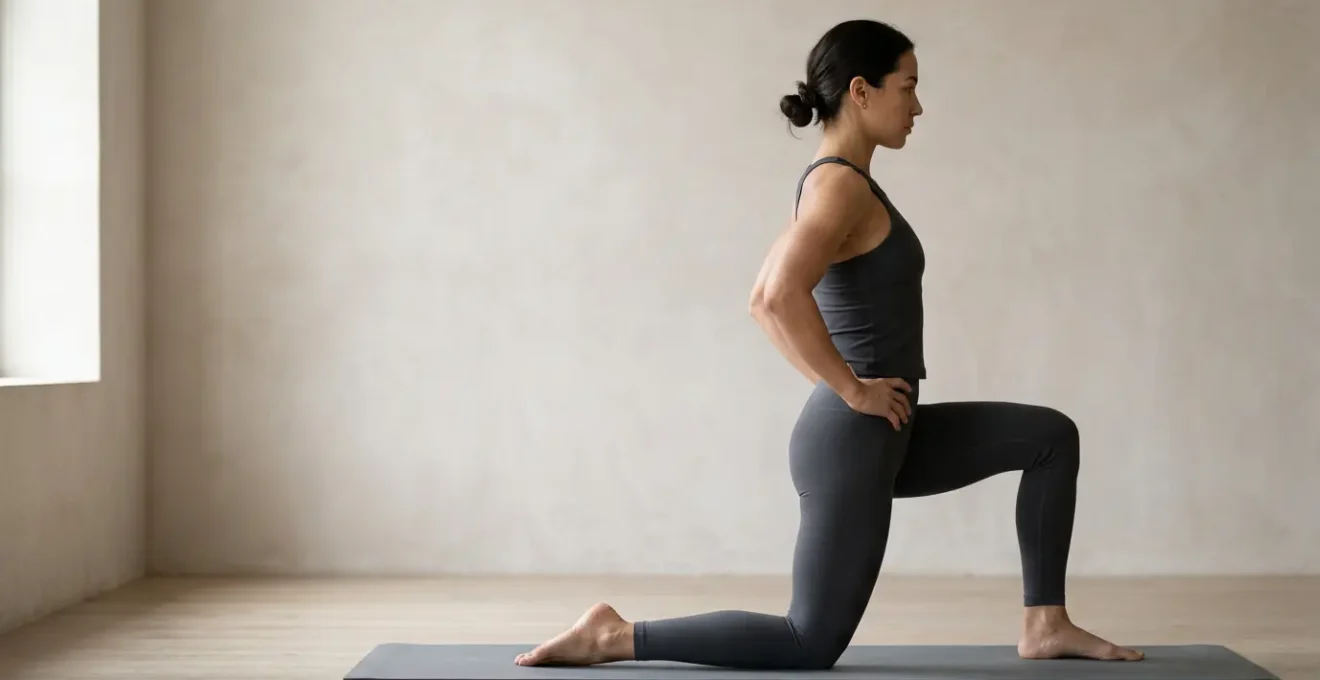
- Why Tight Hip Flexors Are Actually Pulling on Your Lower Back?
- Why Your Foot Pain Might Be Causing Your Neck Tension?
- Ergonomic Chair or Standing Desk: Which Fixes Back Pain Faster?
Why Your Knee Pain Is Actually caused by Misaligned Hips?
The concept of referred pain is fundamental to understanding posture. Pain is often just a signal, and its location isn’t always the source of the problem. This is particularly true for knee pain, which is frequently a direct consequence of dysfunction at the hip. Your hip joint dictates the rotation and tracking of your femur (thigh bone). When the muscles controlling the hip are weak or imbalanced, the entire leg’s alignment is compromised.
Specifically, weakness in the gluteus medius and maximus—key hip stabilizers—can lead to femoral internal rotation and adduction. This causes the femur to twist inward, forcing the patella (kneecap) to track improperly within its groove. This maltracking creates friction, inflammation, and ultimately, pain, a condition known as patellofemoral pain syndrome. You can perform thousands of leg extensions, but if the hip isn’t controlling the femur’s position, the knee will always be the victim.
This biomechanical link is not theoretical. A study on female patients with unilateral knee pain found that the gluteal muscles on the painful side were significantly weaker. The research confirms that impaired hip strength leads to improper femoral rotation and is a primary driver of knee maltracking and pain. Correcting knee issues, therefore, must begin with assessing and strengthening the hip musculature to restore control over the entire kinetic chain of the leg.
How to Check Your Pelvic Alignment in the Mirror in 30 Seconds?
Your pelvis is the foundation of your spine. If this bony structure is tilted or rotated, every vertebra above it must compensate, leading directly to issues like rounded shoulders and forward head posture. Before you can correct your ‘computer hunch’, you must first assess the state of its foundation. A quick self-assessment in front of a mirror can provide immediate, valuable feedback on your pelvic alignment.
These simple tests don’t require any equipment and reveal your body’s default postural patterns. They help you identify the specific direction of your misalignment—whether it’s an anterior tilt (arched lower back), a posterior tilt (flat back), or a lateral rotation. Identifying this baseline is the critical first step in selecting the correct exercises to restore a neutral pelvic position, which is the cornerstone of good posture.
Your 30-Second Pelvic Alignment Audit
- The Wall Test: Stand with your back against a wall, heels a few inches away. Your head, shoulder blades, and buttocks should touch the wall. There should be a small space at your lower back and neck. An excessive gap (more than a hand’s width) at the lower back suggests an anterior pelvic tilt.
- ASIS Landmark Palpation: Place your hands on your hips and locate the two prominent bony points at the front (Anterior Superior Iliac Spine – ASIS). Look in the mirror. Are they level? Is one more forward than the other? A height difference can indicate a pelvic obliquity (hip hike), while one being more forward indicates pelvic rotation.
- Eyes-Closed Marching Test: Stand in an open space, close your eyes, and march in place for 30 seconds. Open your eyes. Have you rotated or moved significantly from your starting spot? This reveals your body’s dominant neuromuscular patterns and which side tends to pull the pelvis out of alignment.
Performing this quick audit gives you tangible data. It moves your understanding from a vague feeling of “bad posture” to a specific diagnosis, like “I have an anterior pelvic tilt and a rightward rotation.” This information empowers you to target your corrective strategy effectively.
Bone Adjustment vs Muscle Strengthening: Which Fixes Posture Permanently?
In the quest for better posture, many are drawn to passive interventions like chiropractic adjustments. These “bone adjustments” can provide immediate relief by manually repositioning joints into a more optimal alignment. However, this relief is often temporary. The fundamental question is: what holds the bones in place? The answer is your muscles.
Bones are passive structures. They go where the muscles and fascia pull them. A chiropractic adjustment can reset a joint, but if the underlying muscular imbalances—the weak, underactive muscles and the tight, overactive ones—are not addressed, the body will inevitably be pulled back into its dysfunctional pattern. Think of it like aligning the wheels of a car that has a bent frame; the alignment won’t hold for long. The adjustment addresses the symptom (misaligned joint), but not the cause (muscular imbalance).
Permanent postural correction, therefore, is not a battle of “bone vs. muscle” but a synergistic process. The goal is neuromuscular re-education. This involves strengthening the weak, inhibited muscles (like the glutes and lower trapezius) and releasing the tight, chronically shortened ones (like the hip flexors and pecs). This active approach teaches your nervous system a new, correct way to hold your skeleton. The muscles learn to maintain the proper alignment that a passive adjustment can only achieve for a fleeting moment. A passive adjustment can show your body where it *should* be, but only active muscle strengthening can teach it to *stay* there.
The Wallet Mistake: Why Sitting on Your Wallet Twists Your Spine?
One of the most common, yet overlooked, saboteurs of spinal health is the simple act of sitting on a wallet. It seems harmless, but placing an object under one side of your pelvis creates an asymmetrical foundation. This seemingly small imbalance forces a cascade of compensations up the entire spinal column, directly contributing to postural strain and pain. Think of it as building a tower on a slanted base; the entire structure must tilt and twist to stay upright.
When you sit on your wallet, you elevate one ischial tuberosity (sitting bone). This creates an immediate lateral pelvic tilt. To keep your head level and your eyes on the horizon—a primary directive of your central nervous system—your lumbar spine is forced to curve sideways away from the wallet. To counteract that curve, your thoracic spine must then curve back in the opposite direction, creating a functional, or temporary, scoliosis. This constant, low-grade distortion puts uneven pressure on your vertebral discs, strains the sacroiliac joint, and creates chronic tension in your spinal erector and quadratus lumborum muscles.
The thickness of the wallet matters significantly. While a very thin wallet may have negligible effects, research shows that a critical threshold exists. In fact, a study published in *IISE Transactions on Occupational Ergonomics and Human Factors* found that wallets of 22 mm or thicker cause significant pelvic and spinal deviations after just 15 minutes of sitting. The simplest and most effective corrective exercise for this specific problem is to remove your wallet from your back pocket. This single habit change eliminates a major source of asymmetrical loading on your pelvis and spine.
Sequence & Plan: Doing Correctives Before vs After Your Main Workout
Integrating corrective exercises into your routine requires strategic timing to be effective. The goal is not just to “do the exercises,” but to use them to re-pattern your movement for the rest of your workout and your day. Performing them as a dedicated warm-up before your main training session is the most effective approach for lasting change. This pre-workout sequence primes the body for correct movement by inhibiting overactive muscles and activating underactive ones.
If you perform corrective exercises after a workout, your muscles are already fatigued. Trying to teach the nervous system a new, subtle firing pattern at this point is like trying to learn a complex skill when you’re exhausted—it’s highly inefficient. By doing them first, you “wake up” the proper stabilizing muscles (like glutes and core) so they are ready to fire correctly during your main lifts, such as squats and deadlifts. This not only improves your performance and reduces injury risk but also reinforces proper motor patterns under load, which is the key to making postural changes stick.
A well-structured corrective warm-up follows a specific sequence. It’s not a random collection of stretches but a logical progression designed to first release tension, then activate dormant muscles, and finally integrate them into functional movements.
- Release (5 minutes): Use a foam roller or massage ball on tight, overactive areas. Focus on the pecs, lats, hip flexors, and upper traps. Apply sustained pressure for 30-60 seconds on each trigger point. The goal is to send an inhibitory signal to these chronically shortened muscles, telling them to “let go.”
- Activate (3 minutes): Perform low-intensity activation drills for weak, underactive muscles. Examples include glute bridges (10 reps), scapular wall slides (10 reps), and dead bugs (8 reps per side). This step is about improving the mind-muscle connection and “waking up” these key stabilizers before you need them.
- Integrate (2 minutes): Perform fundamental movement patterns with no external load to groove the new firing sequence. Bodyweight squats with arms overhead (8 reps), controlled hip hinges (8 reps), and thoracic rotations (6 per side) help your body practice using the newly activated muscles in a coordinated fashion.
Why Tight Hip Flexors Are Actually Pulling on Your Lower Back?
For anyone who spends hours in a chair, tight hip flexors are a near certainty. This group of muscles, including the powerful psoas major, originates on the lumbar spine and travels down to attach to the femur. In a seated position, these muscles are held in a shortened state. Over time, this chronic shortening becomes adaptive, and they lose their ability to lengthen properly. A 2023 study found people sit for an average of 10.4 hours per day, creating the perfect environment for this dysfunction.
When you stand up, these tight hip flexors exert a constant downward and forward pull on your lumbar vertebrae. This force yanks the pelvis into what is known as an anterior pelvic tilt—where the front of the pelvis drops and the back rises. This tilt dramatically increases the curvature of the lower back (lumbar lordosis), compressing the vertebral joints and leading to chronic, nagging low back pain. You may feel the pain in your back, but the tension is originating from the front of your hips.
This mechanical relationship is a cornerstone of corrective exercise science. As the experts at the Cooper Institute clearly state, the connection is direct and unambiguous:
Tight hip flexors create an anterior pull on the pelvis known as an anterior pelvic tilt.
– Cooper Institute, Cooper Institute Blog – Hip Flexors and Low Back Pain
Stretching your hamstrings or back will provide little relief if the hip flexors are the true culprits. Releasing the tension in the psoas and iliacus, combined with strengthening the opposing gluteal muscles to pull the pelvis back into neutral, is the only effective, long-term solution.
Why Your Foot Pain Might Be Causing Your Neck Tension?
The idea that your feet could be the source of your neck pain perfectly illustrates the principle of the kinetic chain. It seems counterintuitive, but your body is a continuous fascial and skeletal structure. A dysfunction at the foundation—your feet—will force a series of compensations all the way up to the top of the structure—your head and neck. Your feet are the first point of contact with the ground, and how they absorb and transmit force dictates the alignment of every joint above them.
Issues like plantar fasciitis, flat feet (over-pronation), or even rigid big toes alter your gait and standing posture. For instance, if your foot arch collapses inward, your tibia and femur rotate internally. The hip compensates, the pelvis tilts, and the spine contorts to keep your body balanced. The final compensation often occurs in the cervical spine. To keep your eyes level with the horizon, the muscles in your neck and upper back must enter a state of chronic contraction to counteract the imbalances from below. This leads to forward head posture, trigger points in the upper trapezius, and persistent neck tension or headaches.
Case Study: The Toe-to-Jaw Connection
The direct link between the feet and the head is measurable. A fascinating 2010 study by Rubenstein explored the kinetic chain’s influence from the toes to the craniofacial region. Researchers measured subjects’ maximum jaw opening, then had them deliberately activate the muscles that flex the toes downward. The result was an immediate and significant increase in jaw opening (average of 6mm). This demonstrated that proper foot muscle function helps to release compensatory tension held in the jaw and neck muscles, proving a direct, functional link along the kinetic chain.
This means that massaging your neck or stretching your shoulders may only provide temporary relief. If the underlying cause is poor foot mechanics, the neck tension will always return. A holistic approach that includes assessing foot function, ensuring proper footwear, and performing foot-strengthening exercises is often a necessary, though unexpected, component of permanently resolving chronic neck issues.
Key takeaways
- Lasting posture correction is a whole-body endeavor; ‘computer hunch’ is a symptom of a systemic collapse in the kinetic chain.
- The pelvis is the foundation of your spine. Correcting its alignment is the non-negotiable first step to fixing upper body posture.
- Permanent change requires active neuromuscular re-education—teaching muscles to hold your skeleton correctly—not just passive stretching or adjustments.
Ergonomic Chair or Standing Desk: Which Fixes Back Pain Faster?
In the search for a solution to desk-related pain, many invest heavily in ergonomic equipment, debating the merits of a high-end chair versus a standing desk. While both can be valuable tools, neither is a magic bullet. An ergonomic chair can support a better posture, and a standing desk can reduce the negative effects of prolonged sitting, but they don’t fix the underlying problem. The belief that a piece of equipment can “fix” back pain faster is a misconception.
The most crucial element for postural health is not the specific position you hold, but a lack of static loading. The human body is designed for movement. Remaining in *any* single position for too long, whether it’s sitting in the “perfect” chair or standing rigidly at a desk, will lead to muscle fatigue, stiffness, and pain. The ergonomic community has a saying that perfectly captures this reality: “Your best posture is your next posture.” This principle emphasizes that frequent changes in position are far more important than finding one ideal, static posture.
Therefore, the question isn’t “chair vs. desk,” but “how can I integrate more movement?” A standing desk is only effective if used correctly. Standing with locked knees and a tilted pelvis can be just as detrimental as slouching in a chair. The key is active standing and alternating between sitting and standing throughout the day.
To avoid simply trading one set of problems for another, follow this checklist for active standing:
- Avoid locked knees: Maintain a micro-bend in your knees to engage your leg muscles and prevent strain on your lower back.
- Shift your weight: Don’t stand static. Shift your weight from leg to leg every 15-20 minutes or use a small footrest to alternate.
- Engage your core: Lightly pull your navel toward your spine to maintain a neutral pelvis and support your lower back.
- Integrate “movement snacks”: Every 30 minutes, take 30 seconds to perform gentle hip circles, shoulder rolls, or calf raises to reset your muscles.
The fastest fix for back pain isn’t a purchase; it’s a behavioral change. By incorporating consistent movement and alternating between well-supported sitting and active standing, you address the root cause of static postural strain, making any ergonomic equipment far more effective.