The secret to a truly romantic trip isn’t scheduling more activities; it’s deliberately engineering an environment of serene isolation that allows connection to happen naturally.
- Connection is a biological process, strengthened by shared new experiences that release oxytocin, the “bonding hormone.”
- True luxury is “sensory decompression”—choosing private, quiet spaces over crowded, over-stimulated resorts to calm the nervous system.
Recommendation: Instead of planning what to do, first define the atmosphere you want to create. Focus on removing decisions and distractions to make space for stillness and intimacy.
For many couples, the idea of a romantic coastal trip conjures a familiar checklist: sunset dinners, long walks on a crowded beach, and a bottle of champagne in a hotel room with a standard-issue sea view. While pleasant, these experiences often feel like performing romance rather than truly feeling it. They are the clichés we’re told to want, but they rarely address the core need of a busy couple (ages 30-50) looking to escape the pressures of work and family life: the need to genuinely reconnect in a space of privacy and peace.
The problem with the standard approach is that it treats a getaway like another project to be managed, filled with scheduled activities and social expectations. It overlooks the most crucial element for rekindling a connection—the mental and emotional environment. What if the most romantic thing you could plan was… nothing at all? What if the goal wasn’t to fill your time, but to create a beautiful, intentional void where you can find each other again?
This guide moves beyond the clichéd itinerary. It’s about a different philosophy: architecting a sanctuary for two. We will explore how to design a trip that prioritizes sensory calm, psychological space, and authentic shared moments. You will learn not just where to go, but how to think about your time away—transforming a simple vacation into a powerful opportunity for reconnection.
This article details the art of planning a coastal escape that is as deep and restorative as the ocean itself. We’ll cover everything from the science of bonding to the practicalities of choosing the right landscape and avoiding modern travel traps.
Summary: A Concierge’s Guide to Designing an Unforgettable Coastal Retreat
- Why Shared New Experiences Release Oxytocin in Couples?
- How to Balance Activity and Intimacy in a 3-Day Trip?
- Rugged Cliffs vs Sandy Beaches: Which Landscape Suits Your Couple Style?
- The ‘Instagram Trap’: Avoiding Spots Ruined by Influencers
- Sequence & Plan: Finding the Perfect West-Facing Spot for Golden Hour
- Private Villa vs Resort Hotel: Which Offers Better Mental Decompression?
- Why Coastal Cuisine Differs Drastically From Inland Dishes in the Same Region?
- The Trunk Mistake: How to Transport Wine in a Hot Car?
Why Shared New Experiences Release Oxytocin in Couples?
Before planning any trip, it’s essential to understand the “why.” The goal is reconnection, and science offers a powerful clue in the form of a hormone: oxytocin. Often called the “bonding hormone” or “love drug,” oxytocin is a neurochemical that plays a critical role in building trust, empathy, and affection. While it’s famously associated with childbirth and motherhood, its role in adult pair-bonding is just as profound.
When you and your partner step out of your routine and engage in a novel experience together—exploring a hidden cove, navigating an unfamiliar town, or trying a new type of food—your brains are stimulated in a unique way. This shared novelty, especially when it involves positive emotions and focused attention on each other, can trigger a significant release of oxytocin. This isn’t just a feeling; it’s a biological event that reinforces your bond on a chemical level.
The intensity of this release is remarkable, especially in the context of romance. As psychology professor Ruth Feldman explained in Scientific American:
The increase in oxytocin during the period of falling in love was the highest that we ever found. New lovers had double the amount Feldman usually sees in pregnant women.
– Ruth Feldman, Psychology Professor, Scientific American – Be Mine Forever: Oxytocin May Help Build Long-Lasting Love
While you may not be “new lovers,” a romantic trip is an opportunity to tap into that same potent neurochemistry. By breaking routines and creating new, positive memories, you are actively facilitating the biological process of bonding and attachment. This is why a trip designed around authentic, shared discovery is infinitely more powerful than one that simply replicates generic “romantic” scenes. You’re not just having fun; you’re reinforcing the very foundation of your connection.
How to Balance Activity and Intimacy in a 3-Day Trip?
The most common mistake in planning a short romantic getaway is over-scheduling. A packed itinerary, even with “fun” activities, can quickly become another source of stress and decision fatigue, leaving no room for the spontaneous moments where true intimacy blossoms. The key is not to manage time, but to architect a rhythm of activity and stillness. For a three-day trip, a simple rule is to plan no more than one “major” activity per day—be it a hike, a museum visit, or a special dinner reservation.
The rest of the time should be intentionally left as “white space.” This isn’t empty time; it’s an invitation. It’s the space for a lazy morning in bed, an impromptu nap, a conversation that goes deeper than logistics, or simply sitting together in comfortable silence. To facilitate this, focus on establishing simple connection rituals instead of a checklist of activities. This could be as simple as having coffee together on the balcony every morning, device-free, or sharing a glass of wine at the same spot each evening to watch the light change.
This image captures the essence of such a ritual—a quiet, shared moment that is about being, not doing. It’s in these unforced, peaceful intervals that you create the conditions for reconnection.
These rituals become the gentle anchors of your day, providing structure without being rigid. They are repeatable, low-effort moments of togetherness that require nothing but your presence. By prioritizing this balance, you shift the trip’s focus from “what did we do?” to “how did we feel together?”
Your Action Plan: Architecting a 3-Day Trip for Connection
- Define the Atmosphere: Before choosing a location, list the feelings you want to cultivate (e.g., secluded, vibrant, adventurous). Let the desired mood guide your destination choice.
- Audit the Itinerary: For every activity you consider, ask: “Does this add energy or drain it?” Schedule no more than one significant, energy-expending activity per day.
- Engineer Stillness: Block out non-negotiable “white space” on your calendar. Treat this unstructured time with the same importance as a dinner reservation. It’s your time to simply be.
- Establish a Connection Ritual: Identify one simple, repeatable, device-free moment to share daily, like a morning coffee on the balcony or watching the sunset from the same spot.
- Pre-solve Logistics: Make the one “must-do” reservation (a special restaurant, a boat tour) in advance to eliminate decision fatigue during the trip, freeing up mental space for each other.
Rugged Cliffs vs Sandy Beaches: Which Landscape Suits Your Couple Style?
The choice of coastal landscape is more than aesthetic; it’s a decision about the energy and mood of your trip. The environment you immerse yourselves in will subtly shape your interactions and emotional state. Moving beyond the generic “beach vacation” means consciously selecting a landscape that aligns with your couple’s personality and the goal of your getaway.
Sandy beaches often evoke feelings of ease, relaxation, and gentle timelessness. The soft textures, the rhythmic sound of small waves, and the expansive horizon are conducive to slowing down, unwinding, and engaging in low-energy activities. This setting is ideal for couples seeking pure rest and passive relaxation—a place to decompress with a book, take leisurely strolls, and feel the sun without a demanding agenda. It’s a landscape of soft edges and open space.
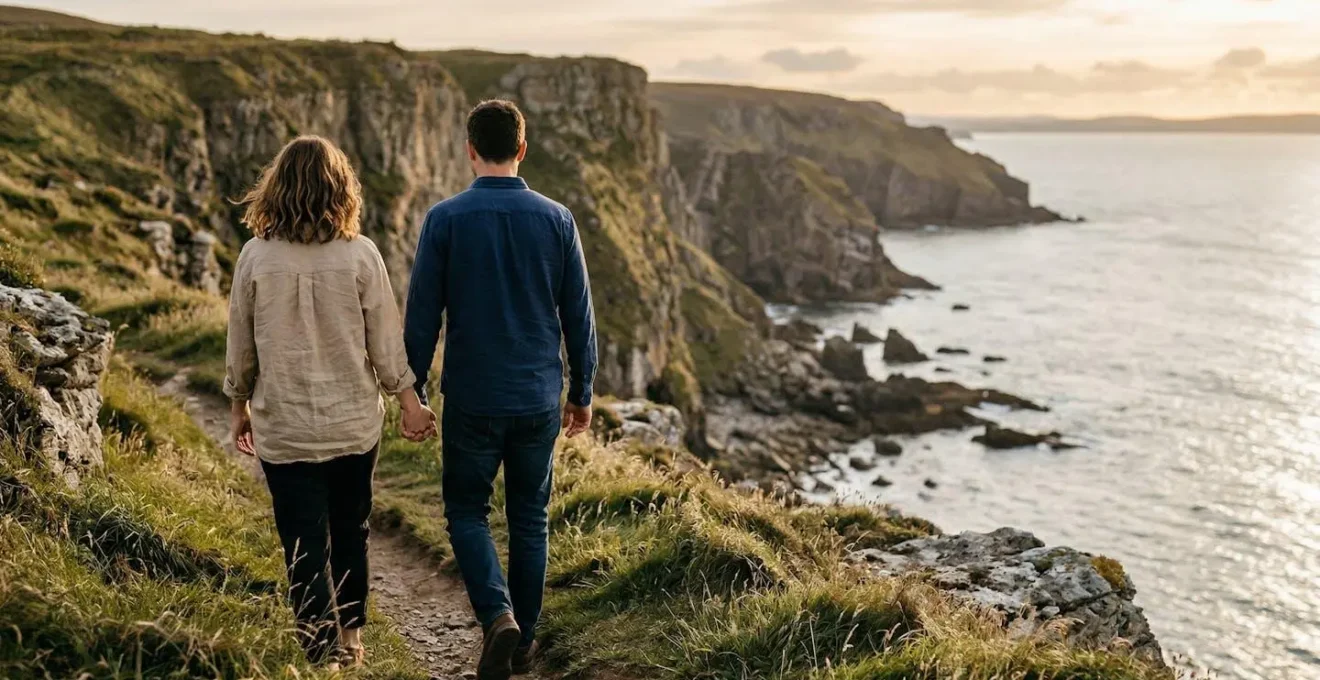
In contrast, rugged cliffs and rocky shores offer an entirely different energy. They speak of drama, resilience, and discovery. The powerful crash of waves against stone, the winding coastal paths, and the dramatic vistas can inspire a sense of awe and adventure. This landscape is perfect for couples who connect through shared activity and exploration. It encourages hiking to a secluded viewpoint, discovering hidden tide pools, and feeling a powerful sense of being alive in the face of nature’s grandeur. It’s a landscape of strong lines and dynamic forces.
Case Study: The ‘Uncrowded’ Alternative of Martin County, Florida
Proving that you don’t need to choose over-touristed destinations, Martin County, Florida, offers a blend of “Old Florida” charm with 22 miles of uncrowded beaches. Building height restrictions maintain an intimate, small-town feel, while unique features like the Blowing Rocks Preserve provide a touch of ruggedness. This shows how couples can find less-crowded coastal alternatives that match their specific energy needs—in this case, sophisticated tranquility—without sacrificing quality or beauty.
The right choice isn’t about which is “better,” but which is right for *you*, right now. Are you seeking a gentle space to exhale and be still together? Or do you need a dramatic backdrop to reignite a sense of shared adventure? Answering this question honestly is a foundational step in designing a trip that truly resonates.
The ‘Instagram Trap’: Avoiding Spots Ruined by Influencers
In the modern age of travel, one of the greatest threats to intimacy and authentic discovery is the “Instagram Trap.” This is the phenomenon where a location becomes so famous on social media that it loses its original charm, overrun by crowds all vying to capture the exact same photo. These spots promise beauty but often deliver queues, noise, and a performative atmosphere—the very opposite of the private connection you’re seeking.
The pressure to visit and document these places is significant. A 2023 study highlighted by InsideHook revealed that more than 75% of travelers use social media for inspiration, and nearly half go to places specifically to post about them. This creates a feedback loop where “viral” locations become impossibly crowded, turning a potential moment of awe into a stressful logistical challenge.
Case Study: The Viral Over-tourism of Delta Lake
A stark example of this is Delta Lake in Grand Teton National Park. According to a study on social media-induced tourism, a handful of geotagged posts by influencers transformed this once-serene spot into a major hotspot almost overnight. The resulting surge in visitors led to environmental damage and risks for unprepared hikers, showing how quickly the digital world can overwhelm a physical space, destroying the tranquility that made it special in the first place.
To avoid this trap, a concierge’s advice is to be strategically contrarian. Use social media for what it’s good at—identifying general regions of beauty—but then, put the phone down. Look at detailed maps of the area. Seek out the *other* cove, the trail that *isn’t* geotagged, or the viewpoint that requires a little more effort to reach. The most romantic spots are rarely the most famous ones. They are the ones you discover for yourselves, creating a story that is uniquely yours, not a recreation of someone else’s feed.
The true prize is not the perfect photo, but the uninterrupted moment. It’s the feeling of having a breathtaking corner of the world all to yourselves, a memory that can’t be fully captured or replicated precisely because it was authentic.
Sequence & Plan: Finding the Perfect West-Facing Spot for Golden Hour
The “golden hour”—that magical period shortly after sunrise or before sunset—is a romantic cliché for a reason. The warm, soft light is universally flattering and imbues any landscape with an ethereal quality. However, the cliché part is not the light itself, but the way most people experience it: gathered in a crowd at the most obvious, signposted “sunset viewpoint.” A more sophisticated approach is to engage in a little atmospheric engineering to have that moment all to yourselves.
This means doing some light research to find a west-facing spot that is off the beaten path. You don’t need to be a professional photographer to do this. Modern tools can give you an incredible advantage. Apps like PhotoPills or even the basic compass on your phone can help you identify the exact direction of the sunset from any given point. Use satellite views on map apps to scout for promising locations: a small, accessible bluff, the end of a lesser-known pier, or a quiet bend in the coastline.
The goal is to find a place where you can be alone with the view. This transforms the experience from a public spectacle into a private ritual. You’re not just watching a sunset; you’re taking ownership of a moment in time and space. As renowned photographer Mark Gee notes about using such tools, they allow you to find unconventional spots away from the crowds. This mindset is key.
PhotoPills shows the exact angle of the sun, allowing you to find unconventional spots that will be perfectly lit, away from the obvious sunset-watching crowds.
– Mark Gee, Astronomy Photographer of the Year, PhotoPills App Store Reviews
By sequencing your afternoon to arrive at your chosen spot with time to spare, you create a seamless experience. Pack a simple picnic—a bottle of wine, some cheese—and settle in. The act of planning this small detail elevates the moment from a happy accident to an intentional act of creating beauty and intimacy for each other. It’s a quiet declaration that your shared peace is worth a little extra thought.
Private Villa vs Resort Hotel: Which Offers Better Mental Decompression?
The choice of accommodation is perhaps the single most important decision in architecting a trip for reconnection. It dictates your level of privacy, control, and exposure to external stimuli. While a luxury resort offers amenities and service, a private villa or a secluded rental often provides a far more valuable asset: the opportunity for true mental decompression.
A resort, by its nature, is a shared space. You are on its schedule for meals, its rhythm for pool-side activity, and constantly surrounded by other guests and staff. This creates a low level of persistent sensory input—background noise, social cues, and subtle pressures—that can prevent your nervous system from fully unwinding. You are a guest in someone else’s environment.
A private villa, in contrast, offers what the travel trend analysis “Hushpitality” calls an environment for sensory input reduction. As the report from VillaPads highlights, these private spaces support mental clarity and emotional regulation by minimizing external demands. In a villa, you have total control. You eat when you’re hungry, sleep when you’re tired, and listen to the sounds of nature instead of your neighbors. This autonomy is the ultimate luxury.
Case Study: The ‘Autonomous Decompression’ Model
The Insight Trends World analysis describes how private villas facilitate “Autonomous Decompression.” This is the freedom for each partner to find their own rhythm without pressure. An early riser can make coffee and read on the terrace without waking their partner. One person can take a nap while the other swims. This ability to decompress individually, within a shared private space, is critical for reducing the friction that can build up in daily life. It allows you to come back together feeling restored, not depleted.
For a couple seeking to reconnect, this private control is invaluable. It removes the performative aspect of being on vacation and creates a safe, quiet container where you can shed the roles you play in the outside world. It’s in this deliberate stillness, where “rest is reclassified from weakness to refinement,” that you can finally hear each other—and yourselves—again.
Why Coastal Cuisine Differs Drastically From Inland Dishes in the Same Region?
One of the most immersive ways to connect with a place is through its food. On a coastal trip, paying attention to the local cuisine offers a story of the land and sea. Many travelers are surprised to find that dishes just a few miles inland can be starkly different from those on the shore, even within the same small region. This isn’t random; it’s a direct reflection of history, geography, and necessity.
The most obvious factor is ingredient proximity. Coastal kitchens have immediate access to the freshest seafood, from fish and shellfish to seaweed. This bounty encourages a culinary style that is often simple, quick, and designed to highlight the clean, delicate flavors of the main ingredient. Think of grilled fish with lemon, raw oysters, or lightly steamed mussels. The goal is to taste the sea. Inland, where fresh seafood was historically a luxury, cuisines evolved around what was readily available: farmed meats, freshwater fish, hearty root vegetables, and grains. This leads to different cooking methods, such as slow-roasting, braising, and stewing.
Secondly, historical preservation methods played a huge role. On the coast, salt was abundant. Salting and air-drying fish (like in bacalhau or stockfish) became a primary way to preserve the catch, creating intense, savory flavors that are now cornerstones of many coastal cuisines. Inland, preservation methods were different—smoking meats, pickling vegetables, and turning milk into aged cheeses were more common. These distinct traditions create two entirely different flavor palates.
Finally, consider the influence of trade and culture. Coastal ports have always been melting pots, a crossroads for sailors, merchants, and migrating cultures. This exposure brought new spices, ingredients, and cooking techniques from around the world, leading to more eclectic and layered cuisines (think of a seafood curry in a port city). Inland areas were often more isolated, preserving older, more traditional recipes passed down through generations. Understanding this “why” behind your plate transforms a simple meal into a rich, sensory history lesson, adding another layer of shared discovery to your trip.
Key Takeaways
- Architect, Don’t Schedule: Focus on creating an environment for connection, not just a list of activities.
- Prioritize Stillness: Unstructured time is not empty time; it is the most valuable commodity for intimacy.
- Choose Landscapes for Energy: Match the coastline’s mood (rugged or soft) to your couple’s current needs for adventure or rest.
- Seek Privacy Over Popularity: Avoid social media hotspots to find authentic moments and protect your peace.
- Control Your Environment: Opt for private accommodation to enable true mental and sensory decompression.
The Trunk Mistake: How to Transport Wine in a Hot Car?
A romantic trip often involves discovering a special bottle of wine at a local vineyard or shop—a liquid souvenir to be enjoyed later. However, a simple mistake can ruin this perfect memento before you even get home: transporting it in the trunk of your car. This is one of those small, detail-oriented tips from a concierge that can make all the difference between a fond memory and a disappointing, cooked bottle.
The trunk of a car, especially in a sunny coastal climate, can quickly become an oven. Temperatures can easily soar well above 100°F (38°C), even on a moderately warm day. This extreme heat is a wine’s worst enemy. It can rapidly accelerate the aging process, “cook” the delicate fruit flavors, and even cause the cork to expand and push out, breaking the seal and allowing oxygen in. The result is a flat, lifeless wine that tastes more like sherry or prune juice than the vibrant drink you purchased.
The solution is simple but crucial. Follow these steps to protect your investment:
- Use the Cabin, Not the Trunk: The passenger area of your car is climate-controlled. Always place your wine bottles on the floor of the back seat, where they are out of direct sunlight and can benefit from the air conditioning.
- Insulate If Possible: If you plan on buying wine, it’s wise to bring an insulated bag or a small cooler (without ice, which can damage labels). This provides an extra layer of protection against temperature fluctuations.
- Minimize Stops: Try to make the winery or wine shop your last stop before heading back to your accommodation. The less time the wine spends in a stationary car, the better.
- Let It Rest: Once you arrive, let the bottle rest for at least a few days, or ideally a week or more, before opening. This allows the wine to recover from the agitation of travel, a phenomenon known as “travel shock.”
This small act of care ensures that when you finally open that bottle, you’re tasting the place you visited and the memory you made, not the heat of the car ride home.
By shifting your focus from a checklist of clichés to the deliberate architecture of a peaceful, private environment, you give your relationship the greatest gift: the space and stillness to truly reconnect. The next step is to start dreaming not about what you will do, but about how you want to feel together.