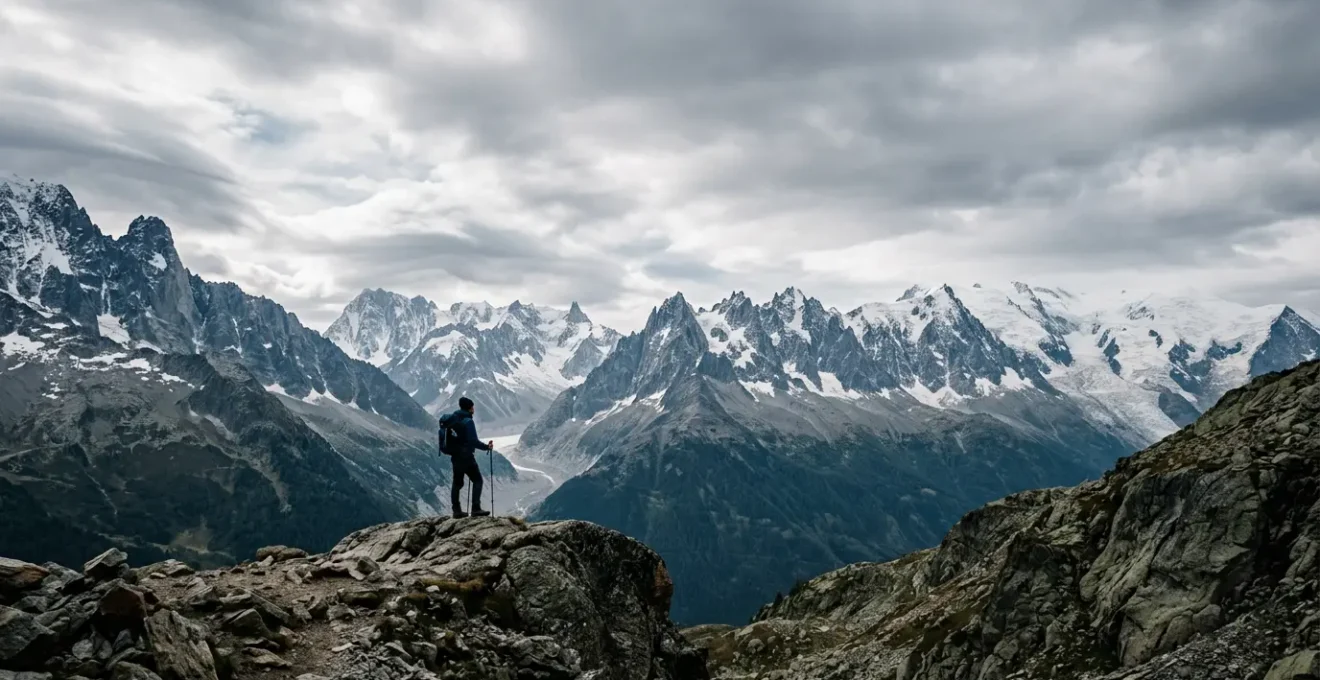
Success on a remote expedition isn’t built on a positive mindset, but on a robust system for handling failure.
- Training for discomfort—physical, mental, and environmental—is more valuable than simply training for fitness.
- Your biggest liability is your own ego; transparent self-assessment and communication are your greatest assets.
Recommendation: Start by identifying your specific anxieties and training those failure points with controlled, uncomfortable practice long before you leave.
The real fear on a multi-day expedition isn’t the bear, the crevasse, or the storm. It’s the quiet voice in your head, three days in, soaked, cold, and exhausted, whispering, “I can’t do this.” You’ve trained your body, but have you truly prepared your mind for the moment it wants to quit? This isn’t about packing lists or fitness plans, although those are important. This is about forging the mental resilience to endure when the glamour of adventure wears off and only the grit remains.
Most preparation guides will tell you to get fit, pack right, and maintain a “positive attitude.” But positivity is a fragile shield against the harsh realities of remote terrain. When you’re facing down hypothermia, altitude sickness, or simple, soul-crushing fatigue, you don’t need platitudes. You need protocols. You need systems you can rely on when your motivation fails you, because it will.
This guide is different. It’s not about avoiding hardship; it’s about building the mental and tactical systems to expect it, manage it, and push through it. We’re not building a house of cards based on feeling good; we’re forging a mental fortress, brick by brick. We will deconstruct the real psychological pressures of expedition life—from tech withdrawal to the ego trap—and provide field-tested frameworks to build true, unbreakable resilience. This is the work that begins long before you take your first step on the trail.
In this guide, we will break down the essential, often-overlooked components of expedition-grade mental preparedness. The following sections provide a structured approach to building the resilience required to not just survive, but thrive in high-stakes environments.
Summary: Mental Preparation for a Multi-Day Expedition
- Why Disconnecting From Tech in the Wild Triggers Withdrawal Anxiety?
- How to Identify Unethical Tour Operators Who Cut Safety Corners?
- Evacuation vs Medical: What You Really Need for 5000m Altitude?
- The Ego Trap: Why Hiding Symptoms Endangers the Whole Team?
- Problem & Solution: Training for Mountain Hiking When You Live in a Flat City
- Problem & Solution: Increasing CO2 Tolerance to Reduce Breathlessness
- Why Shelter Always Takes Priority Over Food in Survival Situations?
- What Gear Layering System Works Best for Unpredictable Alpine Weather?
Why Disconnecting From Tech in the Wild Triggers Withdrawal Anxiety?
In the modern world, your phone is more than a communication device; it’s a dopamine dispenser and an anxiety pacifier. It provides constant validation, distraction, and a sense of control. When you step into the wilderness and that signal dies, you’re not just losing contact with the outside world; you’re severing a deep psychological tether. This isn’t a trivial inconvenience; it’s a genuine withdrawal. The silence that follows can be deafening, allowing repressed anxieties and insecurities to surface with a vengeance.
The “withdrawal anxiety” is a symptom of a deeper issue: a reliance on external validation for internal stability. On an expedition, there are no ‘likes’ for reaching a tough pass and no comment sections to complain in. Your sense of accomplishment must come from within. Your ability to self-soothe when you are cold, tired, and scared must be self-generated. The sudden absence of this digital crutch forces a confrontation with your own unfiltered thoughts and emotions, a prospect that can be terrifying if you’re not prepared.
Preparation involves weaning yourself off this dependency before you leave. Practice “micro-disconnects” in your daily life: go for a walk without your phone, sit in a park and just observe, or dedicate specific hours of the day to being screen-free. The goal is to retrain your brain to find calm and focus without a digital stimulus. You must learn to be comfortable with the “boredom” of the wild, which is really just an opportunity for your mind to process, adapt, and become present in the raw, immediate reality of your surroundings. This is the first and most fundamental test of your mental fortitude.
Ultimately, the anxiety of disconnection is a mirror. It reflects how much of your self-worth and mental calm you’ve outsourced to a device. Reclaiming that is not just a survival skill; it’s a profound step toward self-reliance.
How to Identify Unethical Tour Operators Who Cut Safety Corners?
Choosing an expedition operator is the single most important safety decision you will make. An unethical or incompetent guide service doesn’t just provide a poor experience; it can be a fatal liability. These operators often lure clients with lower prices, achieved by cutting critical corners on guide experience, safety equipment, and emergency protocols. Your job is not to find the cheapest trip, but to find the operator you can trust with your life. This requires a forensic level of scrutiny.
Unsafe operators thrive on ambiguity. They use vague terms like “experienced guides” and “comprehensive safety gear.” Your task is to cut through the marketing fluff with pointed, specific questions. Don’t ask *if* they have safety gear; ask *what specific models* of satellite communicators they carry and how many. Don’t ask *if* guides are certified; ask for their specific certification numbers and the issuing body (e.g., IFMGA, AMGA). A reputable operator will welcome this diligence; a shady one will become evasive or defensive.
This vetting process is your first mental training exercise. It forces you to take active responsibility for your own safety, rather than passively trusting a slick website. It hones your ability to spot inconsistencies and challenge weak answers—skills that are just as valuable on the mountain as they are in the booking process. The following checklist is not just a set of questions; it’s a protocol for systematically dismantling a company’s sales pitch to reveal the truth of its operations.
Your Audit Checklist: Vetting Adventure Tour Operators
- Guide Certifications: Request specific details on guide certifications. Ask for exact certification names and numbers (e.g., “IFMGA Guide #1234”), not vague statements like “our guides are certified.”
- Emergency Comms: Demand transparency on emergency communication equipment. Ask, “What specific satellite communication devices do you carry?” A legitimate operator will list exact models (e.g., “two Garmin inReach devices plus a PLB”).
- Turn-Back Protocol: Inquire about their turn-back decision protocol. Ask, “Describe a situation where you turned a team around and why.” Listen for whether they frame safety decisions as victories or failures.
- Liability Waivers: Verify comprehensive liability waivers with medical detail. Ethical operators provide transparent waivers explaining specific dangers, not just boilerplate legal protection. A detailed waiver shows they understand the risks.
- Cost Breakdown: Request a breakdown of trip cost allocation. Asking “Where does the money go?” can reveal if they invest in guide experience and gear maintenance or simply maximize profit margins.
Remember, the right operator doesn’t sell a summit; they sell a process. A process built on professionalism, redundancy, and a deep, abiding respect for the unforgiving nature of the mountains.
Evacuation vs Medical: What Insurance Do You Really Need for 5000m Altitude?
Insurance is the most boring, and most critical, piece of gear you will carry. At high altitude, a simple mistake can escalate into a life-threatening emergency requiring immediate evacuation. Assuming your regular travel insurance or government-provided search and rescue will cover you is a catastrophic, and common, mistake. You need a specific policy that explicitly covers high-altitude trekking and, crucially, distinguishes between Search & Rescue, Medical Evacuation, and Medical Treatment.
Let’s be brutally clear about the costs. If you need a helicopter at altitude, you are looking at a bill that can easily cripple you financially. For instance, a helicopter evacuation from Everest Base Camp to Kathmandu costs approximately $3,000 to $6,000 or more, and that’s just the ride. It doesn’t cover the hospital bills, the flight home, or the search that may have preceded it. A policy without “medical evacuation” coverage up to at least your maximum altitude is worthless.
The key is to understand the fine print. Many adventurers are shocked to learn that “Search and Rescue” (SAR) coverage may only cover the cost of locating you. The moment a rescuer puts you in a helicopter, it often becomes a “Medical Evacuation,” which is a separate benefit. A “reimbursement-based” policy means you pay the $20,000 bill upfront and hope to get it back later. A “direct-pay” service, like those offered by specialized providers, handles the logistics and payment directly, which is the gold standard. Understanding these distinctions isn’t just about money; it’s about ensuring that when you make that emergency call, someone actually answers with the resources you need.
As this recent comparative analysis of remote rescue insurance shows, the details matter. Study the table below as if your life depends on it. Because it does.
| Coverage Type | What It Actually Covers | What It Does NOT Cover | Typical Cost Implication |
|---|---|---|---|
| Search & Rescue (SAR) | Government service locating you; helicopter dispatch to point of rescue | Transport from rescue point to hospital (that’s ‘evacuation’); medical treatment costs | Often publicly funded but helicopter may bill the person who called it in |
| Medical Evacuation | Transport from point of rescue TO a medical facility capable of treating your condition | The search itself; medical treatment once at hospital; repatriation home | $3,000-$25,000+ depending on location and complexity |
| Reimbursement-Based Policies | You pay upfront, file claim later for reimbursement | No advance payment to providers; you need $50,000+ liquid funds on hand | Premium may be lower, but financial burden in crisis is extreme |
| Direct-Pay Membership (Global Rescue, Ripcord) | Service pays providers directly; no upfront cost to member; evacuation coordinated for you | Typically not a full ‘insurance’ – may need separate medical expense policy | Higher annual fee ($495+ for high-altitude) but zero out-of-pocket in emergency |
Your insurance policy is your one “get out of jail free” card. Make sure it’s the right one, read every line, and confirm your coverage altitude and activities in writing before you leave.
The Ego Trap: Why Hiding Symptoms Endangers the Whole Team?
On an expedition, your greatest enemy is not the mountain; it’s your own ego. The “Ego Trap” is the deadly impulse to hide weakness. It’s the voice that tells you to push through a developing headache, conceal a nagging cough, or pretend you’re not exhausted, all to avoid looking like the “weak link.” This desire to project strength, ironically, is the most dangerous behavior you can exhibit in a team environment. A hidden symptom doesn’t just endanger you; it compromises the entire rope line.
Look at the face in the photo above. That is the look of “I’m fine” that every expedition leader dreads seeing. It’s a mask of determination hiding a potentially serious problem. When a team member hides a symptom of altitude sickness (AMS), for example, they rob the team of its most valuable resource: time. Early AMS is easily treatable by descending. Ignored, it can progress to High-Altitude Cerebral Edema (HACE) or Pulmonary Edema (HAPE)—life-threatening conditions that require a massive, high-risk rescue operation, putting everyone in jeopardy.
This isn’t hypothetical. It’s a documented phenomenon. Your personal pride is not worth your teammate’s life. The mental shift required is to reframe honesty as strength. The strongest person on the team is the one who can say, “Hey, I’ve had a headache for the last hour and I’m feeling a bit dizzy.” That statement isn’t an admission of failure; it’s a vital data point that allows the team leader to make an informed decision.
Case Study: The High Cost of Non-Disclosure
This ego-driven concealment is a proven killer. A comprehensive study on mental health in expeditions revealed a shocking pattern. Of 16 documented psychiatric incidents requiring intervention, a staggering 13 were exacerbations of previously diagnosed depressive illnesses that participants had deliberately hidden from the team. This dramatic under-reporting, driven by ego and fear of being excluded, directly led to preventable expedition failures and dangerous evacuations. It proves that hiding a vulnerability—be it physical or mental—creates a cascading risk that can bring down an entire team.
Before you leave, you must make a pact with yourself and your team: total, unconditional honesty. Celebrate the courage it takes to admit a weakness, because in the high mountains, that honesty is the ultimate form of strength.
Problem & Solution: Training for Mountain Hiking When You Live in a Flat City
The problem is simple: you live in a place with zero elevation gain, but you’re training for a 5000-meter peak. The endless, grinding nature of a multi-hour ascent and the quad-burning torture of a long descent are impossible to replicate on a treadmill. This isn’t just a physical challenge; it’s a mental one. If your body isn’t prepared for the specific stresses of mountain travel, your mind will break long before the summit.
The solution is not to just “do more cardio.” The solution is to get creative and methodical, transforming your urban environment into a high-altitude training ground. You must deconstruct the demands of mountain hiking into their component parts—concentric strength (going up), eccentric strength (going down), and load-bearing endurance—and then find ways to simulate them. Your mantra should be: “If I can’t go up, I’ll bring the ‘up’ to me.”
This means becoming the strange person in your gym or apartment building. It means loading a backpack with 20-30% of your body weight and spending hours on the StairMaster or walking up and down stadium bleachers. It means focusing on exercises that build eccentric strength, like weighted step-downs and slow-negative squats, because it’s the long descents that cause the most muscle damage and failure. This type of training is monotonous and mentally taxing—which is precisely the point. You are not just building muscle; you are building the “failure tolerance” to endure boredom and discomfort, the two most common currencies of any long expedition.
- Phase 1 – Stair Repeats with Progressive Load: Find a stadium or tall building. Start with bodyweight for 20 minutes of continuous climbing. Add 10-15% of your body weight in a backpack by week 2, progressing to 20-25% by week 4.
- Phase 2 – Eccentric Muscle Loading for Descents: Perform weighted step-downs from a 12-18 inch box, 3 sets of 15 reps per leg, 2-3 times per week. This simulates the brutal eccentric contractions of long downhills.
- Phase 3 – Slow-Negative Squats and Loaded Lunges: Execute squats with a 5-second descent phase. Progress to goblet squats and walking lunges with a heavy load to build resilience for sustained downhill hiking.
- Phase 4 – Balance and Proprioception Training: Practice single-leg balance on unstable surfaces (like a wobble board) while carrying a weighted pack. This mimics navigating uneven mountain terrain.
- Phase 5 – Hypoxic Breathing Protocols: During cardio, practice box breathing (4-sec inhale, 4-sec hold, 4-sec exhale, 4-sec hold) to improve CO2 tolerance and mental calm under respiratory stress.
When you’re on the mountain and your legs are screaming, your mind will have a reference point. It will know it has endured this type of suffering before, in a controlled environment, and it will know it can survive. That knowledge is worth more than any piece of gear you can buy.
Problem & Solution: Increasing CO2 Tolerance to Reduce Breathlessness
At altitude, the air is not just “thin” on oxygen; the lower atmospheric pressure makes gas exchange less efficient. Your body’s response is to breathe faster to compensate. This leads to a panicked, shallow breathing pattern that is both physically inefficient and mentally distressing. The feeling of “air hunger” is a primary trigger for anxiety and the urge to quit. The common advice is to “breathe deeply,” but this is useless when your nervous system is screaming for air.
The counter-intuitive solution lies not in getting more oxygen, but in becoming more comfortable with carbon dioxide (CO2). Your urge to breathe is not primarily driven by a lack of O2, but by a buildup of CO2 in your blood. By systematically training your body to tolerate higher levels of CO2, you can slow your breathing rate, reduce anxiety, and improve your efficiency at altitude. You are essentially hacking your own respiratory system, teaching it not to panic.
This training, often used by free-divers, involves specific breath-hold exercises. It feels unnatural and uncomfortable at first, which is exactly why it works. You are practicing “controlled suffering.” By repeatedly and safely pushing your CO2 limits in a controlled environment at sea level, you recalibrate your brain’s chemoreceptors. When you later experience the respiratory stress of high altitude, your body’s panic response will be blunted. It will recognize the sensation not as a novel threat, but as a familiar stressor it has been trained to handle calmly.
This protocol systematically builds your resilience to the feeling of breathlessness.
- Week 1-2 Baseline: Start with nasal-only breathing during gentle walking. Then, attempt a comfortable breath-hold walk for maximum distance without gasping. Record your baseline.
- Week 3-4 Extension: Aim to increase your breath-hold walk distance by 10-15%. Add 5 minutes of box breathing (4-4-4-4 pattern) post-exercise.
- Week 5-6 Intensity: Combine breath-holds with moderate exertion, like on a stationary bike. Pedal at a steady pace, then hold your breath for 15-30 seconds while continuing to pedal slowly. Repeat.
- Week 7-8 Gamification: Set weekly goals for your breath-hold walks. Integrate with stair climbing: two flights with normal breathing, one flight on a breath-hold.
- Ongoing Maintenance: Practice slow, deep nasal breathing during all training. Focus on long exhales (8-10 seconds) to fully expel CO2 and activate your parasympathetic (calming) nervous system.
When others are panting and panicking, you will be able to rely on a slow, steady rhythm. This control over your breath is control over your mind, and at 5000 meters, that is the only control that matters.
Why Shelter Always Takes Priority Over Food in Survival Situations?
The “Rule of Threes” is a survival classic: 3 minutes without air, 3 hours without shelter in extreme conditions, 3 days without water, 3 weeks without food. Yet, in the stress of a real situation, the primal urge for food can dangerously cloud judgment. The mental game of survival is about ruthlessly prioritizing based on thermodynamic reality, not on emotional cravings. And the unassailable reality is that exposure will kill you long before starvation does.
Your body is a furnace, constantly burning calories to maintain its core temperature of 37°C (98.6°F). Shelter is anything that reduces the rate at which you lose this precious heat. It could be a tent, a snow cave, a pile of leaves, or simply the lee side of a rock. Food provides the fuel for the furnace, but it’s a slow, inefficient process. If you are losing heat faster than you can generate it, no amount of food will save you. In fact, searching for food is an energy-negative activity; you will burn far more calories looking for it than you will gain from the meager scraps you might find. As wilderness survival research indicates, a person exposed to cold and shivering can burn thousands of extra calories per day just to stay alive.
Prioritizing shelter is a psychological act as much as a physical one. It is about taking immediate, decisive action to gain control over your environment. Building a shelter, however crude, gives you a locus of control. It is a productive, energy-positive task that directly combats the primary threat. This proactive stance fights off the learned helplessness that can be fatal in a survival scenario. Chasing the fantasy of a meal is a passive, hope-based strategy; building a shelter is an active, reality-based one.
Case Study: Aron Ralston’s 127-Hour Thermodynamic Battle
The case of Aron Ralston, trapped by a boulder for over five days, is a masterclass in survival prioritization. His survival hinged not on finding food, but on managing the immediate thermodynamic threat. The extreme temperature swings in the Utah canyon were a greater danger than starvation. Ralston’s mental focus was entirely on preserving core body temperature—wedging himself against the rock to minimize heat loss and carefully rationing his movements. This focus on shelter-related micro-decisions provided psychological empowerment, a critical survival factor that prevented the spiral of hypothermia and impaired decision-making that would have been fatal.
In a survival situation, your first question should never be “What can I eat?” It must always be “How can I stop losing heat?” Your life depends on getting that answer right, every single time.
Key Takeaways
- Mental readiness is not about ‘positive thinking’ but about building robust systems to handle failure and discomfort.
- Your greatest risks are often internal (ego, anxiety) and logistical (unvetted operators, inadequate insurance), which must be addressed before you leave.
- Effective training simulates the specific stressors of expedition life: muscular load, respiratory stress at altitude, and the psychological weight of survival priorities.
What Gear Layering System Works Best for Unpredictable Alpine Weather?
In the mountains, weather is not a forecast; it’s a dynamic, volatile entity. A sunny morning can turn into a freezing, wind-blasted whiteout in minutes. Your clothing is not an outfit; it is a life-support system. The key to managing unpredictable alpine weather is a “dynamic layering system,” a philosophy that treats your clothing as a set of modular tools, not a fixed costume. The goal is to make constant, micro-adjustments to maintain thermal equilibrium, avoiding the fatal cycle of sweating during exertion and freezing during rest.
The rookie mistake is to think in rigid terms of “base-mid-shell.” The expert thinks in terms of “active” versus “static” insulation. Active insulation is what you wear while moving; it must be highly breathable to vent perspiration and prevent your inner layers from becoming saturated with sweat. Static insulation is what you put on the second you stop moving; its job is to trap all your body heat with maximum efficiency. Hiking in your big, static puffy jacket is one of the most common and dangerous errors; you’ll overheat, soak the down with sweat, and then become hypothermic when you stop and that moisture freezes.
A truly effective system, often called an “action suit,” is fluid. It might mean climbing a steep section in just a base layer and a wind shirt, adding a breathable mid-layer as clouds roll in, and only pulling out the hardshell and the big puffy for a summit stop or a sudden squall. The best gear is the gear you can adjust without stopping. This means full-length side zips on your rain pants, a helmet-compatible hood on your shell, and having your static puffy easily accessible at the top of your pack. Every stop to change layers is a loss of momentum and heat.
This table breaks down the expert-level philosophy. It’s not about brands; it’s about function. Understanding these distinctions is critical for maintaining safety and comfort when the weather turns.
| Insulation Type | Primary Function | When to Wear | Material Examples | Common Mistake |
|---|---|---|---|---|
| Active Insulation | Breathable warmth during high-output movement; manages perspiration while maintaining core temperature | While hiking uphill, during aerobic exertion, in stop-and-go activities | Fleece, Polartec Alpha, lightweight synthetic insulated jackets with high breathability | Wearing a heavy down puffy while climbing – results in overheating, sweat saturation, and subsequent chill during rest |
| Static Insulation | Maximum heat retention with minimal breathability; trap all warmth when body is at rest | At camp, during extended breaks, summit stops, belaying, sleeping | Thick down jackets, heavy synthetic puffies, insulated parkas with low breathability | Hiking in your static puffy – sweat saturates insulation, reducing loft and warmth when you actually need it |
| Dynamic Layering (Action Suit) | Fluid system adapting to micro-climate changes; avoids constant stop-to-change-layers pattern | High-output ascents: wind shirt over base. Temps drop: add breathable mid. Severe weather/stops: add hardshell + puffy | Wind shirt (Patagonia Houdini-style), soft-shell, breathable mid-layer, packable hardshell, compressible puffy kept in pack | Rigid ‘base-mid-shell’ thinking that forces frequent stops; treating layers as fixed rather than modular tools |
| Vapor Barrier Liner (VBL) | Non-breathable layer worn against skin; stops evaporative heat loss and prevents insulation from getting wet over multi-day cold expeditions | Extreme multi-day cold (below -10°C / 14°F); when insulation saturation over days would be catastrophic | VBL shirts/socks (Stephenson’s Warmlite, RBH Designs), or DIY waterproof base layers | Misunderstanding the counter-intuitive benefit; many avoid VBLs thinking they’ll feel ‘clammy,’ not realizing it preserves insulation loft over multiple days better than any breathable system |
You have reviewed the intel. You have the protocols. The next step isn’t on a map; it’s within. Start implementing these training systems today, because the mountain doesn’t care about your plans—it only respects your preparation.