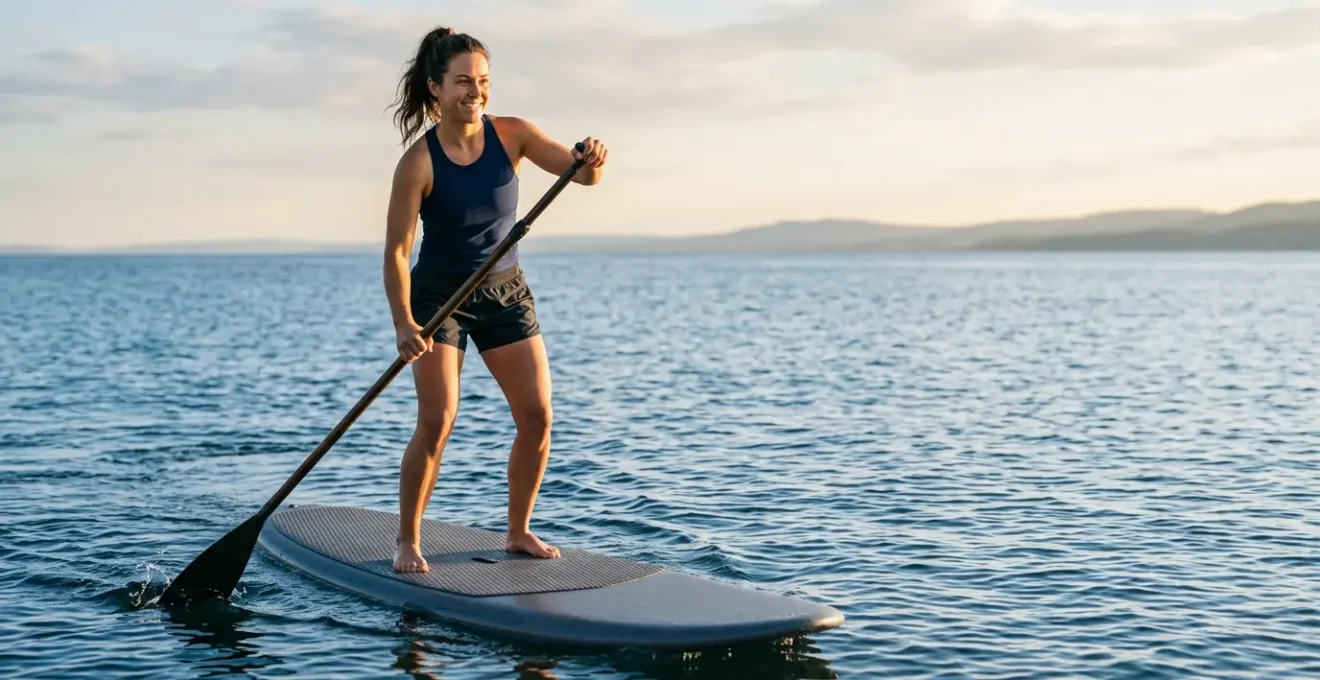
The secret to paddleboard stability isn’t just ‘balance’; it’s understanding how to use your core to create 360-degree tension that works with the water, not against it.
- Falling is caused by over-correcting; success comes from tiny, continuous micro-adjustments.
- ‘Sucking in’ your stomach is a critical mistake that raises your center of gravity and ruins stability.
Recommendation: Before you even get on the water, practice the ‘core bracing’ technique described in this guide. It’s the one skill that separates a wobbly beginner from a confident paddler.
The image is clear in your mind: you, gracefully gliding across a calm lake on a stand-up paddleboard (SUP), sun on your face. The reality, for many, is a frantic, wobbly few seconds followed by a splash and the cold shock of unplanned submersion. The fear of looking foolish, of spending more time in the water than on the board, keeps countless people on the shore. You’ve probably heard the standard advice: “start on your knees,” “look at the horizon,” “use your core.” But these instructions feel hollow when your legs are shaking and the board feels like it’s trying to throw you off.
The problem is that this advice tells you *what* to do, but not *why* or *how*. It treats standing on a board like a static pose, when it’s anything but. This guide is different. We’re going to ignore the platitudes and dive into the physics of stability on an unstable surface. This isn’t just about preventing a fall; it’s about transforming your body’s response to movement. It’s about building real, functional core strength that you can’t get from a thousand floor crunches.
Our angle is simple: standing on a paddleboard isn’t about memorizing steps; it’s about understanding the physics of instability and reprogramming your body’s core to embrace, not fight, the water’s movement. By the end of this article, you won’t just know how to stand up; you’ll understand how to stay up, turn wobbles into a workout, and finally achieve that graceful glide you’ve been dreaming of.
This comprehensive guide will walk you through the essential mechanics, safety considerations, and subtle techniques that make all the difference. Explore the sections below to build your confidence from the ground up.
Summary: Your Guide to Mastering SUP Stability
- Why SUP Tones Your Abs More Effectively Than Floor Crunches?
- How to Hold the Paddle to Avoid Shoulder Strain?
- Inflatable vs Hard Board: Which Is Better for Beginners with Limited Storage?
- The Offshore Wind Danger: Why You Can’t Paddle Back to Shore?
- Problem & Solution: Adjusting Your Feet When the Water Gets Rough
- The ‘Sucking In’ Mistake: Why Pulling Your Stomach In Ruins Stability?
- The UV Exhaustion Factor: Why Sunbathing Makes You Tired?
- Why Proximity to Water Improving Creativity and Sleep Quality?
Why SUP Tones Your Abs More Effectively Than Floor Crunches?
The core workout you get from stand-up paddleboarding is fundamentally different and vastly superior to isolated exercises like crunches. On solid ground, a crunch works a very limited set of muscles in a predictable, two-dimensional plane. On a paddleboard, your body is on a constantly shifting surface, forcing it to make thousands of tiny, unconscious micro-adjustments every minute just to stay upright. This is the essence of dynamic stability.
Every ripple on the water, every gust of wind, and every paddle stroke sends new information to your body. Your deep core muscles—the transverse abdominis, obliques, and multifidus—are forced to fire continuously to counteract these forces. This isn’t a repetitive motion; it’s a sustained, reactive engagement. Scientific studies on unstable surface training back this up, showing that exercises on unsteady platforms trigger intense core activation. A study on core activation found that such movements can activate abdominal muscles at intensities higher than 60% of their maximum contraction, a level of sustained engagement that floor exercises simply cannot replicate.
This image illustrates the deep, textural engagement of core muscle fibers under tension. This is what’s happening beneath the surface as you balance on the board. You are not just building visible “six-pack” muscles; you are forging a deep, functional strength that improves posture, protects your spine, and enhances all other athletic movements. The wobble you feel as a beginner isn’t a sign of failure; it’s the feeling of your core getting the most effective workout of its life.
How to Hold the Paddle to Avoid Shoulder Strain?
A common mistake for beginners is thinking the paddle is just for propulsion. It’s not. It’s your third point of balance, a tool for stability, and a lever for power. Holding it incorrectly is the fastest way to exhaust yourself and risk a painful shoulder injury. The power for your paddle stroke should come from your core, not your arms and shoulders.
Here’s the correct, strain-free grip: one hand should be on the top T-grip, and the other should be on the shaft, roughly a shoulder-width below. A simple way to check your hand spacing is to place the paddle on top of your head; your elbows should form a 90-degree angle. This “box” shape is your power frame. When you paddle on the right side of the board, your left hand is on the T-grip and your right hand is on the shaft. When you switch sides, your hands switch roles.
The crucial technique is to think of your arms and paddle as a fixed triangle. To paddle, you rotate your torso and push the T-grip hand forward, planting the blade fully in the water. Then, you unwind your torso, pulling the blade back. Your arms are just struts; the power comes from the large muscles of your back and core. Your shoulders should feel relatively relaxed. If you feel a burning sensation in your deltoids, you are “arm paddling” and need to focus more on twisting from your midsection. This not only prevents injury but also translates that deep core engagement we talked about into forward momentum.
Inflatable vs Hard Board: Which Is Better for Beginners with Limited Storage?
Choosing your first board can be daunting, but for most beginners, especially those with limited space, the answer is increasingly clear: an inflatable SUP (iSUP). Modern inflatable technology has come a long way. When inflated to the proper pressure (typically 15+ PSI), they become incredibly rigid and offer a surprisingly stable platform that is often more forgiving for beginners than a hard board.
The key advantage of an iSUP is its forgiving nature. It sits slightly higher on the water and has a bit more “give,” which helps absorb the water’s texture and dampen the small, intimidating vibrations that can make a beginner feel unstable on a rigid epoxy board. Furthermore, for those struggling with balance, wider is better. Many experts recommend that beginners choose boards that are at least 34 inches wide for maximum stability. This width is commonly found in all-around inflatable models designed for learning.
Of course, the most significant benefit for anyone not living on a private dock is storage and portability. A hard board requires a 9-12 foot space, a roof rack for your car, and is cumbersome to carry. An iSUP, once deflated, rolls up into a large backpack that can be stored in a closet and easily transported in the trunk of any car. For a beginner, removing these logistical barriers is a huge step toward getting on the water more often. The following table breaks down the key differences:
| Feature | Inflatable Board | Hard Board |
|---|---|---|
| Stability (Beginner) | High – wider platforms (30-34 inches), forgiving | Moderate – requires proper sizing and technique |
| Storage | Compact – rolls into backpack size | Requires 9-12 feet of dedicated space |
| Proprioceptive Feedback | Dampened – absorbs water texture, easier balance | Direct – transmits every ripple for detailed sensory input |
| Rigidity Requirement | 15+ PSI needed for workout effectiveness | Inherently rigid structure |
| Fitness Progression | Ideal for mastering basics and building core confidence | Greater balance challenge, intensifies advanced workout |
| Portability | Excellent – lightweight when deflated | Heavy and cumbersome to transport |
The Offshore Wind Danger: Why You Can’t Paddle Back to Shore?
While calm, glassy water is the ideal, every paddler must respect the power of wind. An offshore wind—one that blows from the land out to the sea—is the single most dangerous condition for a SUP enthusiast. Your body and board act like a sail. What starts as a gentle breeze pushing you along can quickly become an impossible force to paddle against, leaving you stranded and drifting further from shore. Safety guidelines are clear: beginners should avoid wind speeds higher than 10 knots (11.5 mph).
The Royal National Lifeboat Institution (RNLI), a leading authority on water safety, puts it in stark terms:
Offshore winds will quickly blow you and your paddleboard far out to sea, which can make it extremely tiring and difficult to paddle back to shore.
– Royal National Lifeboat Institution (RNLI), RNLI Stand-up Paddleboarding Safety Guide
If you get caught unexpectedly, standing up is the worst thing you can do, as it maximizes your wind profile. You must immediately reduce your center of gravity and the surface area you present to the wind. Knowing the proper emergency procedure is not optional; it’s a critical life-saving skill.
Your Action Plan: Emergency Paddling in High Wind
- Immediately drop to a kneeling position to lower your center of gravity and reduce your wind profile by up to 50%.
- If kneeling fails to allow forward progress, transition to a prone position by lying flat on your stomach.
- Place the paddle shaft under your chest and paddle surfboard-style, using your arms in alternating strokes.
- Keep your body as low as possible. The prone position allows the wind to pass harmlessly overhead.
- Practice this prone paddle maneuver in calm conditions so the muscle memory is there when you truly need it.
Problem & Solution: Adjusting Your Feet When the Water Gets Rough
You’ve done it. You’re standing, you’re stable, and you’re paddling on calm water. Then, a boat passes, or the wind picks up, and the water surface changes from glass to a choppy, unpredictable mess. Your instinct is to freeze, to tense up. This is the moment most beginners fall. The solution lies in your feet and your knees. You must transition from a static stance to a dynamic, ready position.
On calm water, your feet should be parallel, about hip-width apart, and centered around the board’s carry handle. Your knees should have a slight, soft bend. When the water gets rough, you need to widen that stance slightly for a more stable base. More importantly, you must sink your weight lower by bending your knees more. Think of your legs as the suspension system of a car; they need to be able to absorb the bumps (or in this case, the chop) to keep the chassis (your torso and head) stable.
As the board pitches and rolls beneath you, allow your ankles, knees, and hips to move with it. Do not fight the movement. Your upper body should remain relatively still and aligned over your feet, with your gaze fixed on the horizon. Trying to keep your legs rigid is what will topple you. By embracing a flexible, “surfer’s stance,” you allow the board to move freely under you while your core maintains your upright position. It’s another example of dynamic stability: staying balanced *through* movement, not by resisting it.
The ‘Sucking In’ Mistake: Why Pulling Your Stomach In Ruins Stability?
Here is perhaps the most important—and most counter-intuitive—piece of advice in this entire guide. When an instructor tells you to “engage your core,” what do you do? Most people instinctively suck their belly button in toward their spine. This is a technique called “hollowing,” and on a paddleboard, it is a recipe for disaster. While hollowing does activate some deep abdominal muscles, it catastrophically compromises your stability.
Hollowing restricts the movement of your diaphragm, leading to shallow chest breathing. More critically, it pulls your mass inward and upward, raising your center of gravity and making you top-heavy. It creates a rigid, fragile structure. Instead, you need to learn to “brace.” Bracing is the technique used by powerlifters before a heavy squat or by martial artists before impact. It involves creating 360-degree tension around your midsection, as if you were preparing for someone to gently punch you in the stomach. You’re not sucking in; you’re pushing out slightly against a tight belt. This action pressurizes your entire core, lowers your center of gravity, and turns your torso into a solid, stable cylinder.
This braced position provides immense support for your spine and, crucially, connects your upper and lower body into a single, powerful unit. As one fitness expert explains, hollowing might feel like you’re doing something, but it’s bracing that provides true stability under load. This is the “core engagement” you need on a paddleboard. You can practice this right now.
- Lie on your back with your knees bent and feet flat on the floor.
- Place one hand on your chest and the other on your belly.
- Breathe in through your nose. Your goal is for only the belly hand to rise; the chest hand should remain relatively still. This is diaphragmatic breathing.
- Once you’ve mastered this, add the bracing cue: as you breathe, gently tense your stomach muscles as if preparing for a light impact.
- Feel the 360-degree expansion around your torso—front, sides, and back. It should feel solid, not hollowed out or vacuumed in.
Key takeaways
- True core stability on a SUP comes from ‘bracing’ (360-degree tension), not ‘hollowing’ (sucking in your stomach).
- Your paddle is a tool for balance and core-driven power, not just arm-paddling; proper grip is essential to avoid shoulder strain.
- In an offshore wind emergency, immediately drop to your knees or lie prone to reduce your wind profile and paddle back to safety.
The UV Exhaustion Factor: Why Sunbathing Makes You Tired?
You might think of exhaustion on the water as purely a result of paddling, but a significant and often overlooked factor is the sun itself. Prolonged exposure to UV radiation causes a cascade of physiological responses that lead to fatigue, a phenomenon sometimes called “sun-induced lethargy.” Your body expends significant energy to cool itself down through sweating and to repair the cellular damage caused by UV rays. This process diverts resources that would otherwise be available for muscle function.
Dehydration is a major component of this. You lose fluids not only through exertion but also through the body’s thermoregulation process. Even mild dehydration can lead to a noticeable decrease in performance, concentration, and coordination—all of which are critical for staying balanced on a paddleboard. This solar-induced fatigue is then compounded by environmental factors. For example, if you’re paddling against even a moderate wind, your energy expenditure skyrockets. Studies show that paddling in wind speeds over 15 mph requires up to 30% more energy than paddling in calm conditions.
This is why proper sun protection is not just about preventing sunburn; it’s about preserving your energy and performance. Wearing a lightweight, long-sleeved UPF shirt, a wide-brimmed hat, and polarized sunglasses, while consistently hydrating, will do more for your endurance than you might realize. It ensures the energy you have is spent on paddling and balancing, not on fighting off the debilitating effects of the sun.
Why Proximity to Water Improving Creativity and Sleep Quality?
The benefits of stand-up paddleboarding extend far beyond the physical. There’s a profound psychological effect that comes from being on, in, or near water, a concept author Wallace J. Nichols termed “Blue Mind.” This is a mildly meditative state characterized by a sense of calm, peace, and general happiness. SUP is a perfect vehicle for achieving this state because it demands a unique kind of focus.
The act of balancing on an unstable surface forces your brain to process a constant stream of proprioceptive signals—non-verbal information about your body’s position in space. To manage this data flow, your brain enters a “flow state.” The prefrontal cortex, the part of your brain responsible for obsessive thoughts and your “inner critic,” quiets down. You’re not thinking about work or worrying about your to-do list; you are entirely present in the moment, focused on the subtle interplay between your body, the board, and the water.
The Neurological Reset of Balance Training
The intense focus required for balance training on a paddleboard quiets the prefrontal cortex, reducing anxiety and cortisol levels. The sustained core engagement activates the sympathetic nervous system (fight or flight) during the activity, which is then followed by a strong parasympathetic activation (rest and digest) induced by the calming water environment. This pattern of activation and subsequent relaxation creates an optimal reset for the entire nervous system, a pattern that is crucial for promoting restorative sleep and allowing for creative, non-linear thinking to emerge.
This neurological reset is why a good paddle session can leave you feeling both physically tired and mentally refreshed. It’s why ideas seem to pop into your head on the water and why you might experience some of the best sleep of your life after a day of paddling. You’re not just exercising your body; you’re cleansing your mental palate, reducing stress at a chemical level, and creating the perfect conditions for both creativity and deep rest to flourish.
Now that you understand the mechanics of balance, the importance of core bracing, and the right way to approach your first time on the water, the only thing left is to do it. Start on calm water, remember to brace, and be patient with yourself. The journey from wobbly beginner to confident paddler is a rewarding one, both for your body and your mind.