True survival competence isn’t about the gear you carry; it’s about understanding the fundamental principles of heat, shelter, and human physiology.
- Your first priority is always regulating core body temperature, as exposure is a more immediate threat than hunger or thirst.
- Essential tools like a fixed-blade knife are chosen for their reliability in critical tasks like processing damp wood for a fire.
- Mental preparedness is the foundation, allowing you to make clear decisions and apply skills effectively under extreme stress.
Recommendation: Shift your focus from accumulating gear to mastering core concepts like the ‘Rule of Threes’ and how to counter your body’s flawed instincts in the wild.
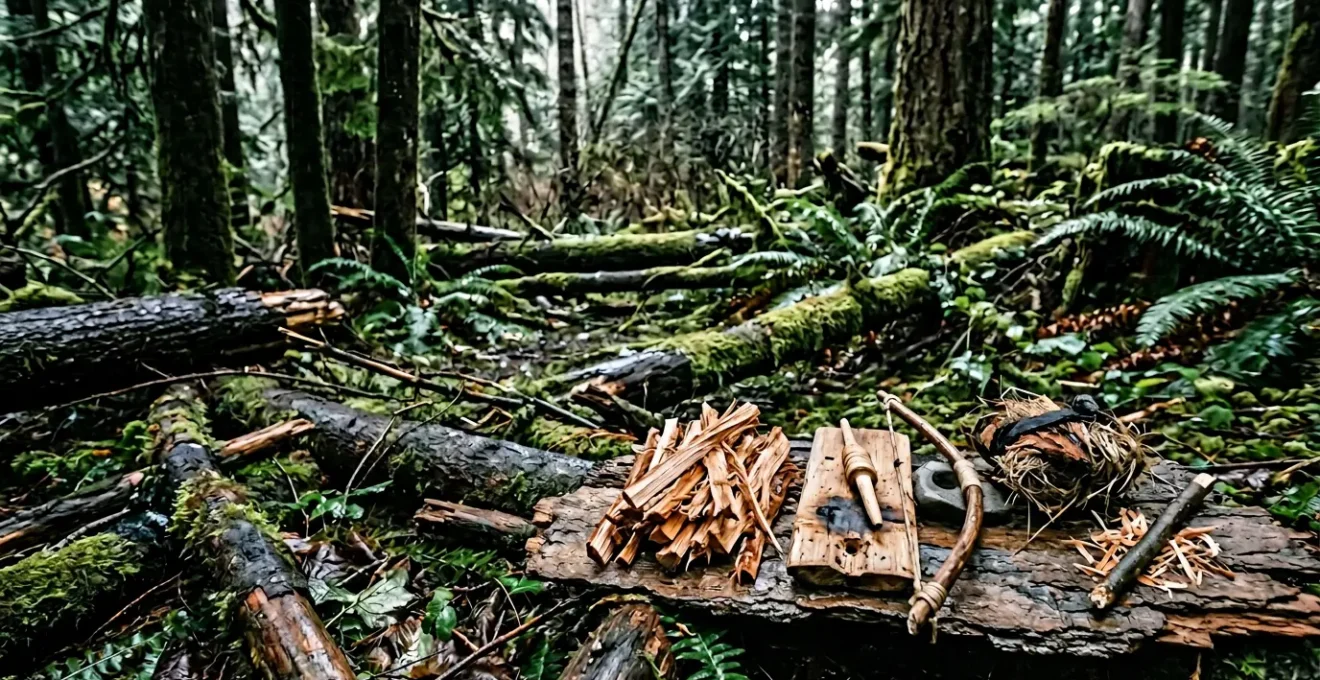
The scenario is a classic fear for any outdoor enthusiast: you are caught out, the temperature is dropping, and a relentless drizzle has soaked everything. You have no matches, no lighter. The ability to create fire in this moment is not a hobbyist skill; it’s the critical line between a manageable night and a life-threatening emergency. Most guides will give you a simple checklist: find tinder, get a spark, build it up. But this approach fails when every piece of potential fuel is damp.
The real secret to fire in the wet has little to do with luck or finding that one-in-a-million dry spot. It is about understanding and applying the physics of moisture and heat. It’s about methodically building a ‘heat engine’—a fire structure so efficient it creates its own dryness, turning damp wood into viable fuel. This requires moving beyond a simple checklist and mastering the principles of survival.
This guide will not just show you what to do; it will explain why you are doing it. We will deconstruct the core priorities of survival, from immediate shelter to long-term mental fortitude. By understanding these foundational pillars, you will gain the confidence to handle not just making a fire, but any unexpected challenge the wilderness presents.
This article provides a structured approach to wilderness self-reliance, covering the essential priorities and skills needed to survive. The table of contents below outlines your path to mastering these concepts.
Table of Contents: A Guide to Essential Wilderness Survival Skills
- Why Shelter Always Takes Priority Over Food in Survival Situations?
- How to Filter Turbid Water Using Natural Materials Found in the Woods?
- Folding vs Fixed Blade: Which Knife Can Handle Batoning Wood?
- The ‘Cotton Kills’ Warning: Why Jeans Are Dangerous in the Wild?
- When to Move vs When to Stay Put: The 72-Hour Decision Protocol
- The Thirst Mechanism Failure: Why You Don’t Feel Thirsty at Altitude?
- Why Disconnecting From Tech in the Wild Triggers Withdrawal Anxiety?
- How to Prepare Mentally for a Multi-Day Expedition in Remote Terrain?
Why Shelter Always Takes Priority Over Food in Survival Situations?
In a survival situation, your instincts will scream for food and water. This is a dangerous cognitive trap. The most immediate and relentless threat in most environments is exposure to the elements. Your body’s ability to regulate its core temperature is the first domino that, if it falls, makes all other efforts futile. This is why shelter is, without exception, your number one priority.
The “Rule of Threes” is a foundational survival mnemonic that puts these priorities into a stark, unforgettable context:
- You can survive for 3 minutes without air.
- You can survive for 3 hours without shelter in extreme conditions.
- You can survive for 3 days without water.
- You can survive for 3 weeks without food.
This framework makes it clear: a drop in core body temperature can incapacitate you in hours, long before dehydration becomes critical. Hypothermia is not just a risk in freezing weather; it can occur in cool, damp conditions, especially when you are wet and fatigued. It impairs judgment and fine motor skills, making it impossible to perform other survival tasks like building a fire or signaling for help. In the United States alone, exposure to cold is a contributing factor in approximately 1,200 fatalities each year, a grim reminder of its lethality.
Therefore, your first actions must be dedicated to creating a moisture barrier and insulation from the environment. This could be a simple lean-to, a debris hut, or even just a thick bed of pine boughs to get you off the cold, wet ground. Securing shelter stabilizes your condition, conserves precious energy, and provides a protected space from which you can then address your other needs, like water and, eventually, fire.
How to Filter Turbid Water Using Natural Materials Found in the Woods?
Once your immediate need for shelter is addressed, the three-day clock on dehydration begins to tick. Finding a water source is the next step, but a running stream or murky pond is not safe to drink from directly. It will be full of sediment, leaf litter, and invisible pathogens. While boiling is the only way to guarantee water is purified, you must first filter out the turbidity (the suspended particles). A clear water boils faster, tastes better, and is a sign you’ve removed the first layer of contaminants.
You can construct a surprisingly effective filter using only materials found around you. The principle is to create a series of layers, from coarse to fine, that trap progressively smaller particles. You will need a container, such as a piece of bark rolled into a cone, a hollowed-out log, or even a section of your clothing (though this should be a last resort).
As the illustration demonstrates, the system relies on gravity and a multi-stage process. Start by building your filter layers in reverse order within your container:
- Bottom Layer (Outlet): A small plug of grass or moss to prevent your finer materials from washing out.
- Fine Layer: A thick layer of sand. This is your primary filter for fine silt.
- Charcoal Layer: A layer of charcoal crushed from an old, cold fire pit. Charcoal is an excellent adsorption agent, helping to remove some impurities and improve taste.
- Coarse Layer: Small pebbles or crushed rock. This layer catches larger debris like leaves and twigs.
- Top Layer (Inlet): A layer of larger stones or a piece of cloth to diffuse the water as you pour it in, preventing it from disturbing the layers below.
Pour the turbid water slowly onto the top layer. The first few outputs will likely be discolored with sand and charcoal dust; discard this water. After a few passes, the water should run significantly clearer. Remember: filtration is not purification. The water still contains bacteria and viruses. You must boil it for at least one minute before it is safe to drink.
Folding vs Fixed Blade: Which Knife Can Handle Batoning Wood?
Your knife is arguably the most important survival tool you can carry. It is instrumental in building shelter, making tools, and, crucially, preparing firewood. When all the wood around you is wet on the outside, your only path to dry fuel is to split open logs and branches to access the dry core. This technique, known as batoning, involves placing your knife on the end of a log and striking the spine with another piece of wood (a baton) to drive it through like a wedge.
This action places immense stress on a knife, and it is the single task that most clearly separates a true survival knife from a simple pocket knife. A folding knife, no matter how well-made, has an inherent weak point: the pivot and locking mechanism. Batoning creates both downward and lateral forces that can, and often will, cause the lock to fail or the pivot to break, rendering the tool useless and creating a serious safety hazard.
A fixed-blade knife, especially one with a full-tang construction (where the steel of the blade extends all the way through the handle as a single, solid piece), has no such weakness. It is structurally sound and designed to withstand the repeated shock and prying forces of batoning. The choice between a folding and fixed blade is not a matter of preference; it is a matter of understanding tool physics for a critical survival task.
This comparative table, based on common findings in blade engineering, shows why a fixed blade is the only reliable choice for serious wilderness use. As confirmed by an analysis of knife construction, the structural integrity is the key differentiator.
| Feature | Fixed Blade | Folding Knife |
|---|---|---|
| Structural Integrity | Full-tang construction with no weak points | Pivot point creates inherent weakness |
| Batoning Capability | Can handle batoning, chopping, prying without failure | Pivot and lock are potential failure points under stress |
| Failure Risk | Virtually indestructible under normal use | Lock mechanism can fail; excessive lateral force damages pivot |
| Maintenance | No moving parts to clean or lubricate | Dirt and debris can gum up mechanism |
| Deployment | Instant – no fumbling with locks | Requires opening mechanism |
Case Study: Full-Tang Construction for Demanding Tasks
Survival instructors consistently choose full-tang fixed blades for field use. The design delivers exceptional strength and stability for batoning wood, prying, and other heavy-duty tasks precisely because the steel extends through the entire handle. With no pivot point to fail, they are the ideal choice for demanding outdoor applications where mechanical failure could prove dangerous or even fatal.
The ‘Cotton Kills’ Warning: Why Jeans Are Dangerous in the Wild?
The phrase “cotton kills” is a stark and unforgiving rule in the outdoor community, and for good reason. While comfortable in dry, casual settings, cotton clothing, particularly heavy denim jeans, becomes a deadly liability in a wet, cold survival scenario. This isn’t hyperbole; it’s a matter of thermal dynamics.
Cotton’s danger lies in its cellular structure. The fibers are hydrophilic, meaning they attract and absorb water molecules. Unlike wool or synthetic fabrics which are hydrophobic and push water away, cotton acts like a sponge. This has two catastrophic effects on your ability to regulate body temperature. First, it loses all of its insulating properties when wet. The air pockets between the fibers that normally trap body heat become filled with cold water.
Second, and more dangerously, that water sits directly against your skin, actively pulling heat away from your body through conduction and evaporation. This process is incredibly efficient at chilling you to the core. According to research on outdoor fabric performance, cotton can absorb up to 27 times its own weight in water. When this happens, your body can lose heat up to 25 times faster than it would if you were dry. A person wearing wet cotton will experience a significant drop in core temperature far more rapidly than someone wearing wet wool or synthetics. This is the fast track to hypothermia.
Wearing jeans in the wilderness is a common mistake made by inexperienced hikers. Once wet, they are heavy, restrictive, and take an impossibly long time to dry without an external heat source. They are a constant drain on your body’s “energy budget,” forcing you to burn precious calories just to stay warm. In a survival situation, this is a deficit you cannot afford. Always opt for layers of wool or synthetic materials that wick moisture away from the skin and retain their insulating properties even when damp.
When to Move vs When to Stay Put: The 72-Hour Decision Protocol
You’ve established shelter, secured a water source, and your clothing is appropriate. Now you face one of the most consequential decisions in a survival situation: do you stay where you are and wait for rescue, or do you attempt to self-extract? This choice is not a guess; it should be a calculated decision based on a protocol known as S.T.O.P. (Stop, Think, Observe, Plan).
The default, and statistically safest, action is to stay put. The overwhelming majority of search and rescue (SAR) operations are successful within the first 72 hours. Your last known position is the single most valuable piece of information rescuers have. The moment you begin to move, you erase that starting point and exponentially increase the size of the search area. As the Wilderness Awareness School notes, this simple fact is a powerful argument for staying in one place.
Most people who are lost are found within 24 hours.
– Wilderness Awareness School
Your job, if you stay, is to make yourself as visible as possible. This means creating signals: a smoky fire during the day, a bright fire at night, laying out brightly colored clothing in a clearing, or creating ground-to-air signals like three large piles of rock or branches. You are turning your location into a target for rescuers.
However, there are specific conditions that override the “stay put” rule. You should only consider moving if you are 100% certain of your location and the route to safety, or if staying in your current location presents an immediate, unavoidable danger (like a flash flood zone or lack of any water). Another critical reason to move is if you know for a fact that no one knows where you are and no rescue is coming. In that case, you are your own rescuer. But this decision must be made with a clear head, a map, a compass, and a realistic assessment of your physical ability to make the journey.
The Thirst Mechanism Failure: Why You Don’t Feel Thirsty at Altitude?
One of the most insidious physiological traps in the wilderness, especially at high altitude, is the failure of your own body’s warning systems. We are conditioned to believe that we drink when we feel thirsty. However, at altitude, this fundamental mechanism becomes unreliable, leading to a dangerous state of “voluntary dehydration.”
Several factors contribute to this phenomenon. First, the colder, drier air at higher elevations significantly increases the amount of water you lose through respiration. You can see this as vapor every time you exhale. Your body is losing moisture at an accelerated rate. Second, exposure to cold can cause vasoconstriction (narrowing of blood vessels) in your extremities, which can trick your body’s sensors into thinking you have adequate fluid volume, thus blunting the thirst response.
Your body is becoming dehydrated, but it isn’t sending you the urgent signals you’d expect. The initial symptoms are not thirst, but rather fatigue, headache, and irritability—symptoms often mistaken for simple exhaustion or the early stages of altitude sickness. This creates a vicious cycle: as you become more dehydrated, your blood volume decreases, your heart has to work harder to pump oxygen to your muscles and brain, and the symptoms of altitude sickness worsen. Performance plummets, and more importantly, so does your cognitive function and ability to make good decisions.
The only way to combat this is through disciplined hydration, not intuitive hydration. You must force yourself to drink water regularly, even when you do not feel thirsty. A good rule of thumb in the mountains is to drink small amounts of water constantly throughout the day, aiming for a total intake that is significantly higher than what you would consume at sea level. Monitoring the color of your urine is a more reliable indicator than thirst; pale and plentiful is the goal. Ignoring this principle because “you don’t feel thirsty” is a critical error that can escalate a challenging hike into a medical emergency.
Why Disconnecting From Tech in the Wild Triggers Withdrawal Anxiety?
In the modern world, our brains have been rewired. The constant stream of notifications, updates, and information from our digital devices creates a steady drip of dopamine, the neurotransmitter associated with reward and pleasure. We are conditioned to seek this stimulus. When we enter the wilderness and that stream is abruptly cut off, many people experience a genuine and unsettling form of withdrawal.
This isn’t just a feeling of being “bored.” It’s a low-grade but persistent anxiety. Your brain, accustomed to a specific pattern of external validation and input, suddenly finds itself in a void. It starts searching for the familiar patterns, and when it can’t find them, it can trigger a stress response. This manifests as restlessness, an inability to be still, a constant feeling that you are “missing something,” or an urge to check a device that isn’t even there.
In a survival context, this is more than a minor inconvenience. It’s a direct threat to your most important survival tool: situational awareness. A mind that is distracted and craving stimulus is not a mind that is present in its environment. It fails to notice the subtle signs of changing weather, the track of an animal, the sound of a distant rescue vehicle, or the specific features of the landscape that could help with navigation. You are physically in the wilderness, but your mind is still caught in a digital feedback loop.
Overcoming this requires a conscious effort to recalibrate your attention. It means actively engaging your senses with the present moment. Focus on the feeling of the wind, the smell of the forest floor, the sound of birds, the details of a leaf. This practice, often called mindfulness, is not a spiritual luxury; it is a pragmatic technique for forcing your brain to disengage from its craving for artificial stimulus and re-engage with the reality of your surroundings. It is the process of reclaiming your focus, which is a prerequisite for effective action and clear-headed decision-making in the wild.
Key Takeaways
- The ‘Rule of Threes’ (3 hours without shelter) dictates that protecting your core temperature is your absolute first priority, above all else.
- Your choice of tools is critical; a full-tang fixed-blade knife is essential for tasks like batoning wet wood, where a folding knife would likely fail.
- Your clothing is gear; wearing cotton (“jeans”) is a major liability as it absorbs water and drastically accelerates heat loss, leading to hypothermia.
How to Prepare Mentally for a Multi-Day Expedition in Remote Terrain?
All the physical skills in the world—fire-making, shelter-building, navigation—are useless if the mind controlling them breaks down under pressure. Mental preparedness is the foundation upon which all other survival skills rest. A multi-day expedition into remote terrain is not just a physical challenge; it is a psychological one. You must train your mind with the same discipline you use to train your body.
Effective mental preparation is not about being fearless; it’s about acknowledging potential stress and building systems to manage it. It begins long before you step onto the trail. The first step is contingency planning. Systematically go through “what if” scenarios: What if my primary navigation tool fails? What if I’m injured? What if the weather turns unexpectedly? For each scenario, think through the immediate actions you would take. This process, known as stress inoculation, turns panic-inducing unknowns into manageable problems with pre-planned solutions.
Another key technique is visualization. In the weeks leading up to your trip, spend time vividly imagining yourself successfully navigating challenges. Picture yourself staying calm during a storm, methodically setting up your shelter, and successfully building a fire. This isn’t just daydreaming; it’s creating neural pathways that your brain can access under real stress, making a calm, competent response more automatic.
Your Pre-Expedition Mental Readiness Checklist
- Contingency Plan: List your top 3 potential emergencies (e.g., injury, getting lost, gear failure) and write down the first 3 action steps for each.
- Knowledge Audit: Identify one skill you feel weak in (e.g., knot tying, map reading) and dedicate time to practice it before you leave.
- Fear Assessment: Honestly write down what you are most afraid of on this trip. Next to it, write down what is within your control to mitigate that fear.
- Goal Setting: Define a clear objective for the expedition, but also set 2-3 smaller, daily process goals (e.g., “reach camp by 3 PM,” “drink 4 liters of water”).
- Communication Plan: Ensure someone knows your exact route and your check-in schedule. This removes the psychological burden of being completely unaccounted for.
Ultimately, mental toughness in the wilderness comes from a deep-seated confidence in your training and preparation. It’s the quiet knowledge that you have the skills to solve problems and a plan for when things go wrong. This proactive mindset is what transforms a potentially terrifying experience into a challenging but manageable adventure.
This mental training is not a one-time event; it is an ongoing practice. Before your next trip, don’t just pack your bag—prepare your mind. It is the sharpest, most reliable, and most important tool you will ever carry into the wild.