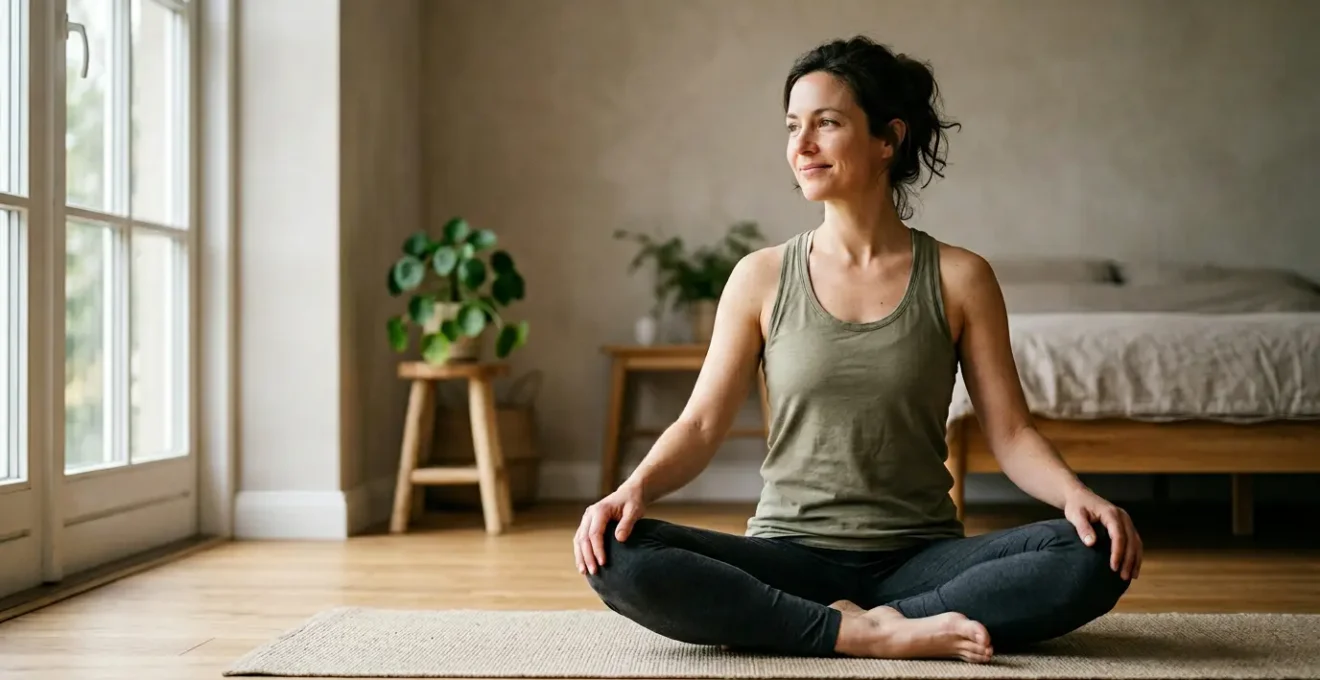
The secret to easing morning stiffness isn’t forcing a deep stretch, but using gentle movement to lubricate your joints from the inside out.
- Morning movement stimulates synovial fluid, acting as a natural lubricant for stiff joints, which is more effective than passive stretching.
- Adapting poses to protect vulnerable areas like wrists and knees is crucial for building a safe and sustainable practice.
Recommendation: Start with a 5-minute dynamic flow focused on joint rotation and activation, not on how far you can stretch.
Waking up with a body that feels tight, rigid, and uncooperative is a frustratingly common experience. The immediate thought for many is, “I need to stretch,” followed quickly by, “But I’m too stiff to even start, and I don’t have the time.” This paradox keeps so many people from discovering the profound benefits of a morning movement routine. You might think yoga is reserved for the naturally flexible, but the truth is the exact opposite: yoga is the tool you use to cultivate mobility.
Many beginner guides will give you a list of static poses, suggesting you hold them to “increase flexibility.” While well-intentioned, this approach can miss the point, especially for a body that’s just woken up. The stiffness you feel isn’t just tight muscles; it’s a lack of lubrication in your joints. But what if the key wasn’t to pull on those stiff muscles, but to gently “wake them up” and encourage your body to produce its own internal mobility fluid? This is a fundamental shift in perspective. It’s not about forcing your body into a shape, but about initiating mindful movement to create space and ease from within.
This guide is designed for you—the person who is stiff, short on time, and maybe a little intimidated. We won’t focus on achieving perfect-looking poses. Instead, we’ll explore the ‘why’ behind the movements. You’ll learn how to hydrate your joints, modify poses for your body, and listen to your internal energy cues to create a 15-minute practice that feels genuinely good and sets a positive tone for your entire day.
To help you navigate this gentle approach, this article is structured to build your confidence and knowledge step by step. Below is a summary of the key areas we will explore to help you establish an effective and enjoyable morning routine.
Table of Contents: A Gentle Path to Morning Mobility
- Why Movement Hydrates Your Joints Better Than Water in the Morning?
- How to Modify Sun Salutations for Wrists That Hurt?
- Energizing Backbends vs Grounding Folds: Which Flow Suits Your Morning Mood?
- The ‘Locking Knees’ Mistake That Damages Joints in Standing Poses
- Before or After Coffee: When Is the Best Time for Morning Yoga?
- Strength or Stretch: What Actually Fixes Rounded Shoulders?
- How to Use Morning Sunlight to Reset Your Cortisol Rhythm?
- Why Static Stretching Before Running Actually Increases Injury Risk?
Why Movement Hydrates Your Joints Better Than Water in the Morning?
That feeling of creakiness when you first get out of bed isn’t just in your head. During periods of stillness, like sleep, the fluid within your joints can become thicker and less distributed. Many people believe that aggressive stretching is the answer, but the real solution is more subtle and intelligent. Think of your joints like sponges. To get a dry, stiff sponge to become pliable, you don’t just pull on it; you gently squeeze and release it in water. Your joints work in a similar way.
The cartilage that lines the ends of your bones relies on a substance called synovial fluid for nourishment and lubrication. This fluid is rich in hyaluronan, which gives it a viscous, egg-white-like consistency, perfect for reducing friction. However, this fluid doesn’t have its own pump. Its circulation is driven by movement. When you gently flex and extend a joint, you are quite literally squeezing old fluid out of the cartilage and drawing fresh, nutrient-rich fluid back in. This process of “imbibition” is what eases stiffness and promotes long-term joint health.
Case Study: Movement-Stimulated Fluid Secretion in Osteoarthritis
This principle is so powerful that it’s used therapeutically. A study on osteoarthritis patients highlighted how critical movement is for joint health. It found that joint immobilization led to a lower concentration of lubricating hyaluronan in the synovial fluid, increasing friction. Conversely, as detailed in an analysis on exercise therapy, flexion and extension movements stimulated the release of this fluid, improving symptoms and providing a clear rationale for using gentle motion as medicine for morning stiffness.
So, when you perform gentle morning movements like Cat-Cow or slow, mindful circles with your ankles and wrists, you aren’t just stretching muscles. You are actively participating in the hydration and nourishment of your entire skeletal system. This is why a short, dynamic flow can feel so much more effective than holding a few static stretches.
How to Modify Sun Salutations for Wrists That Hurt?
Sun Salutations are a cornerstone of many yoga practices, but for beginners, they often introduce an immediate obstacle: wrist pain. The repeated transition into poses like Plank and Downward-Facing Dog can place a significant amount of weight on these small, complex joints, especially if your body isn’t accustomed to it. This discomfort isn’t a sign that you should avoid these movements, but rather a signal to learn how to modify them intelligently.
The most common mistake is “dumping” weight into the heel of the hand, which compresses the carpal tunnel. The key is to distribute that weight across the entire surface of the hand, creating a stable and active base. Imagine your hands have suction cups on them, lightly gripping the mat. This requires active engagement, not passive leaning. The image below shows the ideal hand position, with fingers spread wide and pressure evenly applied through every knuckle and fingertip.
Beyond proper hand placement, there are several effective ways to take pressure off your wrists entirely. You don’t have to skip the flow; you just need to choose a different path. Instead of a traditional Plank, you can lower to your forearms. Instead of Downward-Facing Dog, you can practice Dolphin pose, which builds incredible shoulder strength while giving your wrists a complete break. Another powerful option is to make fists and press your knuckles into the floor in poses like Tabletop. This keeps the wrist in a neutral position, bypassing the strain of extension. Remember, the goal of yoga is to work with your body, not against it.
Energizing Backbends vs Grounding Folds: Which Flow Suits Your Morning Mood?
Not all mornings are created equal. Some days you wake up feeling sluggish and needing a boost, while on others you might feel anxious and scattered, craving calm. Your morning yoga practice can be a powerful tool to meet your energy where it is, but only if you understand how different types of movement affect your nervous system. The two primary categories of poses—backbends and forward folds—have distinctly different effects.
Backbends, like Cobra or Upward-Facing Dog, are natural stimulants. They open up the front of the body, expand the chest, and encourage a fuller inhale. This physical opening sends a signal to your sympathetic nervous system, the “fight or flight” branch responsible for alertness and energy. A flow focused on gentle backbends can be the perfect replacement for that first cup of coffee, creating a sense of uplift and motivation for the day ahead.
Conversely, forward folds, such as Child’s Pose or a simple standing forward bend, are inherently calming. They gently compress the front body, encouraging a longer, slower exhale and turning your awareness inward. This action activates the parasympathetic nervous system, the “rest and digest” branch that promotes relaxation and reduces stress. If you wake up with a racing mind or feeling of overwhelm, choosing a sequence that emphasizes these grounding poses can help soothe your system and create a sense of peace.
The following table, based on common yogic principles and breath anatomy, breaks down these differences to help you make a conscious choice each morning.
| Aspect | Backbends (e.g., Cobra) | Forward Folds (e.g., Child’s Pose) |
|---|---|---|
| Nervous System Effect | Stimulate sympathetic nervous system | Activate parasympathetic nervous system |
| Energy Quality | Energizing, stimulating, upward movement | Calming, grounding, inward focus |
| Breathing Pattern | Fuller, slightly faster inhales | Longer, slower exhales |
| Mental State | Alertness, openness, outward energy | Introspection, relaxation, stress relief |
| Best For | Sluggish mornings, low energy, need for motivation | Anxious mornings, scattered mind, overstimulation |
| Physical Focus | Opens chest, stretches front body, extends spine | Stretches back body, calms digestive system |
The ‘Locking Knees’ Mistake That Damages Joints in Standing Poses
In standing poses like Triangle or even Mountain Pose, beginners often receive the cue to “straighten your legs.” This is frequently misinterpreted as pushing the knees back as far as they will go, a habit known as hyperextension or “locking” the knees. While it might feel stable, this posture is one of the most common and potentially damaging mistakes in yoga. It bypasses muscular support and instead hangs your body weight directly on the ligaments and the delicate structures of the knee joint.
When you lock your knees, you’re not engaging your muscles. You’re simply relying on the passive structure of your joint to hold you up. This creates instability and puts undue stress on the ligaments that are meant to act as emergency brakes, not primary support. In fact, standing in this way puts excess pressure on your heels and the front of your shins, and if pushed with enough force, can strain or even tear the anterior cruciate ligament (ACL), according to research on knee biomechanics. The solution is not to keep the knees deeply bent, but to cultivate active engagement.
The goal is to create a “micro-bend” in the knee—a slight softness that keeps it from locking—and then actively co-contract the muscles of the thigh (quadriceps and hamstrings) to create stability. This feels like you are “hugging the bone” with your muscles. This creates a strong, supported leg that protects the joint while still achieving the full expression of the pose. Learning this technique is a game-changer for building a safe and strong practice.
Action Plan: Safeguard Your Knees from Hyperextension
- Initiate Engagement: Start by slightly bending the knee in any standing pose. This takes you out of the locked position and forces your muscles to turn on.
- Engage Hamstrings: Without actually moving your foot, attempt to isometrically ‘drag’ or ‘scrub’ your front foot backward on the mat. You will feel the back of your thigh (hamstrings) immediately engage.
- Engage Quadriceps: While maintaining that hamstring tension, now actively engage the front of your thigh (quadriceps) as if you are straightening the leg.
- Co-contract to Stabilize: The key is to maintain both actions at once. This co-contraction of both hamstrings and quadriceps creates a powerful muscular support system that stabilizes the femur and protects the knee joint from moving into a damaging hyperextended state.
Before or After Coffee: When Is the Best Time for Morning Yoga?
For many, the morning doesn’t truly begin until the first sip of coffee. So, a practical question naturally arises: should your yoga practice come before or after your caffeine ritual? The answer depends entirely on your personal constitution and the type of practice you’re aiming for. There is no single “right” way, but understanding the effects of each choice can help you decide what’s best for you.
Practicing yoga before coffee allows you to connect with your body’s natural state. You get a clearer baseline of your energy levels, your stiffness, and your mental state without any external stimulants. This can lead to a more intuitive and mindful practice, where you are truly listening to what your body needs. For those who chose a grounding flow to calm an anxious mind, practicing pre-coffee is almost always the better choice. It allows you to use your breath and movement to self-regulate, rather than introducing a stimulant that might amplify feelings of jitteriness. Furthermore, moving on a relatively empty stomach can feel more comfortable, especially in twists and forward folds.
On the other hand, having coffee before your practice can be beneficial if you wake up feeling particularly sluggish and need a significant boost to get on your mat. The caffeine can increase alertness and may even improve physical performance, allowing you to engage more deeply in an energizing, backbend-focused flow. However, there are downsides. Coffee is a diuretic and can be dehydrating, which is counterproductive when your goal is to hydrate your joints. It can also sometimes lead to a “pushing past your limits” mentality, where the stimulant masks the body’s subtle signals to back off, potentially increasing injury risk. If you choose this option, consider drinking a glass of water first and waiting 20-30 minutes for the coffee to settle.
Strength or Stretch: What Actually Fixes Rounded Shoulders?
Rounded shoulders, or “tech neck,” are a hallmark of modern life, stemming from hours spent hunched over desks and phones. The common instinct is to try and fix this by stretching the chest muscles, which feel tight. While opening the chest is part of the solution, it’s only half the story. Lasting postural change doesn’t come from passively stretching tight muscles; it comes from actively strengthening the weak ones.
Think of your posture as a balancing act. Rounded shoulders occur because the muscles in the front of your body (pectorals) have become tight and short, while the muscles in your upper back (rhomboids, trapezius) have become overstretched and weak. They can no longer do their job of pulling the shoulder blades back and down. Simply stretching the pecs without strengthening the back is like loosening the front ropes on a tent without tightening the back ones—the pole will just fall forward again. You need to address both sides of the equation.
Therefore, an effective yoga practice for rounded shoulders must include two components:
- Openers for the Front Body: Poses like Cobra, Bridge Pose, or holding your arms in a “cactus” shape gently stretch the pectoral muscles and the front of the shoulders, relieving tightness.
- Strengtheners for the Back Body: This is the most crucial and often-neglected part. Poses that require you to actively draw your shoulder blades together are key. Think of Locust Pose (Salabhasana), where you lift everything off the floor, or the arm variations in Warrior III. Even in Downward-Facing Dog, the action of externally rotating the upper arms and drawing the shoulder blades down the back is a powerful strengthener.
The goal is to re-educate your muscles. By consistently strengthening the upper back, you give it the endurance to maintain an upright posture throughout the day, making good posture your body’s new default setting, not something you have to constantly think about.
How to Use Morning Sunlight to Reset Your Cortisol Rhythm?
Your morning yoga practice can be even more powerful when you pair it with another potent natural signal: sunlight. Your body’s internal clock, or circadian rhythm, is profoundly influenced by light exposure. This rhythm governs the release of various hormones, including cortisol, which plays a key role in your energy and stress levels.
Cortisol often gets a bad rap as the “stress hormone,” but it’s not inherently bad. In a healthy cycle, you experience a natural cortisol spike within 30-60 minutes of waking. This is what helps you feel alert, focused, and ready to tackle the day. However, modern lifestyles—with indoor lighting and inconsistent sleep schedules—can disrupt this rhythm, leading to a blunted morning spike (feeling groggy) and elevated levels at night (difficulty sleeping). Morning sunlight is the most powerful tool for resetting this system.
When light, particularly the blue light spectrum abundant in morning sun, hits the retina in your eyes, it sends a direct signal to a part of your brain called the suprachiasmatic nucleus (SCN). This is your body’s master clock. This signal tells the SCN that the day has begun, triggering the healthy release of cortisol and anchoring your entire 24-hour hormonal cycle. Combining this with your yoga practice is simple but incredibly effective. If possible, do your 15-minute routine near a window where you can get indirect or direct sunlight. You don’t need to be staring at the sun; just being in a brightly, naturally lit space is enough.
This simple act of pairing movement with light does two things. The movement itself helps to mobilize energy and reduce feelings of sluggishness, while the sunlight provides the crucial hormonal cue for wakefulness. Together, they create a synergistic effect, promoting a vibrant, alert morning state and helping to ensure that your cortisol levels naturally decline toward the evening, paving the way for restful sleep.
Key Takeaways
- Morning movement is about joint lubrication through synovial fluid circulation, not aggressive stretching.
- Protect your joints by actively engaging muscles (e.g., in hands and around knees) rather than passively hanging on ligaments.
- Tailor your practice to your daily energy by choosing stimulating backbends for sluggishness or calming forward folds for anxiety.
Why Static Stretching Before Running Actually Increases Injury Risk?
The long-held belief that you should perform deep, static stretches (holding a stretch for 30 seconds or more) before a dynamic activity like running or even a flow-based yoga class is being overturned by modern sports science. While it seems counterintuitive, extensive research now shows that this type of passive stretching on “cold” muscles can actually be detrimental. It can temporarily decrease muscle power, reduce stability, and may even increase your risk of injury.
When you hold a static stretch, you are sending a signal to your muscles and nervous system to relax and lengthen. This can temporarily inhibit the muscle’s ability to contract forcefully and quickly, which is exactly what you need for dynamic activities. It’s like stretching a rubber band to its limit and holding it there; it loses some of its immediate springiness. For a runner, this can mean a less efficient stride and reduced power output. For a yogi moving through a Sun Salutation, it can mean less muscular support around the joints when transitioning between poses.
The far safer and more effective approach is to perform dynamic warm-ups. This involves moving your body through a full range of motion in a controlled, rhythmic way. These movements, like leg swings, torso twists, or a gentle Cat-Cow sequence, do several things at once:
- They increase blood flow to the muscles, warming them up.
- They stimulate the nervous system, preparing it for activity.
- They lubricate the joints with synovial fluid, as we discussed earlier.
- They improve mobility without compromising muscular stability.
This is precisely why a well-designed morning yoga routine is such an ideal warm-up. It’s a form of dynamic movement that prepares the body for the day ahead. Save the deep, static holds for the end of your practice or the end of the day, when your muscles are warm and more receptive to lengthening without compromising their strength and stability.
By shifting your focus from forceful stretching to mindful, dynamic movement, you create a morning practice that is not only safer and more effective but also deeply nourishing. You are working with your body’s natural design to build mobility, energy, and a lasting sense of well-being, one gentle breath at a time.