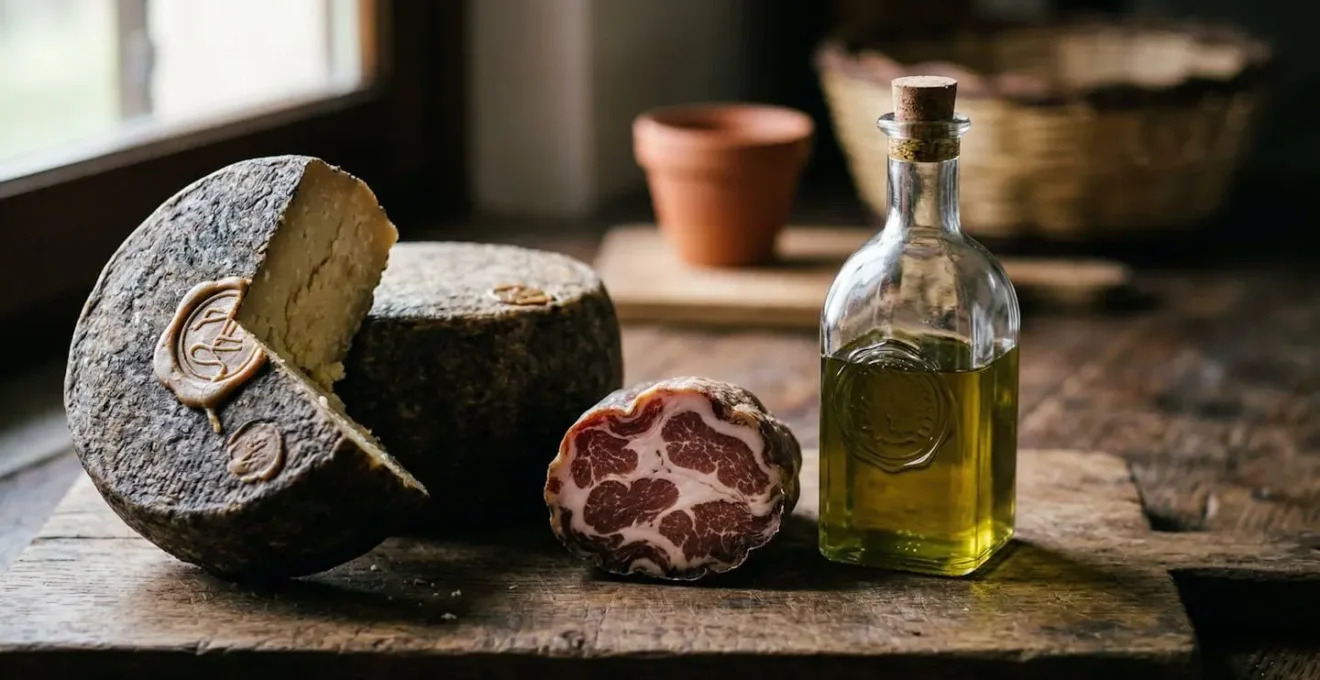
Understanding PDO, PGI, and TSG is only the first step; true quality assurance comes from learning to ‘audit’ the product yourself.
- The labels define a legal framework for origin and method, but the real story of quality is told by the product’s ‘terroir’—the unique impact of its environment.
- Developing ‘product forensic’ skills, like reading batch codes and understanding ingredient choices (e.g., raw vs. pasteurized milk), allows you to verify authenticity beyond the seal.
- Authenticity is a holistic concept that extends from the farm to the table, including the ability to spot ‘tourist trap’ indicators that signal a lack of local integrity.
Recommendation: Use the official labels as a starting point, then apply the ‘auditor’ techniques in this guide to develop a deeper, more reliable sense of product quality and geographic honesty.
Standing in a deli, faced with a wall of cheeses and cured meats, it’s easy to feel overwhelmed. A sea of acronyms—PDO, PGI, TSG—adorns the packaging, each promising a vague notion of “quality” and “authenticity.” The common advice is to simply learn their definitions: one is about the entire process being in one place, another about a single stage, and the third about a traditional recipe. While technically correct, this approach misses the point. It’s like learning the rules of a sport without ever watching a game. You know the theory, but you have no feel for the nuance, the strategy, or the true markers of excellence.
But what if these labels aren’t the final answer, but merely the first clue in a fascinating investigation? What if the real secret to sourcing incredible food lies not in memorizing regulations, but in learning to read the product itself? This is the mindset of a food quality auditor. It’s an approach that goes beyond the seal, using a framework of product forensics to uncover the story of a food’s origin, its production, and its intrinsic character. It transforms you from a passive consumer into an active, discerning connoisseur.
This guide will first clarify the essential definitions of Protected Designation of Origin (PDO), Protected Geographical Indication (PGI), and Traditional Speciality Guaranteed (TSG). However, we will quickly move beyond them. The core of this article is to equip you with the practical, sensory, and analytical skills to assess authenticity for yourself. We will explore how to taste terroir, decipher traceability codes, understand the critical impact of raw ingredients, and even apply these principles to spotting authentic experiences when you travel. It’s time to look beyond the label and discover what truly makes a product exceptional.
Summary: Understanding European Food Quality Seals
- Why Slow-Growth Mountain Cheese Tastes More Complex Than Factory Cheese?
- How to Read the Batch Code to Trace a Product Back to the Farm?
- Raw Milk vs Pasteurized: Which Cheese Offers the True Terroir Experience?
- The Fridge Mistake: Why Cold Storage Kills the Flavor of Cured Meats?
- Problem & Solution: Pairing Regional Foods With Wines From the Same Area
- Why The Same Grape Tastes Different Depending on Soil Composition?
- How to Check Supply Chain Transparency Before Buying a ‘Sustainable’ Tee?
- The ‘Menu in 5 Languages’ Red Flag: Signs a Restaurant Is for Tourists Only
Why Slow-Growth Mountain Cheese Tastes More Complex Than Factory Cheese?
The profound difference in flavor between a mountain cheese and its factory-made counterpart is a direct lesson in the concept of terroir. This French term, which lacks a single-word English equivalent, refers to the complete natural environment in which a food is produced, including factors like soil, climate, and the specific plants that grow there. For cheese, this is not just a romantic notion; it’s a scientific reality. Factory cheese often comes from cows fed a standardized diet of grain and silage, leading to a consistent but one-dimensional milk profile. The goal is efficiency, not complexity.
In contrast, slow-growth mountain cheese originates from animals that graze on natural, biodiverse pastures. As research on alpine cheese terroir demonstrates, high-altitude pastures contain a vastly larger variety of grasses, herbs, and flowers than lowland fields. Each of these plants contributes unique aromatic and flavor compounds to the milk. The cow acts as a natural filter and concentrator for the surrounding ecosystem. This creates a milk that is not just a liquid, but a complex, seasonal snapshot of a specific place—its sensory fingerprint.
Case Study: The Chemical Fingerprint of Alpine Clover
The link between pasture and flavor is not just theoretical. Research on Valdostana alpine cheese from Italy has provided concrete proof. Scientists confirmed that volatile organic compounds from Alpine clover (Trifolium alpinum) are transferred directly into the milk and can be clearly detected in the final aged cheese. Specific fatty acids and hydrocarbons from the clover act as undeniable chemical biomarkers, providing an indelible signature that traces the cheese back to the specific clover-rich meadows where the cows grazed. This is product forensics at a molecular level, proving the cheese is a true expression of its high-altitude terroir.
This complexity from the pasture is then amplified by the cheesemaking process, especially when using raw milk, which carries the unique microflora of its environment. The result is a cheese with layers of flavor—nutty, floral, earthy, spicy—that evolve as it ages and as it warms on the palate. A factory cheese tastes of its process; a mountain cheese tastes of its place.
How to Read the Batch Code to Trace a Product Back to the Farm?
If terroir is the soul of a product, then traceability is its verifiable identity. A genuine PDO or PGI product doesn’t just make a claim; it provides the evidence to back it up. For a food auditor, the batch code and other markings are not just a jumble of numbers and letters; they are a passport that tells the story of the product’s journey from its origin to your hands. Learning to read these codes is a fundamental skill in separating the authentic from the imitation.
These markings can take many forms: a series of stamped numbers on the rind of a cheese, a printed code on a package of cured meat, or a QR code that links to a detailed web page. The goal is the same: to provide an unbroken chain of custody. A strong traceability system allows anyone—a regulator, a retailer, or a curious consumer—to pinpoint the exact production date, the specific facility or farm, and the batch of ingredients used. This transparency is a powerful deterrent to fraud and a core pillar of consumer trust. A product with a vague or missing batch code is a significant red flag.
The most sophisticated systems function as a kind of physical blockchain, where each step of the process is indelibly recorded. This is the ultimate expression of accountability for a producer and the ultimate guarantee for a consumer.
Case Study: The Parmigiano Reggiano “Physical Blockchain”
Parmigiano Reggiano PDO offers a masterclass in traceability. Each wheel is equipped with multiple layers of identification. Within hours of being made, a casein plate with a unique alphanumeric code is applied, permanently embedding the wheel’s “birth certificate” into its structure. This code identifies the specific dairy and production date. The rind is also marked with a dotted pattern spelling out “Parmigiano Reggiano” and including the dairy’s registration number and production month/year. After a minimum 12-month maturation, a Consortium expert inspects the wheel, and only if it passes is the final fire-branded oval seal applied, certifying its PDO status. As explained by the official consortium’s guide, this multi-layered system makes it possible to trace any piece of authentic Parmigiano Reggiano back to its exact origin.
Raw Milk vs Pasteurized: Which Cheese Offers the True Terroir Experience?
The debate between raw milk (lait cru) and pasteurized milk cheese is central to the discussion of authenticity and terroir. From a food auditor’s perspective, the choice of milk is one of the most critical decisions a cheesemaker makes, with profound implications for the final product’s character. Pasteurization, the process of heating milk to kill potentially harmful bacteria, is a safety measure. However, it is an indiscriminate process; it also eliminates the vast and complex community of native, beneficial microorganisms that define a farm’s unique microbial terroir.
Think of pasteurization as a “reset button.” It creates a blank canvas, a neutral base that ensures consistency and a longer shelf life. For industrial-scale production, this is a necessity. Cheesemakers then add back a handful of specific, lab-cultured starter bacteria to begin fermentation. The result is a predictable, safe, and often pleasant cheese, but one that has been largely disconnected from its place of origin. Its flavor profile is a product of the laboratory, not the land.
Raw milk cheese, on the other hand, is a bold declaration of confidence in the quality of the milk and the health of the herd. It carries the complete sensory fingerprint of the farm—not just the flora the animals ate, but also the unique yeasts and bacteria present in the air, in the soil, and on the animals themselves. This native microflora contributes to a far more complex and unpredictable fermentation process, yielding flavors and aromas that are impossible to replicate with pasteurized milk. It is the microbial expression of the Terroir Trinity: the unique interplay of soil, climate, and local biological environment.
For this reason, many of Europe’s most revered cheeses, such as Roquefort and many traditional cheddars and Gruyères, are required by their PDO regulations to be made with raw milk. It is understood that pasteurization would erase the very characteristics that make them unique. Choosing a raw milk cheese is choosing a more direct, unfiltered, and authentic taste of the place it came from.
The Fridge Mistake: Why Cold Storage Kills the Flavor of Cured Meats?
You’ve invested in a beautiful, artisanal prosciutto or salami, a product of time, craft, and quality ingredients. You bring it home and, with the best of intentions, immediately store it in the coldest part of your refrigerator. This, from a sensory perspective, is a critical mistake. While refrigeration is essential for preventing spoilage of fresh meat, it is the enemy of flavor for dry-cured products. Cold temperatures fundamentally alter the physical and chemical properties that make these meats so delicious.
The complex, nutty, and savory aromas of high-quality cured meats are carried by volatile aromatic compounds. As the name suggests, these compounds need to be “volatile”—that is, able to evaporate and travel to the receptors in your nose—for you to perceive them. Cold temperatures suppress this volatility, effectively locking the flavor inside the meat. Furthermore, the rich, melt-in-your-mouth texture of products like Ibérico ham comes from their complex intramuscular fats. When chilled, these fats solidify and become waxy, completely changing the texture and preventing the flavor from properly coating your palate.
The impact of temperature is not just anecdotal. A 2021 study in the journal Molecules found that temperature was the main factor affecting volatile production in dry-cured meats. It showed that higher storage temperatures significantly increased the presence of aromatic aldehydes, ketones, and alcohols that are key to a rich flavor profile. Proper storage for whole cured meats is a cool, well-ventilated space, much like the traditional cellars or curing rooms where they are aged. For sliced products, the rule is simple: remove them from the refrigerator at least 30 minutes before serving to allow them to come to room temperature, letting the fats soften and the aromas awaken.
Problem & Solution: Pairing Regional Foods With Wines From the Same Area
The problem is a familiar one: you’ve prepared a dish with a strong regional character—a rich Boeuf Bourguignon, a delicate plate of Asturian Fabada, or a sharp Pecorino cheese. Now you face the daunting task of choosing a wine from a global selection of thousands. The solution, however, is often deceptively simple and deeply rooted in the concept of terroir: look to the wine from the same region. The old adage, “what grows together, goes together,” is one of the most reliable principles in food and wine pairing.
This is not a coincidence or a matter of mere tradition; it’s a logical consequence of a shared environment. The same soil, climate, and water that influence the character of the local livestock, crops, and cheeses also shape the grapes that grow nearby. A wine from a specific place is the liquid expression of that region’s geology and weather. It has evolved over centuries alongside the local cuisine, creating a natural and often perfect synergy.
For example, the earthy, mineral-rich soils of Burgundy that give its Pinot Noir grapes their characteristic flavor profile are also reflected in the cattle that graze there, making it a natural partner for the local beef in Boeuf Bourguignon. The acidic, high-altitude white wines of the Savoie region in France have the perfect crispness to cut through the rich, fatty fondue made from local Alpine cheeses. The salty, tangy notes of a coastal Greek Assyrtiko wine beautifully complement the fresh, briny seafood caught just offshore. Pairing a regional food with a regional wine is not just a safe bet; it’s a way to experience a more complete and holistic expression of a place’s terroir, where the whole is greater than the sum of its parts.
Instead of trying to find a contrasting flavor from halfway across the world, start by seeking a complementary one from just down the road. You are creating a pairing that is not only delicious but also tells a coherent story of geographic and cultural identity.
Why The Same Grape Tastes Different Depending on Soil Composition?
This question cuts to the very heart of the terroir concept and explains why the world of wine is infinitely complex and fascinating. It is the reason a Chardonnay grape grown in the chalky soils of Champagne, France, produces a wine that is crisp, acidic, and mineral-driven, while the very same grape variety grown in the fertile clay soils of Napa Valley, California, can yield a wine that is rich, buttery, and tropical. The grape’s genetic code is the same, but its expression is entirely dictated by its environment, with soil composition being a primary driver.
Different soil types have dramatically different properties that influence how a grapevine grows and, consequently, how its fruit tastes. Key factors include:
- Water Retention: Clay soils hold water well, which can lead to vigorous growth and potentially diluted flavors. In contrast, sandy or gravelly soils drain quickly, forcing the vine’s roots to dig deeper in search of water. This stress can lead to smaller, more concentrated grapes with more intense flavors.
- Nutrient Availability: Soils rich in certain minerals can impart specific characteristics to the wine. For example, the slate soils of Germany’s Mosel region are often credited with giving Riesling wines their distinctive flinty or “steely” minerality.
- Heat Retention: Dark soils like slate or volcanic rock absorb and radiate heat, helping grapes to ripen more fully in cooler climates. Lighter-colored chalk or limestone soils reflect sunlight, which can also aid ripening and contribute to a wine’s acidic structure.
Ultimately, the soil is not just an inert medium for the vine to stand in; it is an active partner in the creation of flavor. It controls the vine’s access to water and nutrients, influencing everything from the thickness of the grape skins (where tannins and color are found) to the acid-sugar balance in the pulp. Understanding this relationship is fundamental to appreciating why a PDO for a wine, like Chablis or Barolo, is so fiercely protective of its specific, demarcated vineyard areas. They are not just protecting a name; they are protecting a unique and irreplaceable synergy between a grape and its soil.
How to Check Supply Chain Transparency Before Buying a ‘Sustainable’ Tee?
The principles of a food auditor—demanding evidence, verifying claims, and understanding origins—can and should be applied beyond the kitchen. In the world of fashion, the term “sustainable” has become as ubiquitous and often as meaningless as “natural” is in the food industry. Just as a PGI label requires at least one stage of production to be in a specific region, a claim of sustainability requires tangible proof. Your job as a discerning consumer is to look for that proof through the lens of supply chain transparency.
A brand that is genuinely committed to sustainability will not hide its processes. In fact, it will be proud to share them. Vague claims like “made with eco-friendly materials” are red flags. You are looking for specific, verifiable information. The first place to check is the product’s label and the brand’s website. Look for more than just marketing copy. Search for dedicated sections on sourcing, production, or corporate responsibility. A transparent brand might provide:
- A detailed list of factories: Naming the factories where their garments are cut, sewn, and finished.
- Information on raw material origins: Specifying where their cotton is grown or their recycled fibers are sourced.
- A QR code on the tag: Some brands now include codes that link directly to a page detailing the specific journey of that very garment.
- Third-party certifications: These are the “PDOs” of the textile world. Look for trusted, independent seals like GOTS (Global Organic Textile Standard), which covers the entire production chain, or Fair Trade Certification, which ensures ethical treatment of workers.
If a brand is not forthcoming with this information and instead relies on green-washed imagery and empty slogans, it is a strong indicator that their sustainability claims are more about marketing than reality. Just as you would question a cheese with no batch code, you should question a “sustainable” t-shirt with no story. True sustainability, like true terroir, has a clear and traceable origin.
Key Takeaways
- Labels like PDO, PGI, and TSG are a valuable starting point for identifying quality, but they are not the end of the story.
- True quality is found in the ‘terroir’—the unique and complex combination of soil, climate, biodiversity, and human skill that defines a product’s origin.
- Develop ‘product forensic’ skills: learn to read traceability codes, understand the impact of core ingredients (like raw milk), and assess the context to verify authenticity for yourself.
The ‘Menu in 5 Languages’ Red Flag: Signs a Restaurant Is for Tourists Only
The final and perhaps most practical test of your new auditing skills comes when you travel. You’ve landed in a new city, hungry for an authentic taste of the local cuisine. It is here that you must be most vigilant, as the line between a genuine local eatery and a tourist trap can be thin. Fortunately, the same principles of looking for evidence of authenticity apply. A restaurant, like a cheese, either has geographic honesty or it doesn’t, and there are clear signs to look for.
The most glaring red flag is the menu itself. A menu laminated and translated into five different languages, often accompanied by glossy, faded pictures of the food, is a clear signal that the establishment caters exclusively to tourists. A local restaurant has no need for this; its menu is for its community. It will be in the local language and will likely be a simple, frequently changed document reflecting seasonal availability. Be wary of a host or “hawker” standing outside, aggressively trying to lure you in. Authentic, popular local spots don’t need to solicit business this way; their reputation speaks for itself.
Observe the context. Is the restaurant located on the main, crowded tourist square, or is it tucked away on a quiet side street? While not a universal rule, authentic gems are often found just a few steps off the beaten path. Look at the clientele: is it filled with other tourists, or can you see locals, families, and workers enjoying a meal? The presence of a local crowd is one of the strongest endorsements a restaurant can receive. These are not foolproof rules, but they form a powerful diagnostic toolkit. By using your senses and applying a critical, auditor’s eye, you can dramatically increase your chances of avoiding a disappointing, overpriced meal and finding a truly memorable and authentic culinary experience.
Your Action Plan: Vetting a Restaurant’s Authenticity
- Points of contact: Quickly scan for the most obvious red flags. Is there a hawker outside? Is the menu a multi-language, laminated booklet with pictures?
- Collect data: Inventory the evidence. Note the location (main square vs. side street) and observe the current clientele (locals or tourists?).
- Check for coherence: Does the restaurant offer a long, unchanging “international” menu, or does it feature a short list of daily or seasonal specials on a chalkboard? The latter is a sign of freshness and local focus.
- Assess the vibe: Does the atmosphere feel like a unique, personal establishment, or does it have the generic, impersonal feel of a high-volume tourist-processing operation?
- Formulate a plan: Based on your audit, make a decision. If multiple red flags are present, trust your instincts and continue your search for a more authentic option.
Now that you are equipped with an auditor’s mindset, the next logical step is to consciously apply it. Begin by evaluating your next gourmet purchase or restaurant choice not just for its label or its price, but for the coherence of its story. Look for the evidence of its origin and craft, and you will transform every meal into a more meaningful and delicious experience.