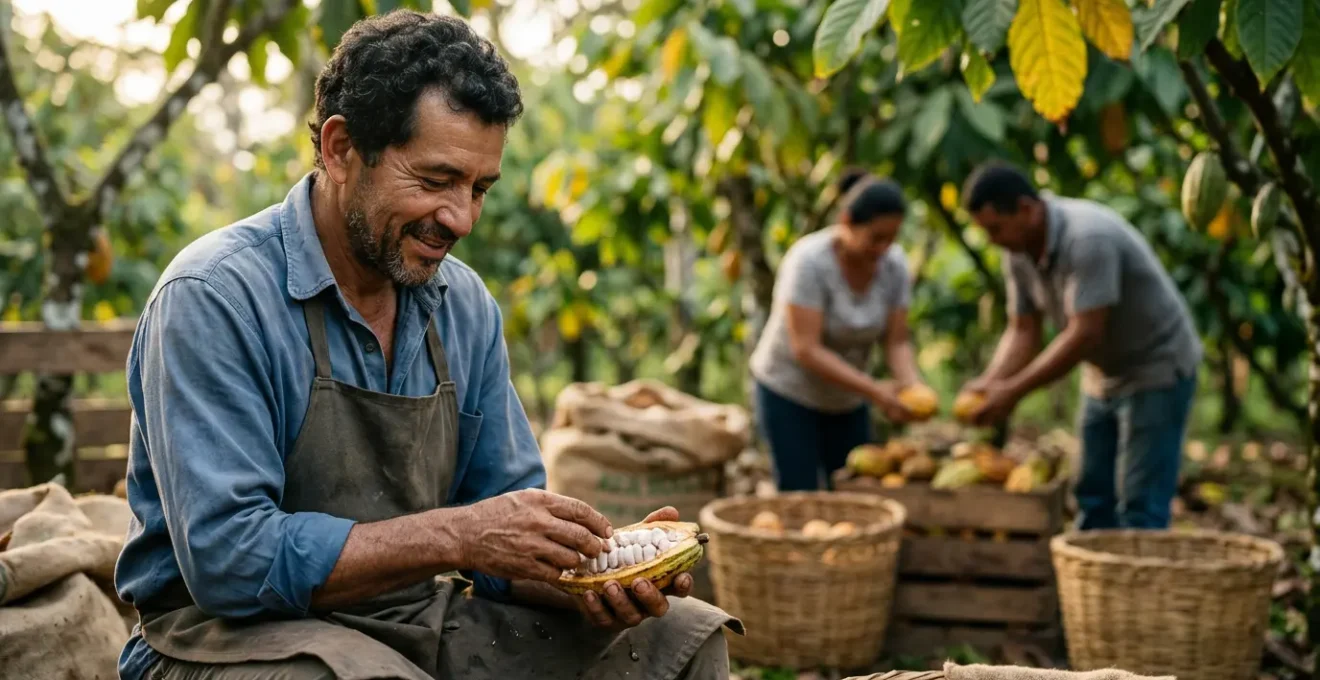
Contrary to popular belief, a Fair Trade label is not a guarantee of poverty eradication; it is a starting point for verifying the economic mechanisms that can create change.
- A guaranteed minimum price acts as a crucial insurance policy against market crashes, but its impact depends on market volatility.
- Certifications do not promise zero child labor but implement systems for monitoring, remediation, and prevention, which can be a stronger indicator of progress.
Recommendation: Shift your focus from simply trusting a label to investigating the evidence of price stability, long-term contracts, and supply chain transparency a brand provides.
For the conscientious consumer, the Fair Trade logo has long served as a beacon of hope—a simple way to ensure a purchase supports farmers and workers in developing nations. The implicit promise is that paying a small premium helps lift producers out of poverty. Yet, for the skeptical mind, a nagging question persists: does that extra money truly make a difference, or is it a feel-good marketing tool with little real-world impact? The desire to support ethical labor is clear, but the efficacy of the method is not.
Most discussions remain at the surface, praising the concept of a “fair price” without dissecting the economic machinery behind it. They often present certifications as a silver bullet, ignoring the complex realities of global commodity markets, the challenges of auditing remote farms, and the rise of corporate-led “sustainability” programs that can be difficult to verify. This creates a paradox where consumers want to do the right thing but lack the tools to critically assess if their choices are truly effective.
This article moves beyond the label. We will adopt the critical, evidence-based lens of a development economist to analyze the core question. The key to understanding Fair Trade’s impact lies not in the logo itself, but in scrutinizing the underlying economic mechanisms: price stability, labor standard enforcement, trade models, and the verifiability of corporate claims. It’s about shifting from passive trust to active verification.
By dissecting these components, you will gain a framework for evaluating whether a product genuinely contributes to a farmer’s economic resilience, empowering you to make purchasing decisions based on evidence, not just hope.
Summary: An Economic Analysis of Fair Trade’s Impact on Farmer Poverty
- Why a Guaranteed Minimum Price Protects Farmers From Market Crashes?
- How Do Certifiers Check That No Child Labor Was Used?
- Direct Trade vs Fair Trade: Which Returns More Money to the Grower?
- The ‘Ethically Sourced’ Trap: How to Spot Unverified Corporate Claims?
- Sequence & Plan: Why Long-Term Contracts Matter More Than One-Off Fair Prices
- How to Check Supply Chain Transparency Before Buying a ‘Sustainable’ Tee?
- How to Read the Batch Code to Trace a Product Back to the Farm?
- Why Conventional Cotton Is Called the ‘Thirsty Crop’ Compared to Organic?
Why a Guaranteed Minimum Price Protects Farmers From Market Crashes?
The most lauded feature of the Fair Trade system is the Minimum Price—a floor price set for most commodities. From an economic standpoint, this is not a simple subsidy but a powerful tool for managing risk. It functions as an insurance policy against the extreme price volatility inherent in global commodity markets, such as coffee, cocoa, and cotton. When the global market price (or ‘C-Market’ price for coffee) is high, buyers pay the market price. But when the market crashes below the Fair Trade threshold, the minimum price kicks in, providing a vital safety net.
This mechanism is far from theoretical. According to Fairtrade America data, the minimum price floor was activated for coffee 53% of the time between 2011 and 2022. This demonstrates its crucial role in providing stability. Beyond the minimum price, producer organizations also receive a non-negotiable Fairtrade Premium, an additional sum of money designated for community, business, and environmental projects. This dual system aims to provide both immediate price protection and funds for long-term development.
The real-world impact of this safety net becomes clear during market downturns. As Fair Trade USA noted in an analysis of the coffee market:
When the C market crashed to 12-year lows in 2018, many unprotected farmers lost money or fled their countries. Fair Trade’s price floor provides stability so farmers can plan for the future and sustain their operations through market downturns.
– Fair Trade USA, Fair Trade Coffee Month analysis
This stability is the foundation of economic resilience. It allows farmers and their cooperatives to plan beyond a single harvest, secure loans, and invest in improving crop quality or infrastructure, knowing they are buffered from the most catastrophic market swings. While it doesn’t guarantee wealth, it provides the predictability necessary to begin climbing out of poverty.
How Do Certifiers Check That No Child Labor Was Used?
A common misconception is that a Fair Trade label offers a 100% guarantee that no child labor was used in a product’s creation. The reality is more complex and, for the skeptical consumer, more credible. Fairtrade openly acknowledges that no certification system can provide a foolproof guarantee, especially in rural, small-scale agriculture where family labor is common. Instead of making an impossible promise, the system is built on a “monitor and remediate” approach.
This means certifiers like FLOCERT conduct regular, and often unannounced, audits of farms and cooperatives. These audits check for compliance with Fairtrade Standards, which include strict prohibitions against forced labor and the worst forms of child labor. If an auditor finds a violation, the response is not simply to decertify the producer, which could push the community further into poverty. The primary goal is remediation: working with the cooperative and local child protection agencies to address the root causes of the problem, such as lack of access to education or household poverty.
This approach moves beyond a punitive checklist and towards building robust, community-owned systems for prevention. It is a sign of a system’s strength, not weakness, when it can identify and correct issues. A powerful example of this process in action is the case of the Belize Sugar Cane Farmers Association (BSCFA).
Case Study: The Belize Sugar Cane Farmers Association (BSCFA) Child Labor Remediation Program
In 2014, when Fairtrade auditors found two children working on farms, the BSCFA was suspended. Rather than just meeting minimum compliance, the association used Fairtrade premiums to implement a comprehensive, community-based child labor monitoring and remediation system. They partnered with local NGOs, UNICEF, and government agencies. A 2019 independent evaluation showed significantly increased awareness of child labor issues across the community, demonstrating how a prevention-focused approach creates lasting change beyond simple compliance.
For a skeptical consumer, the takeaway is crucial: look for transparency about the process. A certification that openly discusses its audit findings and remediation efforts is far more trustworthy than one that makes a simplistic, absolute guarantee it cannot possibly enforce everywhere, all the time.
Direct Trade vs Fair Trade: Which Returns More Money to the Grower?
As consumer awareness has grown, “Direct Trade” has emerged as a prominent alternative to the Fair Trade model, particularly in specialty coffee and cocoa. The core idea is simple: roasters or chocolate makers bypass intermediaries and buy directly from farmers or cooperatives. This fosters a closer relationship and, in theory, allows a greater share of the final price to return to the producer. The economic question is whether this model is superior for the farmer.
From a price perspective, research indicates Direct Trade typically pays a significant premium. Some analyses suggest that prices can be 25% to 100% higher than even Fair Trade minimums. This is because Direct Trade is often focused on securing micro-lots of exceptionally high-quality products, for which specialty buyers are willing to pay a premium. The model is built on quality incentives and relationship, rather than a standardized safety net.
However, the two models serve different purposes. Fair Trade is a large-scale, accessible system designed to provide a floor for millions of farmers, ensuring a baseline of social and environmental standards. Its strength is its breadth. Direct Trade, conversely, is a narrow, deep model. It benefits a smaller number of producers who can meet the high-quality demands of specialty buyers. It lacks the third-party auditing and community development requirements (like the Fairtrade Premium) that are central to the Fair Trade system, relying instead on the buyer’s own ethical commitments.
For the farmer, neither is universally “better.” Fair Trade offers broad-based risk mitigation, while Direct Trade offers a high-reward pathway for top-tier producers. For the consumer, it highlights that the highest ethical impact might not always come from the most well-known certification, but from business models built on radical transparency and direct relationships.
The ‘Ethically Sourced’ Trap: How to Spot Unverified Corporate Claims?
Perhaps the biggest challenge for the skeptical consumer is the proliferation of vague, self-defined ethical claims. Terms like “ethically sourced,” “responsibly grown,” or “farmer-friendly” are now common on packaging, but they often lack the rigor of third-party verification. This practice, often a form of “greenwashing,” can mislead consumers into believing they are supporting a high standard when none exists. The scale of the problem is significant; a 2020 European Commission cross-sector sweep found that 42% of green claims were exaggerated, false, or deceptive.
These unverified claims create asymmetric information: the corporation knows the reality of its supply chain, while the consumer sees only a positive marketing message. Unlike Fairtrade, B Corp, or the Rainforest Alliance, these in-house programs are not accountable to an independent standard-setter or auditor. They can highlight one positive aspect (e.g., a donation to a school in a sourcing community) while ignoring systemic issues like poverty-level wages or poor working conditions across the rest of their supply chain.
To cut through this noise, consumers must become adept at spotting red flags. This requires moving from a passive acceptance of claims to an active search for proof. A robust ethical claim should always be backed by specific, measurable data and, ideally, verification from an independent body. The absence of such evidence is a major warning sign.
Action Plan: Auditing ‘Ethically Sourced’ Claims
- Scrutinize the language: Identify vague, undefined terms like ‘sustainable’ or ‘eco-friendly’. Demand specifics and data, not just feel-good words.
- Demand transparency: Check if the company’s website discloses its suppliers, factory locations, or audit results. A lack of transparency is a major red flag.
- Uncover selective disclosure: Be wary of brands that highlight one small positive action (e.g., a single “model farm”) to distract from broader systemic issues in their supply chain.
- Verify third-party certification: If a brand claims to be “certified,” check which independent body issued the certification. Is it a credible, internationally recognized standard like Fairtrade, or a meaningless logo they created themselves?
- Distinguish in-house vs. independent programs: Question corporate-owned schemes (like Starbucks C.A.F.E. Practices). While not inherently bad, they lack the independent oversight of a true third-party certification and should be scrutinized more heavily.
By using this critical framework, you can begin to differentiate between genuine commitment and clever marketing, ensuring your money supports real impact, not just a well-crafted story.
Sequence & Plan: Why Long-Term Contracts Matter More Than One-Off Fair Prices
While a fair price in a single year provides immediate relief, it does not, on its own, lift a farmer out of poverty. The true catalyst for economic mobility is predictability. From a development economics perspective, the ability to plan for the future is paramount. This is where the importance of long-term contracts and stable purchasing relationships comes to the forefront, an element that is encouraged but not always guaranteed by certification systems alone.
When a farmer or cooperative has a multi-year commitment from a buyer, it fundamentally changes their economic calculus. They can confidently invest in improving their farm—planting new trees, improving irrigation, or achieving organic certification—knowing there will be a buyer for their harvest. This security of demand unlocks access to credit and fosters a virtuous cycle of investment and quality improvement. As Carla Veldhuyzen van Zanten, a Senior Advisor at Fairtrade International, notes:
We are still in the process of unravelling the indirect effects of a secured higher price, but we already see strong indications that farmers invest more in their farms and improve yields as well.
– Carla Veldhuyzen van Zanten, Fairtrade International Senior Advisor Sustainable Livelihoods
This stability is a key component of moving towards a “Living Income,” an income sufficient to afford a decent standard of living for all household members. Fairtrade has begun piloting a Living Income Reference Price, which is higher than the standard minimum price. However, achieving this is a slow process. A 2023 report on one project revealed that after the first year of the Living Income Learning project, 21% of farmer households had reached a living income. This realistic figure shows that while progress is possible, it requires a sustained, multi-faceted approach where price is just one component.
For the consumer, this means looking beyond the price paid for a single product and inquiring about a brand’s sourcing practices. Do they engage in short-term, opportunistic buying, or do they cultivate long-term partnerships with their producers? The latter is a much stronger indicator of a genuine commitment to farmer empowerment.
How to Check Supply Chain Transparency Before Buying a ‘Sustainable’ Tee?
The fashion industry is notorious for its complex and opaque supply chains. A single t-shirt can pass through dozens of hands—from the cotton farm to the gin, the spinner, the weaver, the dyer, and the garment factory. A claim of being “sustainable” or “ethically made” on the final product is meaningless without transparency across these multiple tiers. As a discerning consumer, your task is to probe the brand’s claims about its chain of custody.
Genuine transparency goes beyond simply naming the factory where the shirt was sewn (Tier 1). It involves disclosing suppliers further down the chain, ideally back to the farm where the raw material was grown (Tier 4). This multi-tier transparency is the only way to verify claims about organic cotton, water usage, or the absence of forced labor in the raw material production stages, where the highest risks often lie.
How can you check this? Start by visiting the brand’s website and looking for a “Sustainability” or “Our Suppliers” section. A transparent brand will often provide a public supplier map or a list of their partner factories. Look for specificity. Do they just list countries, or do they name specific facilities? Do they participate in industry-wide transparency initiatives like the Fashion Revolution’s Transparency Index?
Furthermore, look for credible third-party certifications that require chain of custody verification, such as the Global Organic Textile Standard (GOTS) or Fair Trade Certified™ apparel. These standards audit each step of the production process to ensure the integrity of the final claim. A brand that invests in these rigorous, multi-tier certifications is demonstrating a tangible commitment to transparency, whereas a brand relying on vague, self-made claims is likely hiding something.
How to Read the Batch Code to Trace a Product Back to the Farm?
In the quest for ultimate transparency, the batch code, lot number, or QR code on a package can be the final link in the chain of custody. For products like coffee, chocolate, or olive oil, this code can theoretically allow a consumer to trace the item in their hands back to the specific cooperative, region, or even the individual farm where it originated. This is the pinnacle of verifiable sourcing—transforming an anonymous commodity into a product with a clear and documented provenance.
However, the utility of this code depends entirely on the system the company has built behind it. In many cases, a batch code is purely for internal quality control and provides no public-facing information. A truly transparent company will invest in a system that connects that code to a website or app. When you enter the code, you should see information about the harvest date, the name of the farmer cooperative, tasting notes, and details about the community. This is radical transparency in action.
The absence of a functional, consumer-facing traceability system is a significant data point. If a brand makes bold claims about its direct relationships with farmers but offers no way to verify the origin of a specific product, skepticism is warranted. It suggests their “story” may be a marketing narrative applied to all products, rather than a factual account of the specific item you purchased. The ability to trace a product is the ultimate proof of a controlled and transparent supply chain.
Therefore, when you see a QR code or “trace my food” message on a package, test it. Does it lead to a generic marketing page, or does it provide specific, verifiable details about that batch? Your role as a skeptic is to call the bluff. The answer will tell you volumes about the company’s true commitment to transparency versus its commitment to marketing.
Key Takeaways
- The Fair Trade Minimum Price is a risk management tool against market volatility, not a constant subsidy.
- True ethical standards rely on “monitor and remediate” systems for issues like child labor, not on impossible guarantees.
- Long-term contracts and stable demand are more critical for a farmer’s economic resilience than one-off high prices.
Why Conventional Cotton Is Called the ‘Thirsty Crop’ Compared to Organic?
The discussion of “ethical sourcing” must extend beyond labor prices and into environmental stewardship, as a farm’s long-term viability is intrinsically linked to the health of its ecosystem. The case of cotton provides a stark example. Conventional cotton is notoriously known as the “thirsty crop” due to its immense water consumption. Growing the cotton needed for a single conventional t-shirt can require up to 2,700 liters of water, often in regions already facing water scarcity. This heavy reliance on irrigation can deplete local water tables and create significant environmental stress.
Furthermore, conventional cotton is one of the most pesticide-intensive crops in the world. These chemicals can degrade soil health, contaminate water sources, and pose health risks to farmers and their communities. This creates a cycle of dependency on expensive chemical inputs, increasing a farmer’s costs and reducing their long-term economic and environmental resilience.
In contrast, organic cotton production offers a clear alternative. By avoiding synthetic pesticides and fertilizers, organic farming relies on practices that build healthy soil, such as crop rotation and composting. Healthy soil retains water much more effectively, drastically reducing the need for irrigation. Studies have shown that organic cotton can reduce water consumption by up to 91% compared to its conventional counterpart. This not only conserves a vital resource but also lowers the farmer’s production costs and protects their health.
For a skeptical consumer, this provides another verifiable data point. A switch to organic cotton isn’t just a “green” claim; it represents a fundamental shift in the agricultural model with measurable benefits for water conservation and farmer well-being. It underscores that an truly ethical product must consider its full environmental footprint, as ecological sustainability is a prerequisite for long-term economic prosperity at the farm level.
Ultimately, supporting farmers is not a simple transaction but a commitment to a system. To ensure your purchasing power genuinely contributes to lifting farmers out of poverty, the next logical step is to actively seek out and support brands that provide clear, verifiable evidence of long-term partnerships and a transparent chain of custody.