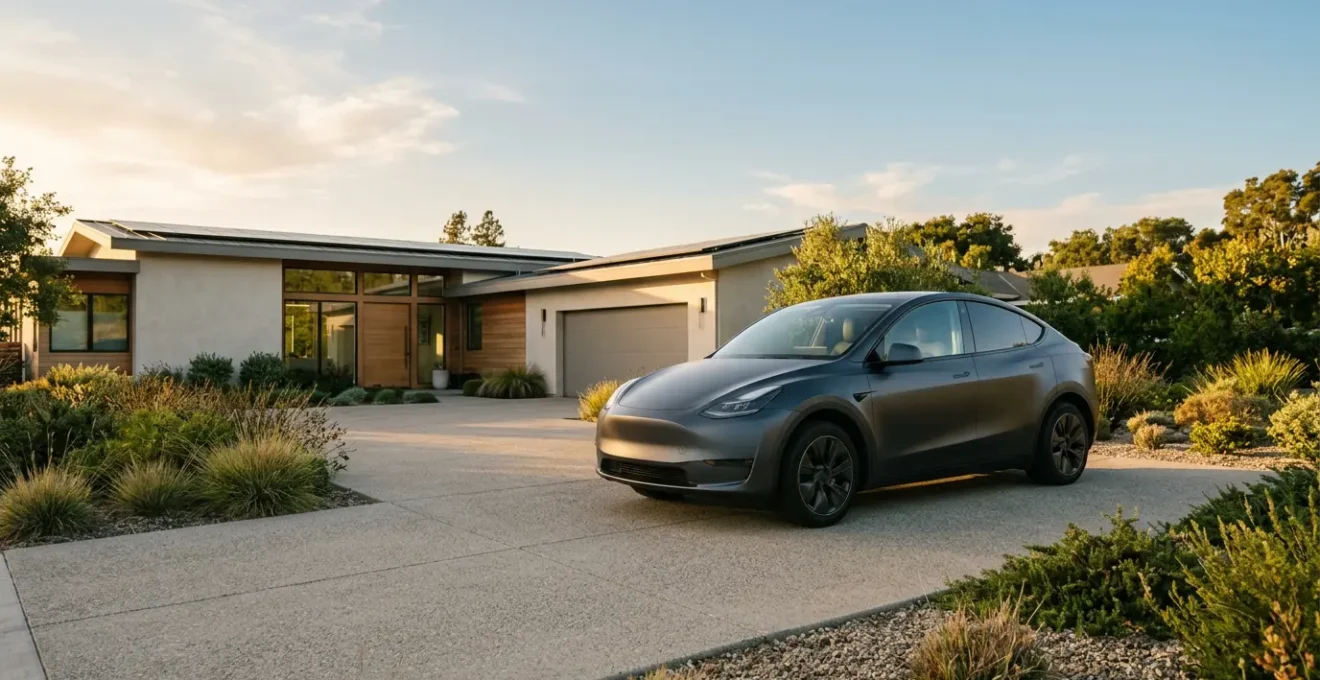
Over five years, an EV is projected to be significantly cheaper than a comparable gas car, but only if you analyze it as a total system investment, not just a vehicle purchase.
- Maintenance savings are substantial and immediate, often cutting annual costs by half or more.
- The largest “hidden” cost is home charging infrastructure, which must be factored into the initial budget.
- Long-term value is dictated more by battery technology (LFP vs. NMC) and degradation than by mileage.
Recommendation: Shift your focus from the sticker price to the complete personal energy ecosystem, including home upgrades and potential solar integration, to accurately calculate your true long-term ROI.
For any prospective car buyer, the math seems simple: compare the purchase price, estimate fuel costs, and make a decision. However, the debate between electric vehicles (EVs) and internal combustion engine (ICE) cars shatters this traditional model. Many buyers are drawn to the promise of eliminating gas station visits and oil changes, yet remain wary of high upfront costs and horror stories about battery replacement. The conversation often gets stuck on these surface-level trade-offs.
The common advice is to look at government incentives and compare your local electricity rates to gas prices. While valid, this approach misses the bigger picture. The transition to an EV is not just about swapping one car for another; it’s about adopting an entirely new personal energy ecosystem. The true financial impact extends far beyond the dealership and into your home’s electrical panel, your long-term asset management strategy, and even your daily travel planning.
But what if the key to unlocking an EV’s economic advantage isn’t just in the fuel savings, but in a strategic, system-level approach to ownership? This analysis moves beyond the sticker price to provide a forward-looking, data-driven framework. We will dissect the true costs and savings over a five-year horizon, treating the vehicle and its supporting infrastructure as a single, integrated financial asset.
This guide provides a comprehensive financial breakdown of EV ownership. We will explore maintenance savings, home charging installation, battery technology, road trip planning, resale value, and the larger economic models that make EVs a forward-thinking investment, ultimately showing you how to calculate a true return on investment.
Summary: Is an Electric Vehicle Actually Cheaper to Own Over 5 Years?
- Why Maintenance Costs for EVs Are 40% Lower Than Gas Cars?
- How to Upgrade Your Electrical Panel for Level 2 Charging?
- LFP vs NMC Batteries: Which Is Better for Daily Commuting and Longevity?
- The Planning Mistake: How to Map Charging Stops for Long Road Trips?
- When to Sell: How Battery Degradation Affects Used EV Value?
- Why Linear ‘Take-Make-Waste’ Models Are Doom for Long-Term Profits?
- How to Calculate Safe Wattage Loads for LED Circuits in Older Homes?
- How to Calculate the ROI of Solar Panels for Your Specific Roof?
Why Maintenance Costs for EVs Are 40% Lower Than Gas Cars?
The most immediate and compelling financial argument for EV ownership lies in the dramatic reduction of ongoing maintenance. An internal combustion engine is a complex machine with hundreds of moving parts—pistons, valves, spark plugs, belts, and exhaust systems—all requiring regular inspection, fluid changes, and eventual replacement. An EV powertrain, by contrast, is remarkably simple, consisting primarily of an electric motor and a battery.
This fundamental difference eliminates the need for oil changes, spark plug replacements, fuel filter swaps, and emission checks. The primary wear-and-tear items on an EV are tires, cabin air filters, and brake pads. Even brake wear is significantly reduced thanks to regenerative braking, where the electric motor slows the car down while recapturing energy, saving the physical brakes for harder stops. This streamlined design translates directly into quantifiable savings.
Data from the U.S. government confirms this advantage. A pivotal analysis shows that on a per-mile basis, EV maintenance is substantially lower. According to a report highlighted by the U.S. Department of Energy’s Argonne National Laboratory, EV maintenance costs are about 40% less than for a comparable gasoline-powered vehicle. This isn’t a minor discount; it represents a fundamental shift in the long-term cost of ownership.
Case Study: U.S. Federal Fleet Savings
An analysis of the federal government’s light-duty vehicle fleet provided a powerful real-world example of these savings at scale. Research from the General Services Administration and Argonne National Laboratory projected that converting the entire fleet to electric would reduce annual maintenance expenditures by approximately $78 million compared to an all-gasoline fleet. This demonstrates that the savings are consistent and predictable across a large number of vehicles.
For the average consumer, this translates to tangible annual savings. Research from industry analysts suggests that maintaining an EV costs around $150 per year, a stark contrast to the $300–$380 typically spent on a gas or hybrid vehicle. Over a five-year period, this alone can account for over $1,000 in savings, directly offsetting the initial purchase price.
How to Upgrade Your Electrical Panel for Level 2 Charging?
While maintenance offers clear savings, the first significant “hidden” cost of EV ownership is the home charging setup. While you can technically use a standard 120V wall outlet (Level 1 charging), it’s impractically slow, adding only 3-5 miles of range per hour. To unlock the convenience of overnight charging, a Level 2 charger is essential. This requires a dedicated 240V circuit, similar to an electric dryer, and this is where the infrastructure investment begins.
Your home’s electrical panel is the heart of its power distribution. Many older homes have 100-amp panels that may not have the capacity to handle the sustained load of a 32- or 40-amp EV charger alongside other household appliances. An electrician must perform a load calculation to determine if your existing panel can support the new circuit or if an upgrade to a 200-amp service is required. This is the single biggest variable in home charger installation costs.
The process involves more than just plugging in a new device; it’s a professional electrical installation that must be done to code for safety and reliability.
As seen in the detailed view of a panel, this work involves installing a new two-pole circuit breaker and running heavy-gauge wiring to the charger’s location. The total cost for a Level 2 charger installation can vary widely based on these factors, but 2024 installation data shows a typical range of $800 to $3,200, with an average around $1,600. The key components driving this cost include:
- Charger Equipment: The unit itself can cost from $400 to over $2,000, depending on brand, smart features, and power output.
- Electrician Labor and Materials: Typically ranges from $800 to $2,500, influenced by the complexity of the wire run and local labor rates.
- Electrical Panel Upgrade: If your home needs an upgrade from 100A to 200A service, this can add a significant $1,500 to $3,000 to the project.
- Permits and Inspections: Required by most municipalities, these can cost anywhere from $50 to $800.
LFP vs NMC Batteries: Which Is Better for Daily Commuting and Longevity?
Once the home infrastructure is addressed, the next critical element in the total cost equation is the battery itself. It’s the most expensive component of an EV and the primary driver of its long-term value. Not all batteries are created equal, and the two dominant chemistries in today’s market—Lithium Iron Phosphate (LFP) and Nickel Manganese Cobalt (NMC)—have distinct trade-offs that directly impact both daily use and asset longevity.
NMC batteries have been the long-standing industry favorite, prized for their high energy density. This means they can store more energy in a smaller, lighter package, enabling longer range—a key factor for performance-oriented models and drivers with range anxiety. However, they contain cobalt, a costly and ethically complex material, and are generally more sensitive to being charged to 100% regularly, which can accelerate degradation.
LFP batteries, on the other hand, are rapidly gaining market share, especially in standard-range vehicles. Their key advantage is durability and a longer cycle life. They can be regularly charged to 100% without significant degradation, making them ideal for daily commuting where maximizing range every morning is convenient. While less energy-dense (meaning a heavier battery for the same range), they are safer, less prone to thermal runaway, and do not use cobalt, making them cheaper to produce. As the International Energy Agency has noted, this durability is a major asset.
LFP batteries offer high durability with up to 2,000 full cycles or more, making them particularly favored for stationary applications.
– International Energy Agency, IEA Battery Technology Research Report
For a buyer focused on a 5-year ownership cost, the choice is strategic. If your daily commute is well within the vehicle’s range, an LFP-equipped EV offers a more robust and worry-free ownership experience, preserving its capacity and value over thousands of charging cycles. For those who frequently take long trips or prioritize maximum possible range, the higher energy density of an NMC battery might be a worthwhile trade-off, provided they follow best practices for charging (e.g., daily charging to 80%).
The Planning Mistake: How to Map Charging Stops for Long Road Trips?
A common source of anxiety for potential EV owners is the long-distance road trip. The typical planning mistake is to think about charging like refueling a gas car: drive until the “tank” is nearly empty, then look for a “station.” This approach leads to stress and long, inefficient charging sessions. The key to successful EV road-tripping is a paradigm shift: plan for shorter, more frequent charging stops that coincide with natural breaks.
Modern EVs charge fastest when the battery is at a low state of charge (e.g., 10-20%) and slow down dramatically as they approach 80%. Therefore, the most time-efficient strategy is to drive for 2-3 hours, stop for 15-25 minutes to charge from roughly 20% to 70%, and then get back on the road. This aligns perfectly with a typical break for a coffee, a meal, or a rest stop. Instead of one long 60-minute charge, two 20-minute stops are often faster and far less tedious.
This requires using charging map apps like A Better Routeplanner (ABRP), which factor in your specific vehicle, elevation changes, and weather to create an optimal charging itinerary. The financial aspect on the road is also different; you’re paying for electricity by the kilowatt-hour (kWh), with current DC fast charging costs ranging from $0.40 to $0.70 per kWh depending on the network and location.
While more expensive than charging at home, it’s often still competitive with gasoline, and the experience can be seamless with proper planning.
Real-World Road Trip: 1,482 Miles in a Kia EV9
A 2024 Kia EV9 owner documented a 1,482-mile round trip from Oklahoma City to Denver, relying exclusively on the Electrify America DC fast-charging network. The trip consumed 447.95 kWh of energy for a total cost of $350, working out to an efficient $0.24 per mile. Critically, the average charging session lasted just 17-20 minutes, demonstrating the effectiveness of the short-stop strategy. The owner reported zero charger reliability issues, highlighting the growing maturity of public charging infrastructure along major corridors.
When to Sell: How Battery Degradation Affects Used EV Value?
Depreciation is the single largest cost of owning any new car, and EVs are no exception. The conversation around EV resale value is dominated by one factor: battery health. Unlike an engine that can be rebuilt, a battery’s capacity degrades over time. An EV with 80% of its original battery capacity is a much less valuable asset than one with 95%. Understanding this is key to forecasting your 5-year total cost and deciding on an optimal time to sell.
Current market data paints a challenging picture for early-cycle depreciation. Driven by rapid technological advancements and fluctuating incentives, some analyses show a steep drop in value. According to a 2025 used EV market analysis, some models experience close to 60% value loss in 5 years, which is higher than many popular ICE vehicles. This figure represents the market’s current uncertainty and the pace of innovation, where a new model with better range or faster charging can quickly make an older one less desirable.
However, this headline number doesn’t tell the whole story. The fear of a sudden, catastrophic battery failure is largely unfounded. To build consumer confidence, manufacturers provide extensive battery warranties. As noted by industry researchers, this provides a significant safety net for owners.
Most EVs in the U.S. carry at least an 8-year/100,000-mile battery warranty, and data from high-mileage fleets shows many packs still retaining 80–90% capacity past 150,000–200,000 miles.
– Recharged.com Research Team, Total Cost of Ownership EV vs Gas Analysis
For a 5-year ownership window, it is highly unlikely that a well-cared-for battery will degrade below the warranty threshold. The financial strategy, therefore, is to maximize battery health through smart charging habits (e.g., avoiding constant deep discharges and adhering to recommended daily charge limits for NMC batteries). Selling the vehicle well within its battery warranty period, with a documented history of good battery health, is the best way to maximize its residual value.
Why Linear ‘Take-Make-Waste’ Models Are Doom for Long-Term Profits?
Stepping back from the individual vehicle, the long-term economic viability of the entire EV transition rests on moving beyond the traditional automotive business model. For a century, the industry has operated on a linear “take-make-waste” system: extract raw materials, manufacture a product with a limited lifespan, and then discard it at the end of its life. This model is fundamentally unsustainable in a world of finite resources and growing environmental pressures.
For EVs, the battery is the focal point of this challenge. An NMC battery, for instance, relies on mined materials like cobalt and nickel. A linear model where these valuable materials are used once and then sent to a landfill is not only environmentally irresponsible but also economically doomed. The future of profitability lies in creating a circular economy, where batteries are designed from the start for a second life (e.g., in stationary energy storage) and, ultimately, for efficient recycling of their core components.
This is where battery chemistry again plays a crucial role. As a 2024 lifecycle study from ScienceDirect points out, LFP batteries have a significantly reduced carbon footprint over their entire lifecycle compared to NMC batteries. This is due not only to their cobalt-free composition but also their recyclability. According to MotorWatt EV Research, “LFP batteries are also simpler and cheaper to recycle. NMC contains cobalt and nickel, which require complex recovery processes.”
From a forward-looking analyst’s perspective, a company—and by extension, a consumer—investing in technology that is better aligned with a future circular economy is making a more robust long-term bet. As recycling technology matures and regulations tighten, the “end-of-life” value of an EV battery will become a significant factor in its lifecycle cost. Choosing an EV with a more easily recyclable battery is a hedge against future disposal costs and a step toward a more sustainable and profitable economic model.
How to Calculate Safe Wattage Loads for LED Circuits in Older Homes?
While upgrading your electrical panel for an EV charger, it’s a strategically sound moment to audit the rest of your home’s electrical consumption. This is a key part of building a holistic “personal energy ecosystem.” One of the most impactful micro-optimizations is upgrading your home’s lighting to LEDs. However, especially in older homes, simply swapping bulbs isn’t enough; you must ensure the circuits can handle the load safely, even if that load is much lower.
The core principle for electrical safety is the 80% rule: a circuit should never be continuously loaded beyond 80% of its maximum rating. For example, a standard 15-amp lighting circuit in a U.S. home (operating at 120 volts) has a maximum capacity of 1,800 watts (15A x 120V). Applying the 80% rule, the safe continuous load is 1,440 watts.
To calculate your load, you simply add up the wattage of all fixtures on a single circuit. With old incandescent bulbs (e.g., 60-100 watts each), it was easy to overload a circuit with too many lights. With LEDs (which might use only 9-13 watts for the same brightness), the risk of overload is much lower, but calculation is still crucial, especially if you have many fixtures on one circuit. The formula is simple:
Total Wattage = Sum of all individual bulb/fixture wattages on the circuit.
Upgrading to LEDs reduces the overall baseline load on your electrical system. This frees up more of your panel’s total capacity, providing a greater buffer for your large-draw EV charger. It’s a small but intelligent part of a comprehensive home electrification strategy, ensuring your entire system operates efficiently and safely without putting undue stress on your newly upgraded infrastructure.
Key Takeaways
- An EV’s financial advantage is locked in by viewing it as a system investment, including home charging and potential solar, not just a car.
- The largest variable cost is the home electrical upgrade; bundling this with other projects can yield significant savings.
- Battery longevity is a manageable risk through smart technology choices (LFP vs. NMC) and adherence to manufacturer charging guidelines.
How to Calculate the ROI of Solar Panels for Your Specific Roof?
The final and most powerful step in optimizing your EV’s 5-year cost is to transform your home into a personal power plant. By installing solar panels, you can effectively lock in your “fuel” costs for the next 25+ years, achieving a level of savings and predictability that gasoline can never offer. This is the ultimate expression of the “personal energy ecosystem,” where you control both the generation and consumption of your transportation energy. Calculating the Return on Investment (ROI) for this system, however, requires a specific, personalized analysis.
The ROI calculation depends on several key variables: your home’s location and sun exposure, the size and cost of the solar installation, your household’s electricity consumption (including the new EV), and the available incentives. Government programs are designed to make this investment more accessible. For instance, there are often federal tax credits for clean energy equipment; some programs offer a credit for 30% of the costs of home charging equipment up to $1,000, and similar or even more substantial credits are typically available for solar panel installations.
As industry analysis from SolarTech Online notes, “The combination of federal tax credits, state rebates, and utility incentives can reduce installation costs by 40-60% in some markets.” Bundling projects can yield further savings, as one homeowner discovered.
Case Study: Bundled Project Savings in Phoenix
A homeowner in Phoenix, Arizona, saved $1,800—a 35% reduction in total project investment—by strategically installing his Level 2 EV charger at the same time as a planned electrical panel upgrade. By combining the projects, the homeowner reduced shared costs for labor and permits, demonstrating the significant financial benefit of coordinating home electrification projects rather than tackling them piecemeal.
To calculate your specific ROI, you must conduct a thorough audit of your own situation. The following checklist outlines the essential steps to determine if solar is a financially sound addition to your EV ecosystem.
Action Plan: Your Solar ROI Audit
- Points of Contact & Consumption: List all major electrical draws in your home, including your future EV’s estimated annual kWh consumption. Inventory your roof’s characteristics: size, orientation (south-facing is ideal), and any shading from trees or buildings.
- Data Collection: Gather your last 12 months of electricity bills to determine your average consumption and cost per kWh. This is your baseline against which you will measure solar savings.
- System Coherence: Get quotes for a solar system sized to cover both your home’s and your EV’s energy needs. Confront this proposed generation with your current consumption to ensure it’s a good match.
- Value Proposition Analysis: Identify all available federal, state, and local utility incentives (rebates, tax credits). Calculate your estimated annual savings and divide the net installation cost by this figure to find your payback period.
- Implementation Plan: Based on the payback period, create a prioritized plan. Secure financing if needed, select a certified installer, and schedule the installation to potentially coincide with other electrical work for bundled savings.
Ultimately, the decision to go electric is a comprehensive financial one. By moving beyond the sticker price and analyzing the entire system—from maintenance and home infrastructure to battery technology and energy generation—you can accurately forecast the total cost of ownership and determine if an EV is truly the cheaper, smarter investment for your specific needs over the next five years. To start this process, the next logical step is to begin the audit of your own home and driving habits.